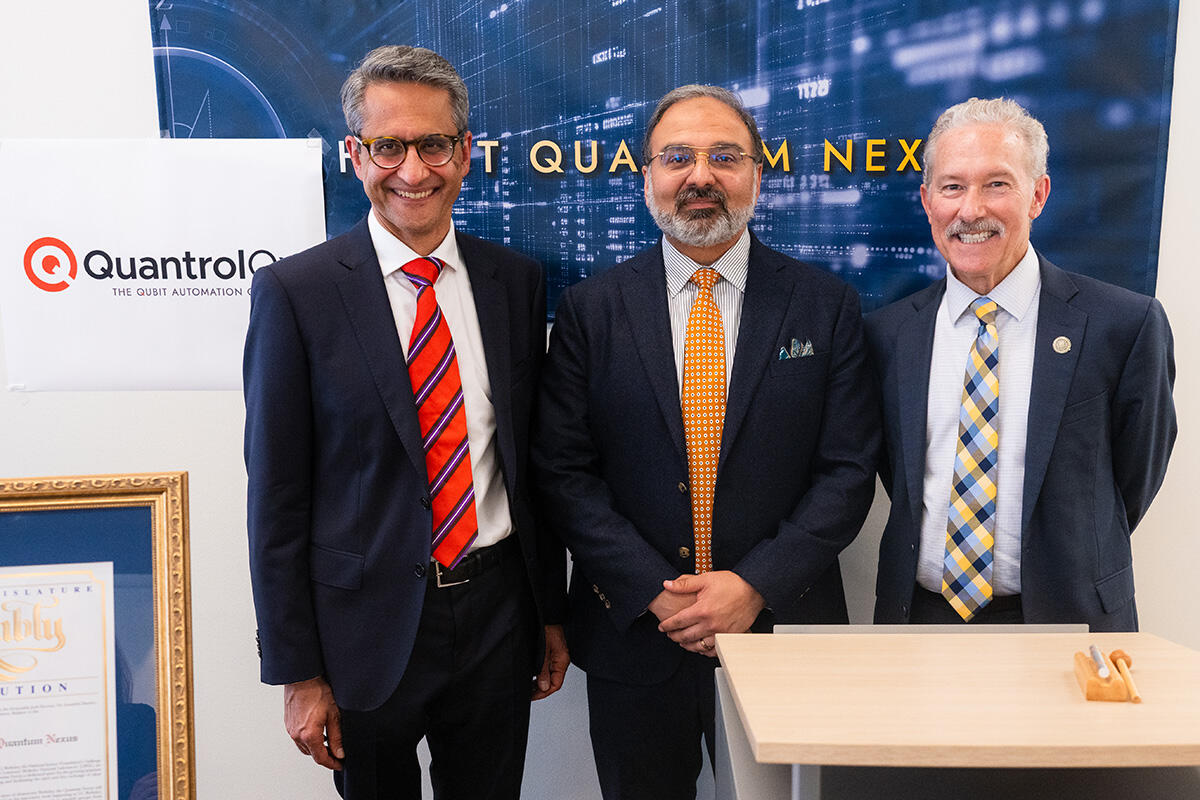
The University of California, Berkeley has formally welcomed UK-headquartered qubit automation startup QuantrolOx as a tenant within its Roger Herst Quantum Nexus. Marking the Oxford University spin-out’s first physical facility in North America, the move establishes a U.S. operational base to support joint research and commercialize automated quantum control software across the San Francisco Bay Area deep-tech ecosystem.
The expansion operationalizes a five-year Memorandum of Understanding (MOU) executed between UC Berkeley’s Department of Physics and QuantrolOx. Under the direction of Physics Department Chair and Quantum Nanoelectronics Laboratory (QNL) Director Professor Irfan Siddiqi, the collaboration integrates QuantrolOx’s machine-learning-driven Quantum EDGE software suite directly onto UC Berkeley’s open-architecture superconducting quantum processing unit (QPU) testbeds. The joint framework focuses on replacing manual, physicist-driven qubit tuning with autonomous characterization, real-time pulse calibration, and automated randomized benchmarking.
| [ UC Berkeley & QuantrolOx Quantum Nexus Partnership Scope ] | ||
|---|---|---|
| Facility & Institutional Anchor | Core Automation Software Stack | Target Operational Objectives |
| • Roger Herst Quantum Nexus (Downtown Berkeley) | • Flagship Platform: Quantum EDGE | • Autonomous Superconducting QPU Calibration |
| • Academic Lead: Prof. Irfan Siddiqi (QNL) | • Algorithmic Engine: Physics-Aware ML / AI Agents | • High-Throughput Characterization & Tuning |
| • Regional Framework: Quantum California Initiative | • Educational Base: Quantum EDGE Academy | • Open-Architecture PDK & EDA Tool Integration |
Located one block from campus, the 6,000-square-foot Roger Herst Quantum Nexus serves as an incubator hub uniting academic researchers, industry partners, and government agencies under California’s state-backed Quantum California initiative. By validating commercial control algorithms on academic QPU architectures, the partnership aims to standardize automated hardware pipelines, addressing critical workforce bottlenecks and enabling scaling toward fault-tolerant superconducting quantum computers.
Review the announcement coverage via the UC Berkeley College of Letters & Science here, read our prior analysis of UC Berkeley and QuantrolOx’s Five-Year Partnership Agreement here, and explore our coverage of NSF Quantum Leap Challenge Institute Initiatives at UC Berkeley here.
September 9, 2026