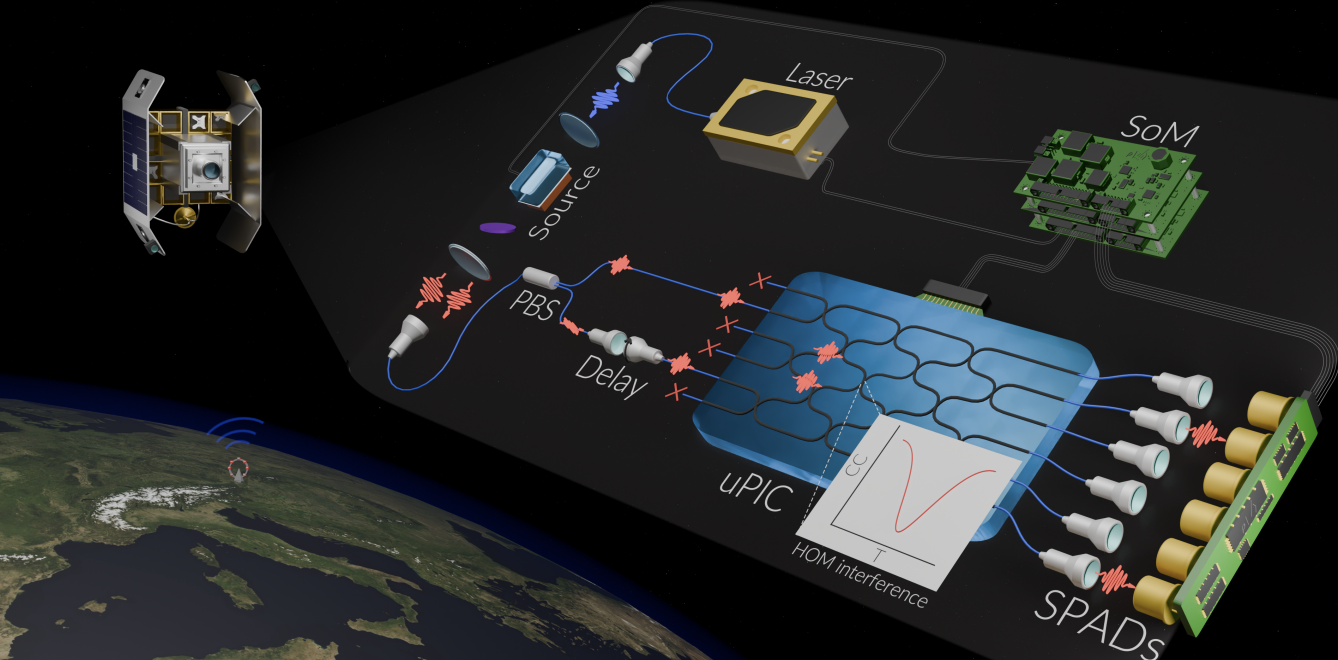
A research team led by the University of Vienna and the Vienna Center for Quantum Science and Technology (VCQ) has achieved the first demonstration of two-photon quantum interference and programmable matrix execution in low Earth orbit (LEO). Deployed aboard a 3U nanosatellite payload hosted on D-Orbit’s ION SCV platform (launched via SpaceX Transporter-14 to a 510 km sun-synchronous orbit), the experiment transitions spaceborne quantum hardware from state-distribution communications (such as satellite QKD) to active, on-board edge quantum processing.
Operating under strict Size, Weight, and Power (SWaP) constraints—weighing 9.8 kg, occupying a 15 cm × 15 cm × 45.3 cm footprint, and consuming 10 Watts—the hybrid system combines a 405 nm continuous-wave pumped spontaneous parametric down-conversion (SPDC) single-photon source, a 6-mode universal photonic integrated circuit (uPIC), and a passively quenched single-photon avalanche diode (SPAD) array. The femtosecond laser-written glass circuit incorporates 15 Mach-Zehnder interferometers (MZIs) driven by thermo-optic micro-heaters, enabling arbitrary 3 × 3 sub-unitary matrix programming with an average classical fidelity of 0.949. Over eight months in orbit, the payload successfully observed non-classical two-photon Hong-Ou-Mandel (HOM) interference (visibility = 0.908 ± 0.191) at a crystal degeneracy temperature of 32.5°C, proving that photon indistinguishability can be maintained amidst rocket launch vibrations, thermal cycling, and space radiation.
| [ Spaceborne Quantum Photonic Hardware Specifications & Orbital Benchmarks ] | ||
|---|---|---|
| Subsystem / Parameter | Hardware Specification | Orbital Operational Metrics |
| SWaP Envelope & Orbit | • Form Factor: 3U (15 cm × 15 cm × 45.3 cm) • Mass: 9.8 kg | Power: 10 W average | • LEO Altitude: 510 km Sun-Synchronous • Host: D-Orbit ION SCV (Transporter-14) |
| Photonic QPU Circuit | • 6-mode uPIC (15 thermal-phase MZIs) • Femtosecond laser-inscribed borosilicate glass | • Universal unitary fidelity: F = 0.949 • Phase shifter 2π dissipation: <11.5 mW |
| Source & Interference | • Type-II ppKTP SPDC photon-pair source (810 nm) • Active TEC & 1 cm AA7075 Al radiation shield | • HOM Visibility: V = 0.908 ± 0.191 • Degeneracy Point: 32.5°C crystal temp |
Developed alongside IFN-CNR Milano, DLR, and Politecnico di Milano, the project establishes the hardware primitive for onboard satellite image analysis and Earth-observation data reduction. By executing linear optical transformations passively in orbit, photonic processors can run onboard quantum machine learning inference to compress high-volume remote-sensing data prior to downlink, bypassing ground-transmission latency bottlenecks.
Review the research preprint on arXiv:2609.25248 here.
September 29, 2026