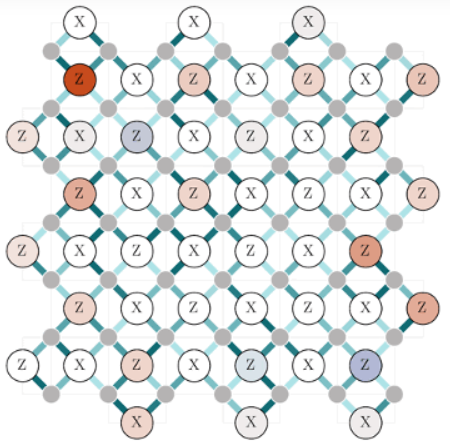
Credit: Quantum Elements and AWS
A collaboration between Quantum Elements Inc., USC, Harvard, and AWS addresses a critical bottleneck: traditional classical simulations of Quantum Error Correction (QEC) are either too slow to be realistic or too simplified to capture the complex “noise” (errors) found in actual quantum hardware. By using Quantum Monte Carlo (QMC) methods on cloud infrastructure, they created a “digital twin” capable of simulating 97-qubit error correction cycles with experimental accuracy, to help pave the way for more robust, hardware-aligned quantum computers.
1. The Problem: The “Realism vs. Scalability” Trade-off
To achieve fault-tolerant quantum computing, we need QEC to suppress errors. However, designing effective QEC requires understanding how a device actually fails.
- Simplified Models (Clifford/Stim): These are fast but rely on “Pauli twirling,” which ignores coherent errors (like over-rotations) and correlated noise (crosstalk).
- Full Simulations (Master Equations): These capture every detail but are computationally impossible at scale. A 97-qubit simulation would normally require tracking 497 variables—more than there are atoms in the observable universe.
2. The Solution: Quantum Monte Carlo (QMC) Digital Twins
The researchers utilized a real-time Quantum Monte Carlo algorithm that stochastically compresses the data needed to simulate a quantum system.
- Efficiency: They simulated a distance-7 surface code (97 physical qubits) in roughly one hour on a single AWS compute node.
- High Fidelity: Unlike simplified models, this “digital twin” captures pulse-level details, gate miscalibrations, and ZZ crosstalk.
- Scalability: By using AWS ParallelCluster, the team demonstrated that these simulations can run at the scale of modern experimental quantum hardware.
3. Key Findings & Comparison
The study compared their QMC digital twin against Stim (the industry standard for fast QEC simulation).
| Feature | Stim (Pauli-Twirled) | QMC Digital Twin |
| Speed | Extremely Fast | Fast (1 hour for 97 qubits) |
| Noise Capture | Simple stochastic flips | Coherent, correlated, & phase-sensitive |
| Accuracy | Misses structured bias | Reveals spatially structured errors |
| Diagnostic Value | Low (uniform response) | High (reveals control-parameter issues) |
By sweeping gate detuning (frequency errors), the digital twin showed a spatially structured syndrome bias. Stim, by contrast, predicted a uniform response, missing the nuanced patterns that a real-world decoder would have to navigate.
4. Why This Matters
This capability allows hardware teams to:
- Train Better Decoders: Use realistic data to train neural-network decoders that “understand” a specific chip’s unique quirks.
- Stress-Test Protocols: Test how QEC holds up against errors that are difficult to isolate in physical experiments.
- Hardware Co-design: Predict how changes in chip layout or pulse shapes will affect logical error rates before building the hardware.
For more about this research, view the blog posted on the AWS website here.
April 3, 2026