IBM Research and AMD have open-sourced Pelagos (distributed on PyPI as pelagos-decoder), a vendor-neutral, GPU-accelerated quantum error-correction (QEC) decoding framework designed to evaluate quantum low-density parity-check (qLDPC) codes at supercomputing scale. Announced at SC26 alongside a multi-GPU scaling study and a six-organization hierarchical decoding survey co-authored by AMD, HPE, IBM, IQM, Riverlane, and Xanadu, the release advances the joint QEC co-design platform established earlier this month by IBM, AMD, and Oak Ridge National Laboratory (ORNL).
| IBM & AMD Pelagos Open-Source Decoder Architecture & Benchmarks | ||
|---|---|---|
| Technical Dimension | Implementation Specification | Measured Scaling & Performance |
| Algorithm & Kernel Stack | Disordered-memory Relay-BP (Relay-BP-S) in fused Triton kernels | Targets AMD ROCm/HIP, NVIDIA CUDA, and Intel SPIR-V GPUs with up to 97x single-GPU speedup vs. 1 CPU core. |
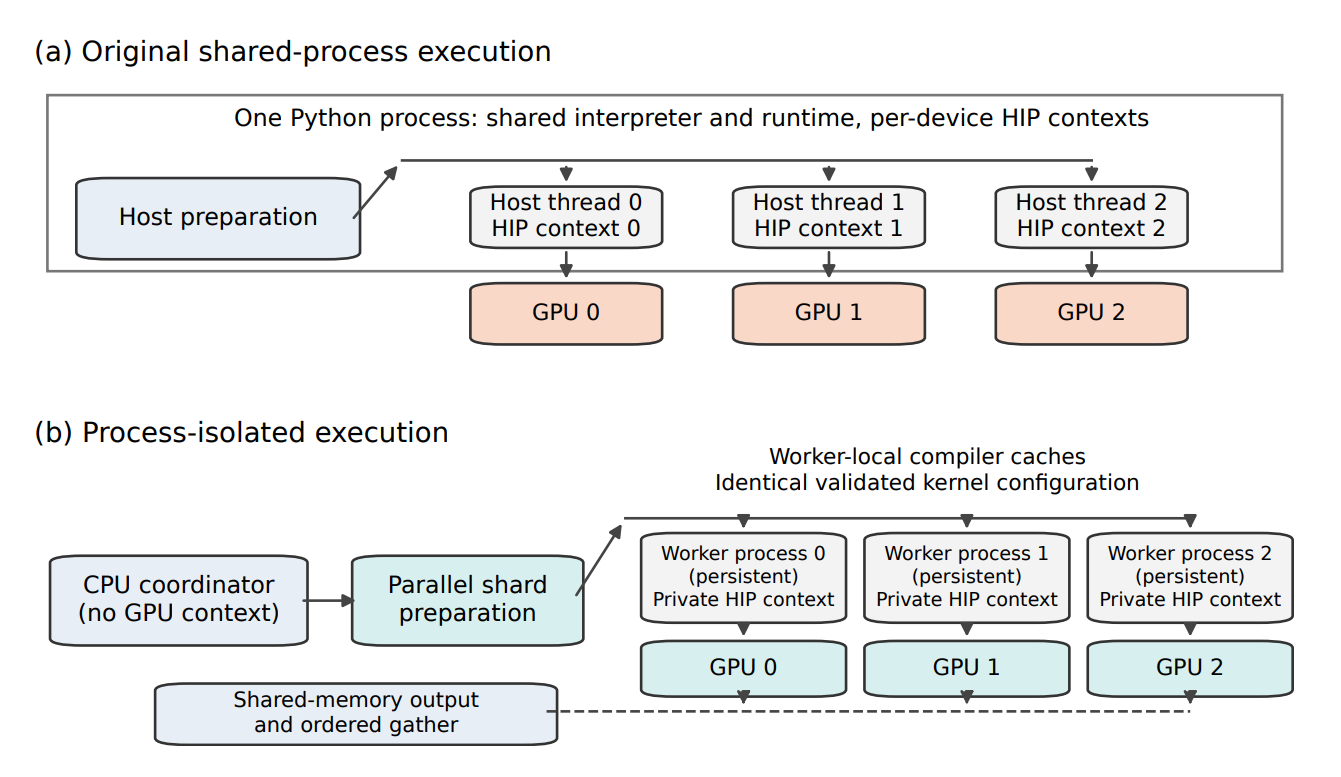
| Multi-GPU Orchestration | Process-isolated HIP workers, parallel host prep, shared memory | Eliminates single-process runtime contention and pipe serialization across 8-GPU nodes. |
One-Gross [[144, 12, 12]] | 12 noisy rounds + 1 noiseless round (p = 0.003, R = 50) | Reached 3,845 decodes/s on 8x AMD Instinct MI355X (6.23x E2E scaling) and 2,686 decodes/s on 8x MI300X. |
Two-Gross [[288, 12, 18]] | 18 noisy rounds + 1 noiseless round (p = 0.003, R = 50) | Achieved 7.58x GPU decode scaling on MI300X and 7.45x GPU decode scaling (1,265 decodes/s) on ORNL’s Lux MI355X. |
Evaluating fault-tolerant qLDPC codes such as bivariate-bicycle memories requires simulating billions of circuit-level error syndromes to resolve logical error rates down to 10−12. Written in the open-source Triton GPU programming language under an Apache 2.0 license, Pelagos keeps belief-propagation message arrays, convergence flags, and candidate selection resident in GPU high-bandwidth memory while autotuning between syndrome-major and edge-major layouts.
In an accompanying technical study deployed on ORNL’s AMD Instinct MI355X-powered Lux supercomputer, researchers from AMD and IBM replaced single-process threaded dispatch with persistent per-GPU worker processes and shared-memory output buffers, cutting eight-GPU host preprocessing overhead on two-gross circuits from 3.21 seconds to 0.73 seconds. Alongside the software release, authors from AMD, HPE, Riverlane, Xanadu, IQM, and IBM published a comprehensive taxonomy mapping single-code predecoding cascades, sliding-window streaming pipelines, and concatenated-code interfaces across CPUs, GPUs, FPGAs, ASICs, and cryogenic hardware, noting that real-time reaction targets span three orders of magnitude from microsecond superconducting cycles to millisecond-scale trapped-ion and neutral-atom schedules.
Read technical blogs from IBM Quantum here and AMD Developer Central here, explore the Pelagos source code and tutorials on GitHub here, review the multi-GPU scaling preprint on arXiv here, and access the multi-institutional hierarchical decoding survey here.
Related QCR SC26 coverage includes the IBM, Fermilab, and NVIDIA modular co-design platform and Slurm 26.11 integration here, the IBM, RIKEN, and NVIDIA 79x accuracy gain on iron-sulfur cluster simulations here, and the ORNL-IBM-AMD co-located error-correction platform in Poughkeepsie here.
November 16, 2026