
IBM Research and AMD have open-sourced Pelagos (distributed on PyPI as pelagos-decoder), a vendor-neutral, GPU-accelerated quantum error-correction (QEC) decoding framework designed to evaluate quantum low-density parity-check (qLDPC) codes at supercomputing scale. Announced at SC26 alongside a multi-GPU scaling study and a six-organization hierarchical decoding survey co-authored by AMD, HPE, IBM, IQM, Riverlane, and Xanadu, the release advances the joint QEC co-design platform established earlier this month by IBM, AMD, and Oak Ridge National Laboratory (ORNL).
| IBM & AMD Pelagos Open-Source Decoder Architecture & Benchmarks | ||
|---|---|---|
| Technical Dimension | Implementation Specification | Measured Scaling & Performance |
| Algorithm & Kernel Stack | Disordered-memory Relay-BP (Relay-BP-S) in fused Triton kernels | Targets AMD ROCm/HIP, NVIDIA CUDA, and Intel SPIR-V GPUs with up to 97x single-GPU speedup vs. 1 CPU core. |
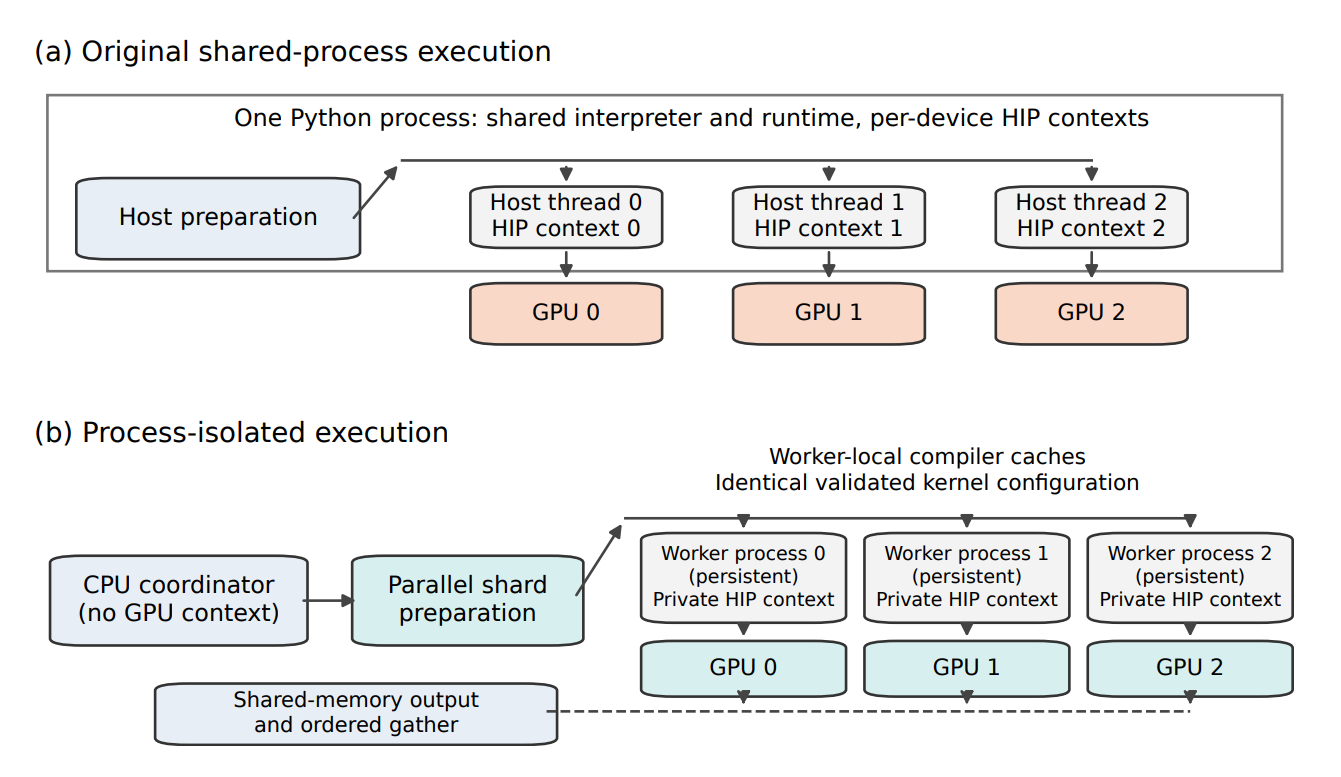
| Multi-GPU Orchestration | Process-isolated HIP workers, parallel host prep, shared memory | Eliminates single-process runtime contention and pipe serialization across 8-GPU nodes. |
One-Gross [[144, 12, 12]] | 12 noisy rounds + 1 noiseless round (p = 0.003, R = 50) | Reached 3,845 decodes/s on 8x AMD Instinct MI355X (6.23x E2E scaling) and 2,686 decodes/s on 8x MI300X. |
Two-Gross [[288, 12, 18]] | 18 noisy rounds + 1 noiseless round (p = 0.003, R = 50) | Achieved 7.58x GPU decode scaling on MI300X and 7.45x GPU decode scaling (1,265 decodes/s) on ORNL’s Lux MI355X. |
Evaluating fault-tolerant qLDPC codes such as bivariate-bicycle memories requires simulating billions of circuit-level error syndromes to resolve logical error rates down to 10−12. Written in the open-source Triton GPU programming language under an Apache 2.0 license, Pelagos keeps belief-propagation message arrays, convergence flags, and candidate selection resident in GPU high-bandwidth memory while autotuning between syndrome-major and edge-major layouts.
In an accompanying technical study deployed on ORNL’s AMD Instinct MI355X-powered Lux supercomputer, researchers from AMD and IBM replaced single-process threaded dispatch with persistent per-GPU worker processes and shared-memory output buffers, cutting eight-GPU host preprocessing overhead on two-gross circuits from 3.21 seconds to 0.73 seconds. Alongside the software release, authors from AMD, HPE, Riverlane, Xanadu, IQM, and IBM published a comprehensive taxonomy mapping single-code predecoding cascades, sliding-window streaming pipelines, and concatenated-code interfaces across CPUs, GPUs, FPGAs, ASICs, and cryogenic hardware, noting that real-time reaction targets span three orders of magnitude from microsecond superconducting cycles to millisecond-scale trapped-ion and neutral-atom schedules.
Read technical blogs from IBM Quantum here and AMD Developer Central here, explore the Pelagos source code and tutorials on GitHub here, review the multi-GPU scaling preprint on arXiv here, and access the multi-institutional hierarchical decoding survey here.
Related QCR SC26 coverage includes the IBM, Fermilab, and NVIDIA modular co-design platform and Slurm 26.11 integration here, the IBM, RIKEN, and NVIDIA 79x accuracy gain on iron-sulfur cluster simulations here, and the ORNL-IBM-AMD co-located error-correction platform in Poughkeepsie here.
In GQI Portal
The players behind the news
The team that writes QCR tracks every company, deal and technology in the GQI Factory, GQI's verified database of the quantum industry. Next up: every story linked to its players, coming to QCR's paid plans.
- Players Companies and institutions across the quantum industry, by segment.
- Scorecards How the players compare on hardware, software, funding and more.
Newsletter
QCR Alerts in your inbox
The latest reporting and analysis from Quantum Computing Report. Free, unsubscribe any time.