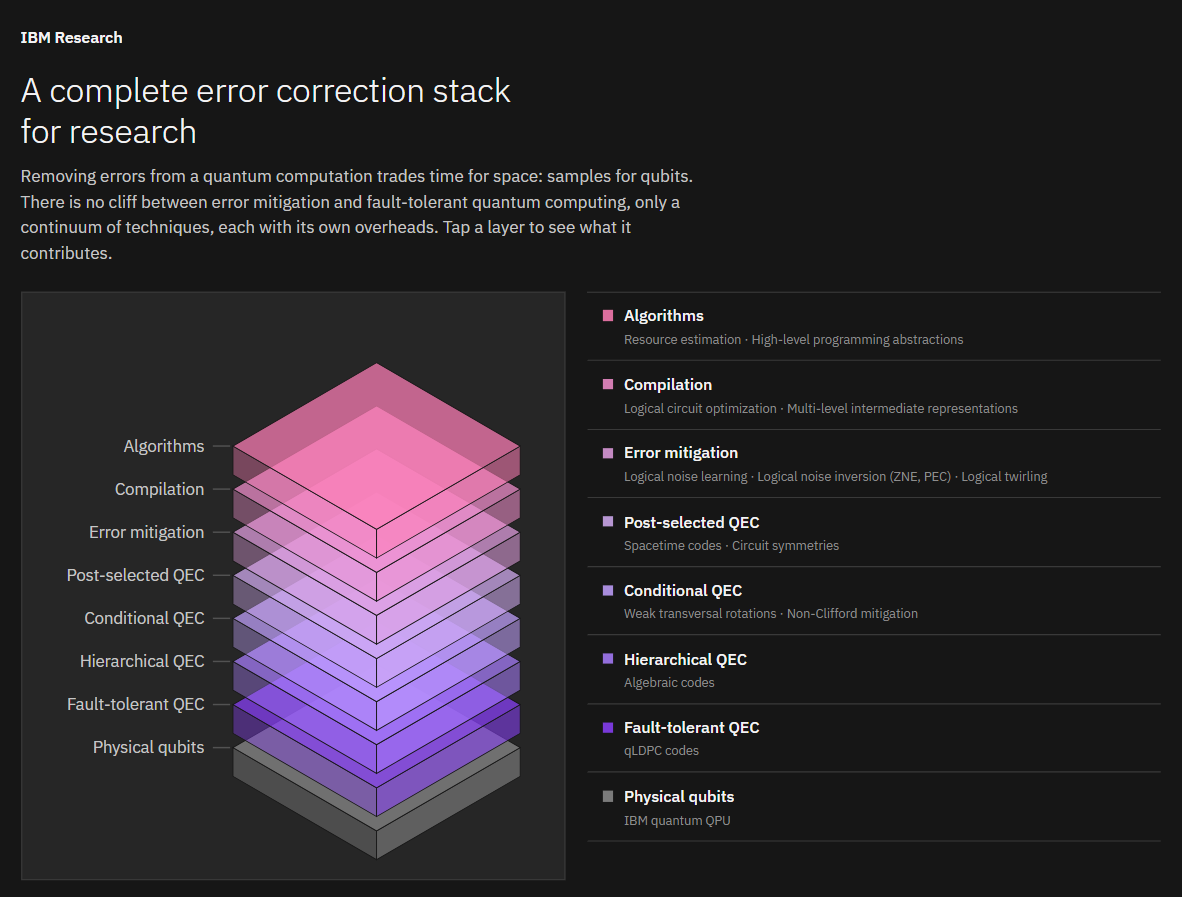
In a technical briefing and accompanying paper published on arXiv (arXiv:2609.13108), researchers at IBM Quantum introduced Spacetime Probabilistic Error Cancellation (Spacetime PEC), a hybrid error-handling framework that layers Probabilistic Error Cancellation (PEC) on top of post-selected Quantum Error Detection (ED). The protocol addresses a critical scalability bottleneck in near-term quantum computing, establishing a continuous spectrum between physical-qubit error mitigation and full fault-tolerant quantum computing (FTQC) by systematically removing single-location errors from the PEC sampling exponent using circuit syndrome information.
Traditional PEC eliminates noise-induced bias by sampling inverted noise channels, but its sampling overhead (Γ) grows exponentially with total physical circuit noise. Conversely, error-detecting checks discard runs with non-trivial syndromes but leave residual unmitigated logical errors. IBM’s Spacetime PEC resolves this tradeoff by formulating a sparse spacetime Pauli-Lindblad noise representation across both space and time. By accounting for single-location faults that trigger error checks at first order and higher-order syndrome-canceling combinations at second order, the method reconciles post-selection state rejection with the linear operator combinations required by PEC.
The practical implementation builds upon IBM’s broader advances in Doped Clifford Sampling (DCS) and spacetime codes—detailed in a companion study (Martiel et al., arXiv:2607.25941) and supported by the open-source release of Qiskit Paulice
| [ IBM Spacetime PEC Experimental Performance Benchmarks (ibm_aachen) ] | ||
|---|---|---|
| Trotter Depth / Circuit Scope | Standard PEC Overhead (ΓPEC) | Spacetime PEC Overhead (ΓED+PEC) & Gain |
| • 2 Trotter Steps (Hexagonal Ising) | • ΓPEC = 44.1 | • ΓED+PEC = 12.1 (3.7× reduction) |
| • 4 Trotter Steps (Hexagonal Ising) | • ΓPEC = 1,941 | • ΓED+PEC = 122 (15.9× reduction) |
| • 6 Trotter Steps (648 CZ Gates) | • ΓPEC = 85,545 | • ΓED+PEC = 1,359 (63.0× reduction) |
Experimental validation for Spacetime PEC was conducted on the 27-qubit heavy-hex superconducting processor ibm_aachen across a six-plaquette hexagonal lattice using n = 22 data qubits and k = 27 check qubits. Executing Trotterized transverse-field Ising dynamics up to 6 Trotter steps (incorporating 648 CZ gates), Spacetime PEC recovered ideal mean magnetization values within statistical uncertainty while reducing total sampling overhead—including syndrome post-selection costs—by up to 63-fold compared to standard PEC alone. These runtime capabilities are supported by client-side directed execution tools in the IBM Quantum Compute Service, including qiskit-noise-learning, qiskit-mitigation, and Samplomatic, alongside soft-information IQ-point extraction via the Executor primitive.
Review the research blog on IBM Quantum Blog here, inspect the Spacetime PEC preprint on arXiv (Spacetime PEC) here, examine the Doped Clifford Sampling paper on arXiv (Doped Clifford Sampling) here, explore open-source tools on Qiskit GitHub here, review our previous report on IBM Demonstrating Trusted Quantum Advantage here, and read our prior analysis of IBM’s Release of Qiskit Paulice for Spacetime Error Detection here.
September 19, 2026