

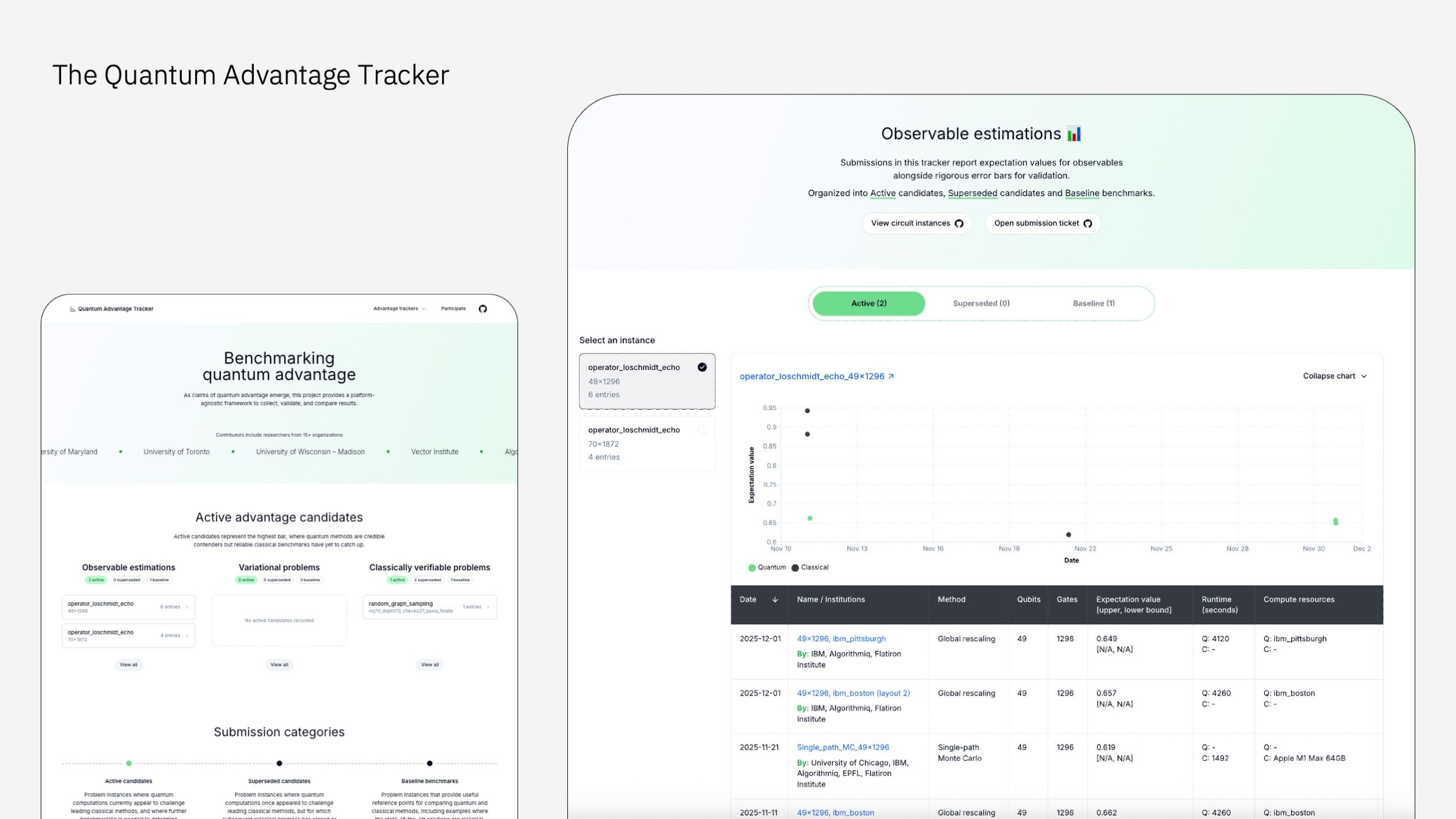
IBM and a coalition of research collaborators—including the University of Chicago, Qedma Quantum Computing, Algorithmiq, RIKEN, and BlueQubit—have announced three joint technical demonstrations of quantum advantage. Published alongside public circuit repositories on the Quantum Advantage Tracker, the studies report that IBM’s cloud-accessible quantum hardware ran complex, utility-scale algorithms beyond the computational capacity of leading classical supercomputers. Crucially, each demonstration introduced verification frameworks designed to establish verifiable trust in the quantum outputs when exact classical verification becomes mathematically or computationally impossible.
| [ IBM Ecosystem “Trusted Advantage” Matrix ] | ||||
|---|---|---|---|---|
| Collaborator | Target Problem | Hardware / Qubits | Classical Comparison | Validation Method |
| UChicago | Hard Doped Clifford Sampling | IBM Heron / 70 Logical Qubits | Classically Intractable (~15 Min QPU Run) | Spacetime Codes & Logical Error Bounds |
| Qedma | 2D Floquet Ising Dynamics | IBM Heron / 74 Qubits | RIKEN Fugaku Supercomputer Breakdown | Unbiased QESEM & Quantinuum Cross-Check |
| Algorithmiq | Operator Loschmidt Echo (OLE) | IBM Heron / 56 Qubits | 3 Independent Classical Group Failures | Noise Manipulation & Open Monoprop Tool |
Demonstration 1: IBM & UChicago — 70-Logical-Qubit Doped Clifford Sampling
In collaboration with the University of Chicago, IBM researchers demonstrated a structured alternative to Random Circuit Sampling (RCS) using doped Clifford circuits. RCS has long served as a benchmark for quantum computational separation, but traditional cross-entropy benchmarking (XEB) requires calculating ideal output probabilities on classical hardware—a process that becomes exponentially intractable at scale, leaving researchers without direct proof of fidelity.
To solve this “verification gap,” the team engineered encoded quantum circuits embedded within spacetime codes. By strategically inserting non-Clifford T gates into an efficiently simulable Clifford circuit, the team created a computationally hard sampling problem while retaining fault-tolerant error-detection regions across the space-time topology.
| [ Spacetime Code Validation Framework ] | |
|---|---|
| Execution Stage | Technical Pipeline Details & Error Bounds |
| Clifford Reference Circuit | Efficiently simulated classically to establish initial baseline fidelity. |
| Encoded Hard Circuit | Strategic insertion of non-Clifford T-gates across 70 logical qubits (468 T-gates, 2,415 logical 2-qubit ops); becomes classically intractable. |
| Certified Output | Syndrome & logical error post-selection yields 10× error reduction vs. physical baseline, establishing a self-certifying fidelity bound. |
- Circuit Complexity: Executed across 70 encoded logical qubits, the circuit incorporated 2,415 logical two-qubit operations and 468 logical T gates.
- Error Reduction: Logical encoding yielded an effective gate error rate 10 times lower than the underlying physical hardware error rates.
- Verification Metric: The IBM quantum system completed the sampling task in approximately 15 minutes, whereas leading classical simulation methods faced prohibitive runtimes. Rather than relying on external statistical proxies, the spacetime code framework enabled the quantum computer to calculate a mathematically rigorous lower bound on its own logical fidelity.
Demonstration 2: IBM & Qedma — Simulating 2D Floquet Physics Beyond RIKEN Fugaku
In a second study, Tel Aviv-based Qedma Quantum Computing paired its QESEM (Quantum Error Suppression and Error Mitigation) software with IBM Quantum Heron processors to model the long-time oscillatory behavior of a two-dimensional Floquet Ising model. The system simulates how magnetic domains evolve under periodic external energy pulses—a problem relevant to optoelectronics and light-induced superconductivity.
To benchmark the results, the team collaborated with Japan’s RIKEN Center for Computational Science and classical simulation developer BlueQubit, running tensor-network and classical simulation algorithms on Fugaku, one of the world’s most powerful supercomputers.
| [ Qedma Floquet Dynamics Benchmarking Breakdown ] | |
|---|---|
| System Metric | Execution Environment & Observed Performance |
| System Scale & Hardware | Up to 74 physical qubits on IBM Quantum Heron processors running Qedma QESEM via Qiskit Functions Catalog. |
| Classical Baseline Stack | RIKEN Fugaku Supercomputer paired with BlueQubit tensor-network simulators. |
| Classical Breakdown Point | State-of-the-art classical simulation strategies diverged and failed to yield consistent predictions as dynamic complexity expanded. |
| Cross-Platform Validation | QESEM-mitigated results resolved long-lived Floquet oscillations, independently verified on Quantinuum trapped-ion hardware. |
- Classical Breakdown: As system size and time steps expanded up to 74 qubits, different state-of-the-art classical simulation strategies diverged and failed to yield consistent predictions.
- Persistent Oscillations: The QESEM-mitigated IBM quantum processor resolved clear, long-lived Floquet oscillations that classical supercomputers missed.
- Cross-Platform Trust: The quantum results were validated using both heuristic and unbiased, provable error-mitigation estimators within QESEM, and independently confirmed by reproducing core circuit segments on Quantinuum trapped-ion hardware.
Demonstration 3: IBM & Algorithmiq — Information Propagation in Heterogeneous Matter
Helsinki and Milan-based quantum software developer Algorithmiq collaborated with IBM to simulate the operator Loschmidt echo (OLE)—a metric tracking how information and energy propagate through heterogeneous, disordered quantum materials, such as battery electrolytes and chemical catalysts. Executing 56-qubit circuits on IBM Heron hardware, the researchers pushed the simulation into a regime where three independent classical simulation groups produced conflicting predictions.
Because no exact classical answer existed, Algorithmiq established process-based trust by manipulating hardware noise profiles—executing the algorithm across five distinct IBM quantum processors with controlled noise injection and varied gate calibrations to demonstrate output stability. To support transparent community benchmarking, Algorithmiq open-sourced monoprop, a C++/Python classical simulation engine implementing both Majorana and Pauli propagation in the Heisenberg picture. Driven by polynomial resource scaling, monoprop optimizes up to 100-qubit ansätze—an algorithmic framework that previously won Algorithmiq the $2 million Wellcome Leap Quantum for Bio prize for simulating drug-activation pathways on IBM hardware.
| [ Algorithmiq Process-Validation Stack ] | |
|---|---|
| Framework Layer | Technical Strategy & Tooling Integration |
| Target Observable | Operator Loschmidt Echo (OLE) tracking quantum information flow in disordered materials (56 Qubits). |
| Verification Strategy | Process validation via intentional noise manipulation, modified calibrations, and cross-QPU execution. |
| Hardware Testing Scope | Verified output stability across 5 distinct IBM QPUs with varied physical noise profiles. |
| Open-Source Tooling | Released monoprop classical ground-state simulation engine to challenge and benchmark advantage claims. |
Strategic & Industry Perspectives
The overarching message from leadership across IBM, UChicago, Qedma, and Algorithmiq marks a fundamental departure from theoretical advantage claims toward verifiable, utility-scale execution. Across all three milestones, executives emphasized that quantum advantage is not a single static event, but an empirical process requiring rigorous verification. By shifting the verification paradigm—whether through spacetime logical error bounds (UChicago), unbiased hardware-agnostic mitigation (Qedma), or systematic noise manipulation (Algorithmiq)—the ecosystem has established a practical blueprint for trusting quantum outputs when classical verification is no longer possible.
Furthermore, the release of open classical stress-testing tools like Algorithmiq’s monoprop alongside public circuit repositories on the Quantum Advantage Tracker ensures that future claims remain open to continuous community benchmarking. As quantum hardware scales toward fault tolerance, establishing this verifiable foundation gives enterprises in drug discovery, materials science, and fundamental physics the confidence needed to transition quantum workloads into real-world production.
Review the official announcements via the IBM Newsroom here, inspect the technical breakdowns on the IBM Quantum Blog here, read the Qedma Advantage Release here, examine the Algorithmiq Advantage Release here, and track open circuit data on the Quantum Advantage Tracker here.
In GQI Portal
The players behind the news
The team that writes QCR tracks every company, deal and technology in the GQI Factory, GQI's verified database of the quantum industry. Next up: every story linked to its players, coming to QCR's paid plans.
- Players Companies and institutions across the quantum industry, by segment.
- Scorecards How the players compare on hardware, software, funding and more.
Newsletter
QCR Alerts in your inbox
The latest reporting and analysis from Quantum Computing Report. Free, unsubscribe any time.