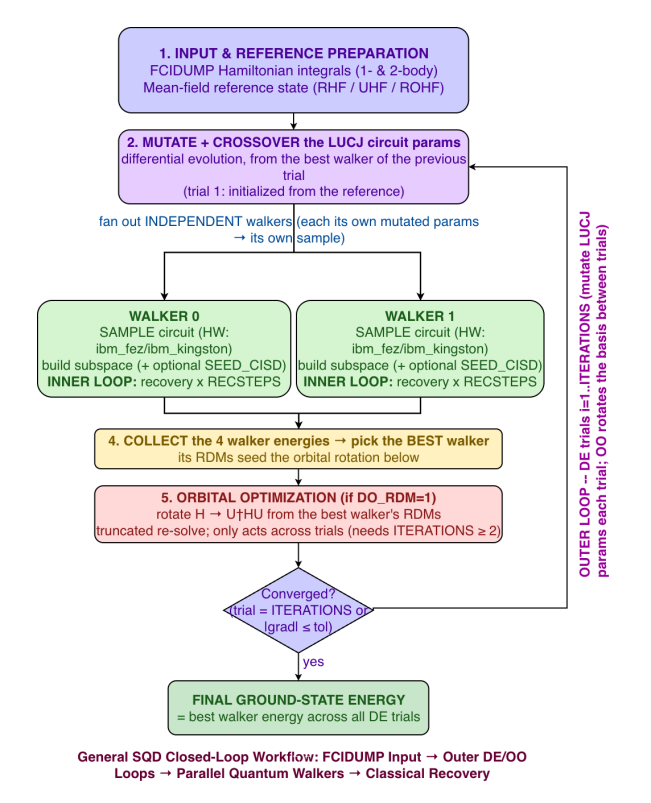
Researchers from IBM Quantum, RIKEN, and NVIDIA have demonstrated a 79-fold improvement in energy accuracy for quantum-classical simulations of strongly correlated iron-sulfur clusters by initializing Sample-Based Quantum Diagonalization (SQD) with broken-symmetry unrestricted Hartree-Fock (BS-UHF) reference states. Executed on the ibm_kingston quantum processor alongside RIKEN’s NVIDIA GB200-powered ROQUO supercomputer, the calculation brought ground-state energy estimates for a 72-qubit [Fe4S4(SCH3)4]2− active space within 4.3 millihartree of high-precision classical density-matrix renormalization group (DMRG) benchmarks.
| Broken-Symmetry SQD Benchmark Profile on [Fe4S4(SCH3)4]2− | ||
|---|---|---|
| Workflow Dimension | Experimental & Algorithmic Configuration | Measured Outcome & Reference Comparison |
| Molecular System & Circuit | CAS(54e, 36o) active space; 88 active qubits on ibm_kingston | Executed 1-layer LUCJ circuit (3,944 CZ gates, 2Q depth 276) across 5 million hardware shots (~25 min QPU). |
| Reference Preparation | Atom-localized Noodleman BS-UHF initial density | Lowered starting mean-field energy by ~534 mHa vs. closed-shell RHF (−327.0809 Ha vs. −326.5474 Ha). |
| Subspace Diagonalization | qcsc-prefect workflow across ROQUO, Miyabi-G, and Fugaku | Reached −327.235076 Ha at subspace dimension d = 3 × 10¹⁰ (512 to 517 mHa deeper than RHF-seeded SQD). |
| Asymptotic Extrapolation | Gaussian-in-log d extrapolation (d → ∞) | Yielded −327.244468 ± 1.05 mHa, matching extrapolated DMRG (−327.244797 ± 0.46 mHa) within 0.33 mHa. |
Iron-sulfur cubane clusters play central roles in biological electron transfer and catalysis, but their antiferromagnetically coupled iron centers create dense multireference electronic correlations that challenge closed-shell quantum chemistry approximations. Previous SQD studies initialized from restricted Hartree-Fock (RHF) determinants stalled more than 500 millihartree above exact ground-state benchmarks even at large subspace dimensions.
By extending the open-source qcsc-prefect workflow to construct spin-polarized, fragment-localized Noodleman initial guesses verified via internal and external stability analysis, the team steered quantum sampling directly toward chemically relevant magnetic configurations. After validating the method on a 40-qubit [2Fe-2S] dimer using ibm_fez, the researchers scaled configuration recovery to 36 nodes (144 NVIDIA GB200 GPUs) of ROQUO and demonstrated cross-architecture checkpoint portability across JCAHPC’s Miyabi-G GPU cluster and RIKEN’s CPU-based Fugaku supercomputer.
Supported by Japan’s New Energy and Industrial Technology Development Organization (NEDO) under its quantum-supercomputer hybrid platform initiative, the study highlights reference-state preparation as a primary driver of SQD accuracy alongside subspace size and GPU-accelerated Davidson diagonalization.
Read the full technical preprint on arXiv here, review the accompanying OpenMP GPU offload study for SQD diagonalization here, and see IBM’s SC26 technical overview here.
Related QCR coverage includes the IBM, Fermilab, and NVIDIA modular co-design platform and Slurm 26.11 integration here, IBM and AMD’s open-source Pelagos GPU decoder framework here, the Cleveland Clinic, RIKEN, and IBM 12,635-atom Gordon Bell finalist simulation here, and IBM’s quantum-centric supercomputing reference architecture here.
November 16, 2026