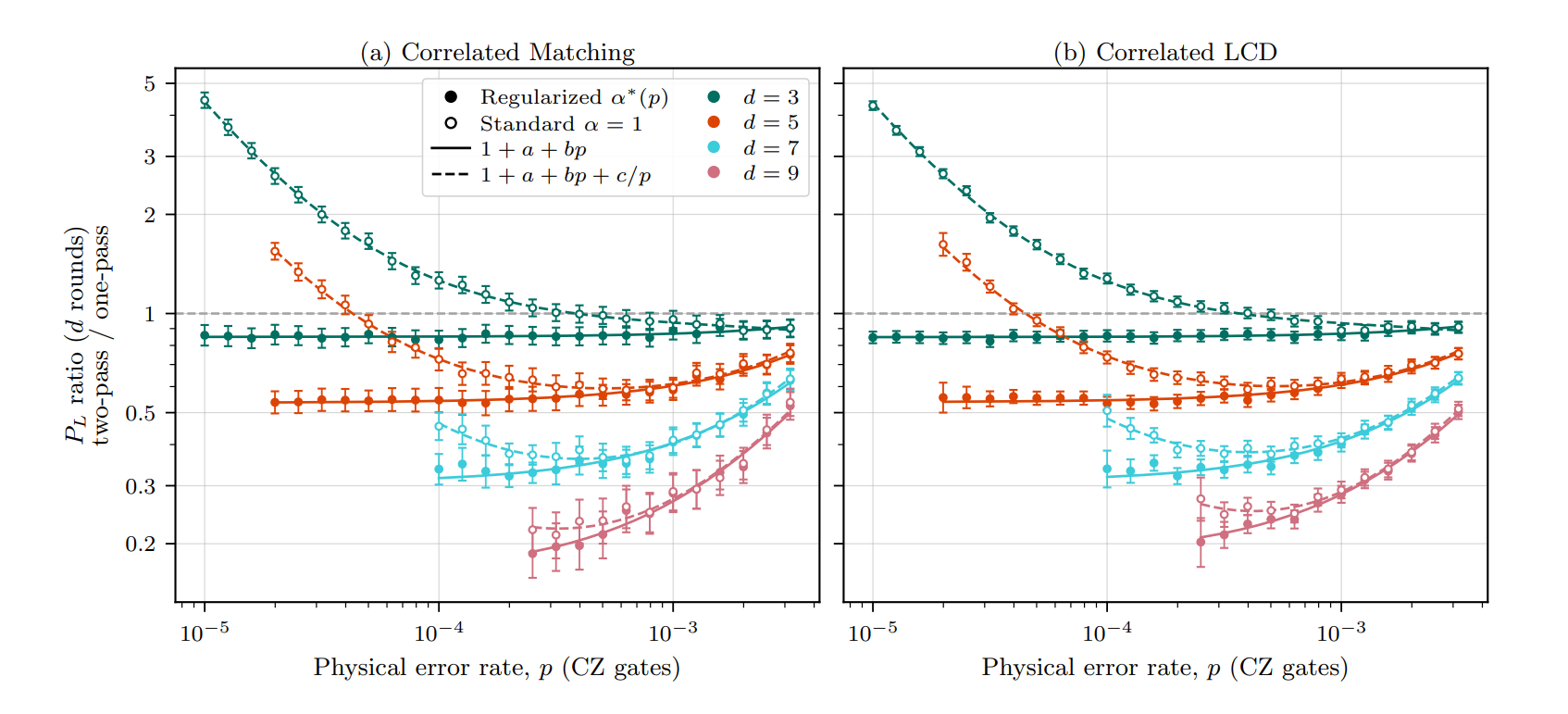
A joint research team from Leiden University (Instituut-Lorentz and Applied Quantum Algorithms) and quantum error correction (QEC) technology company Riverlane has identified a fundamental structural flaw in the standard “re-weighting” protocol used by two-pass correlated decoders. Detailed in a research preprint published on arXiv (“Correlated decoding loses the surface code’s effective distance below threshold“), the study demonstrates that under realistic circuit-level noise, standard correlated decoding protocols cause a unit loss of effective code distance deep below threshold (p < 10-3), leading to higher-than-expected logical failure rates on rotated surface codes.
To resolve this degradation, the researchers introduced an error-rate-dependent regularization parameter (α*(p)) that restores nominal distance scaling and preserves the accuracy advantages of correlated decoding deep into the sub-threshold regime. Crucially, the regularization update can be pre-computed during decoder initialization, adding zero classical runtime overhead or latency during real-time decoding passes.
| [ Standard Correlated vs. Regularized Correlated Decoding Metrics ] | |||
|---|---|---|---|
| Decoder Variant | Low-Noise Scaling Limit (p → 0) | Distance-3 Logical Error Ratio (p = 10-5) | Computational / Latency Overhead |
| • Uncorrelated Baseline (MWPM / UF) | • Nominal Scaling: PL ∝ p(d+1)/2 | • Baseline (1.0×) | • Baseline 1-pass execution speed |
| • Standard Correlated (CM / Correlated LCD) | • Effective Distance Loss: PL ∝ p(d-1)/2 | • 4.4× Higher Failure Rate vs. Uncorrelated | • Constant 2-pass subgraph re-weighting |
| • Regularized Correlated (RCM / RC-LCD) | • Restored Nominal Distance: PL ∝ p(d+1)/2 | • ~0.55× Lower Failure Rate vs. Uncorrelated | • Zero runtime overhead (Pre-computed weights) |
Mechanism of Sub-Threshold Breakdown and Regularization Fix
Correlated decoding is a popular technique used in minimum-weight perfect matching (MWPM / Sparse Blossom) and Union-Find (UF / Local Clustering Decoder) implementations. It operates in two passes: an initial decoding pass identifies errors in one subgraph (e.g., X-type) and uses those outcomes to discount edge weights in the opposite subgraph (e.g., Z-type) for a second pass. Under circuit-level noise, however, a single first-pass error can be shared by multiple independent hyperedge mechanisms. The standard re-weighting rule discounts multiple partner edges simultaneously without penalizing the joint occurrence of independent secondary faults, making long, logically incorrect chains appear artificially cheap to the decoder. As a result, size-(d-1)/2 fault configurations—which a distance-d surface code should easily correct—trigger unexpected logical failures.
The proposed fix dampens over-aggressive re-weighting by applying a smooth interpolation parameter α*(p) = α0 / [1 + (p0/p)k] to the conditional edge probabilities (p’ν = α P(eν | eμ)). At physical error rates near threshold (p ~ 10-2), the optimal re-weighting strength remains near unity (α ≈ 1), preserving the known performance gains of standard correlated decoding. Deep below threshold (p ≤ 10-4), α*(p) shifts toward weaker cross-subgraph discounting, preventing the decoder from selecting multi-edge over-discounted corrections.
The findings provide an important design principle for real-time decoding architectures, belief-matching, and quantum low-density parity-check (qLDPC) codes, ensuring that error suppression scales predictably as qubit gate fidelities continue to improve.
Review the research manuscript on arXiv here, examine the executive breakdown on Riverlane’s LinkedIn update here, and read QCR’s analysis of Riverlane and NVIDIA’s GPU-accelerated QEC decoder calibration here.
October 22, 2026