
In a technical briefing and podcast feature on Quantum World Detangled, NVision Quantum Technologies CEO Dr. Sella Brosh detailed the company’s expansion from its commercial hyperpolarized Magnetic Resonance Imaging (MRI) platform into quantum computing hardware via its PIQC (Photonic Integrated Quantum Chip) molecular architecture.
Headquartered in Ulm, Germany, NVision initially established commercial traction through its flagship Polaris system, which uses quantum spin engineering to hyperpolarize the nuclear spins of organic sugar molecules, boosting MRI signal levels by nearly 100,000x for early cancer detection and rapid metabolic therapy assessment. Leveraging its proprietary synthetic organic chemistry platform, NVision is now applying these same quantum spin principles to fabricate optically addressable, molecular-scale qubits (termed Pixie) directly integrated into silicon photonic circuits.
| [ NVision Commercial Deployment & Hardware Architectural Profile ] | ||
|---|---|---|
| Domain / Pillar | Commercial Polaris MRI Platform | Emerging PIQC Molecular Qubit Strategy |
| • Core Physics & Materials | • Nuclear spin hyperpolarization of organic sugar contrast agents | • Synthetic organic molecules with optically addressable spin states. |
| • Operational Footprint | • 20 systems deployed across Asia, Europe, and North America (e.g., MSK, UCSF, Penn Medicine, WashU) | • Room-temperature optical manipulation; single-photon emission directly into optical cavities. |
| • Fabrication & Scaling | • Onsite clinical preparation without specialized physics staff | • OLED-like 100 nm thin-film deposition directly on silicon photonic chips with integrated waveguides. |
| • Interconnect Architecture | • Coherent spin preparation in standard clinical MRI suites | • Modular photonic-entangled gate architecture connecting distinct molecular sites via photons. |
The PIQC strategy bypasses the monolithic physical constraints of traditional superconducting and ion-trap architectures by combining long coherence, room-temperature optical control, and direct single-photon emission. By depositing ~100 nm thin films of synthetic organic molecules into the optical cavities of silicon photonic chips—utilizing fabrication techniques analogous to commercial OLED display manufacturing—NVision aims to establish a highly scalable, photonically-entangled gate architecture for fault-tolerant quantum computing.

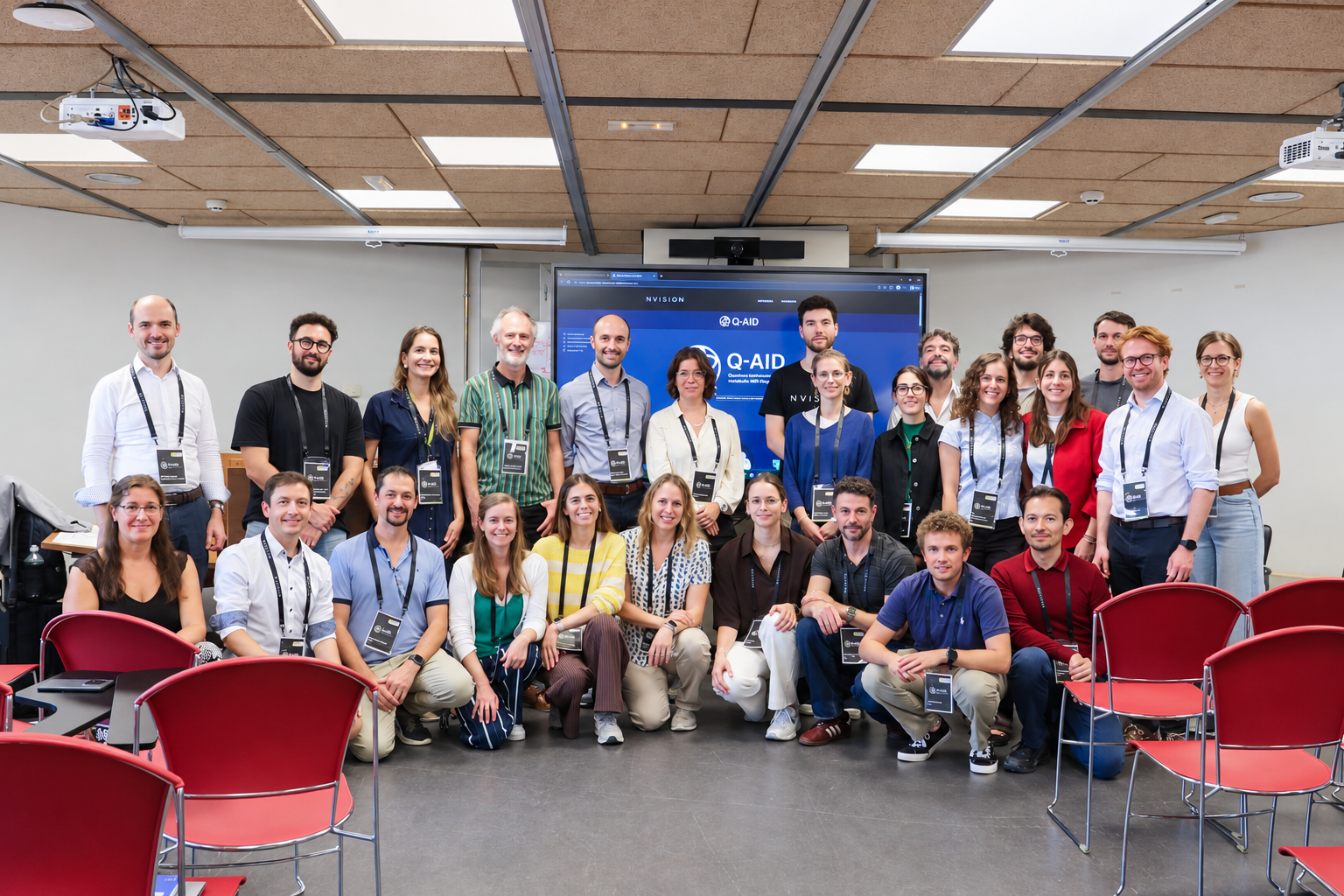
Recent commercial milestones reflect steady global growth across NVision’s clinical sensing network. Through the €8.3 million EU-funded Q-AID initiative, the first two POLARIS systems were deployed at the Institute for Bioengineering of Catalonia (IBEC) in Barcelona and the University of Antwerp to advance quantum-enhanced metabolic MRI and AI-powered oncology diagnostics, as detailed in the NVision Q-AID deployment announcement, the Q-AID network release, and the Q-AID Barcelona Consortium progress report. Additionally, NVision completed a POLARIS deployment at UCLouvain in Belgium for preclinical cancer metabolism research, while Germany’s Federal Ministry of Research extended the QuE-MRT lighthouse project through August 2028, expanding the total project volume to ~€20 million.
The strategic expansion complements NVision’s $55 million Series B financing round led by Abbott and the EIB, builds upon NVision’s selection by EuroHPC JU for the QOSMOS molecular spin-qubit project, and expands its established clinical sensing footprint at the University of Cambridge and Aarhus University’s €5.4M MIRAQLE research hub.
Watch the full interview on YouTube here and review the technical architecture briefing on Google Docs here.
October 16, 2026