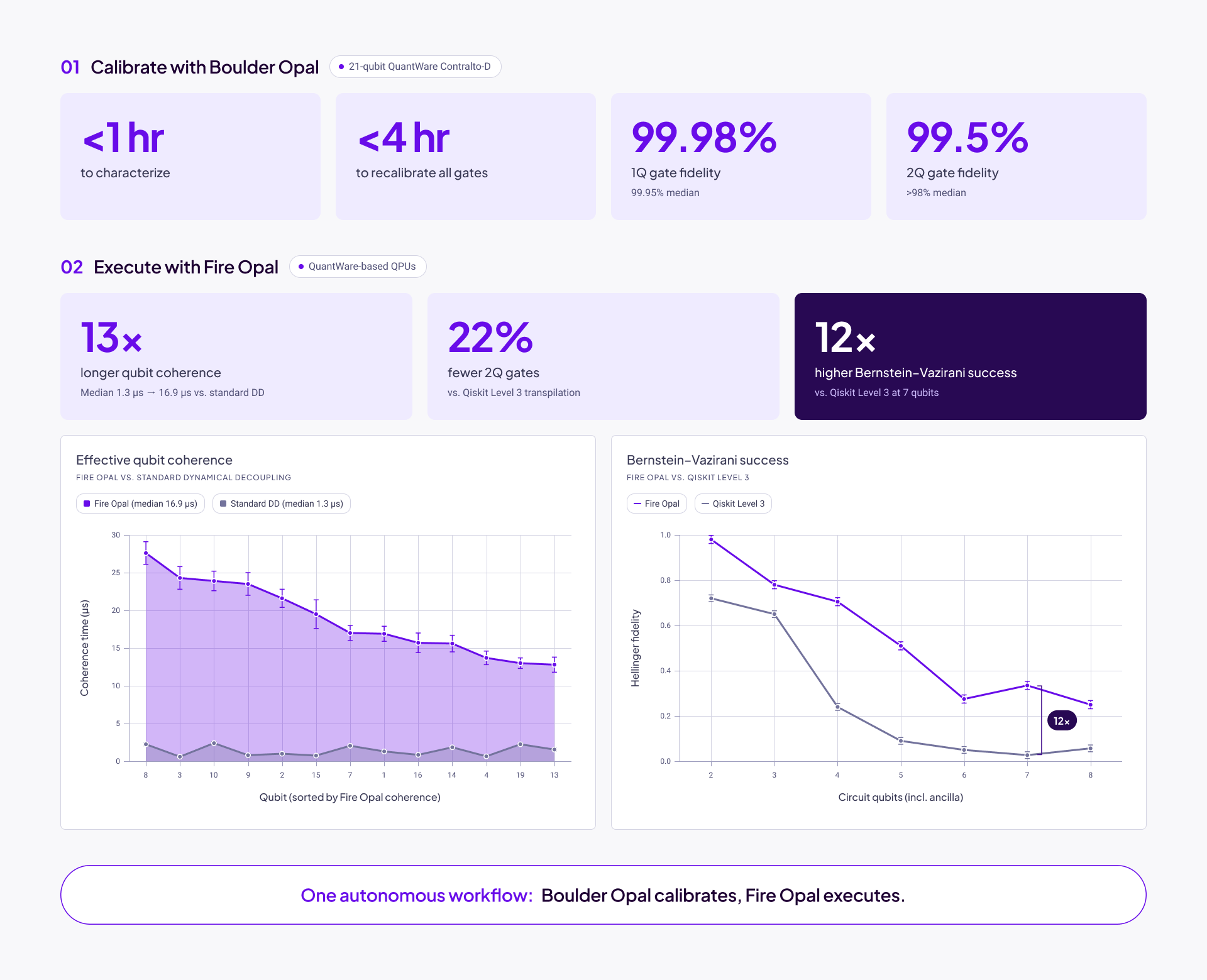
Q-CTRL has unified its autonomous hardware characterization and calibration platform, Boulder Opal, with its error-suppressed algorithm execution software, Fire Opal, into a single end-to-end quantum infrastructure workflow. Announced on November 16, 2026, the integrated software stack automates the full lifecycle from bare quantum processor bring-up to compiled workload execution, replacing weeks of manual specialist tuning with automated routines that share real-time hardware state across calibration and compilation layers.
| Q-CTRL Unified Boulder Opal & Fire Opal Stack and Hardware Validation | ||
|---|---|---|
| Stack / Benchmark Dimension | Supported Systems & Scope | Technical Specification & Measured Performance |
| Circuit Frameworks | Qiskit, QASM, and NVIDIA CUDA-Q | Ingests abstract quantum circuits without requiring user-side language rewrites. |
| Control Electronics | Quantum Machines & Qblox controllers | Cross-compiles optimized pulses into each controller’s native low-level domain language. |
| Supported QPU Platforms | QuantWare, Rigetti, Anyon Computing, Qolab, & Equal1 | Covers both superconducting transmon architectures and silicon spin processors. |
| Autonomous Bring-Up | 21-qubit QuantWare Contralto-D (Boulder Opal) | Characterized in <1 hr and calibrated in <4 hrs; 99.95% median 1Q and >98% median 2Q fidelity. |
| Workload Execution | QuantWare Contralto-D (Fire Opal) | 13x longer median coherence (1.3 μs to 16.9 μs) and up to 12x higher Bernstein-Vazirani success vs. Qiskit L3. |
In conventional quantum computing deployments, bringing a newly cooled processor online requires dedicated physics teams to characterize qubits, tune individual gates, maintain drift parameters, and manually synchronize gate definitions with downstream transpilers. By linking Boulder Opal and Fire Opal over a shared hardware model, Q-CTRL enables parameter updates from autonomous recalibration to propagate immediately into circuit compilation, dynamical decoupling, and crosstalk suppression without manual database updates.
The unified stack is running live on Elevate Quantum’s Q-PAC open-architecture system in Colorado, which pairs QuantWare superconducting hardware with Qblox control electronics. End-user cloud access to the Q-PAC deployment is scheduled to open in December 2026 through Quantum Rings’ Open Quantum platform.
Read Q-CTRL’s technical announcement here and its accompanying commercialization analysis here. Related QCR coverage of Q-CTRL’s automated quantum materials simulation benchmarks is available here.
November 16, 2026