

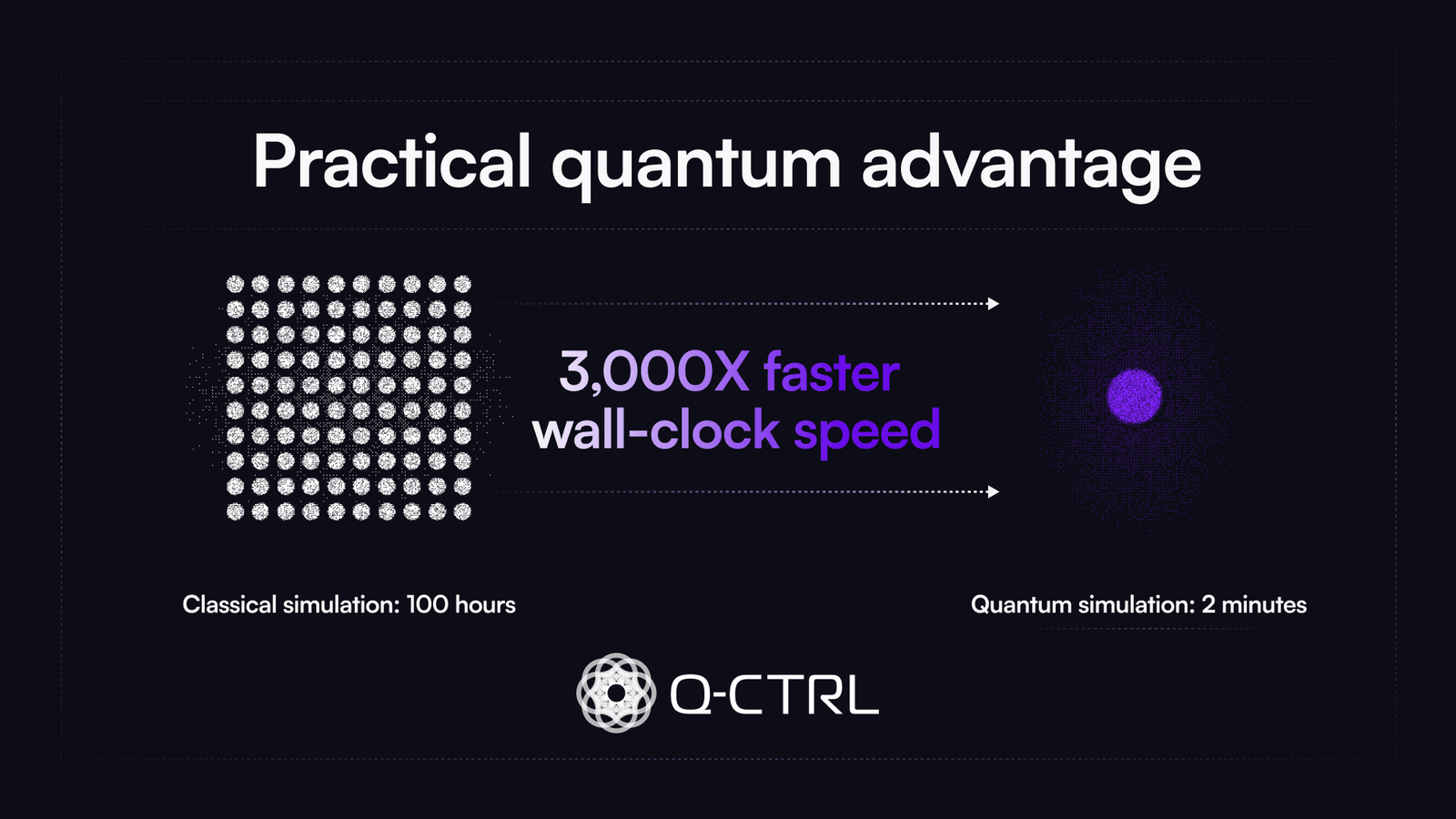
Q-CTRL, in collaboration with IBM, has demonstrated what it defines as “practical quantum advantage” by utilizing the IBM Quantum Platform to simulate the Fermi–Hubbard model at a scale of 120 qubits. The simulation, which focused on the dynamical evolution of interacting electrons in one-dimensional materials, achieved a 3,000-fold speedup in wall-clock time compared to performance-optimized classical benchmarks. While the quantum processor completed the execution in approximately two minutes, the state-of-the-art classical alternative—using a Time-Dependent Variational Principle (TDVP) solver on a high-performance compute cluster—required over 100 hours to reach comparable accuracy.
The execution involved over 10,000 two-qubit quantum-logic operations and up to 90 Trotter steps, a depth that typically results in significant error accumulation on Noisy Intermediate-Scale Quantum (NISQ) hardware. To overcome this, Q-CTRL utilized its performance-management infrastructure software to implement runtime error suppression. Unlike traditional error mitigation, which requires massive sampling overhead and slows down execution, this software-defined approach allowed the hardware to maintain accuracy while operating at native speeds. The results, published on arXiv (2605.04025), showed an agreement within 1% Root Mean Square Error (RMSE) between the quantum outputs and the highest-resolution classical tensor-network simulations.
In a specific 62-qubit experiment, the team observed spin-charge separation, a fundamental quantum phenomenon where an electron’s spin and charge degrees of freedom propagate at different velocities (vc and vs). This simulation reached an evolution time of t=9 in natural units, surpassing prior quantum demonstrations in both scale and resolution. The ability to extract precise velocity ratios that match classical predictions validates the use of contemporary digital quantum processors as a quantitatively accurate platform for many-body physics, particularly for problems in the BQP (Bounded-error Quantum Polynomial time) complexity class that scale poorly for classical algorithms.
The demonstration highlights a shift toward using quantum computers as essential components in the R&D roadmap for energy and materials science. Approximately one-third of global supercomputing time is currently dedicated to chemical and materials simulation, and the computational bottlenecks of classical heuristics limit the discovery of room-temperature superconductors and carbon-neutral materials. By providing a solution that is faster and equally accurate to leading classical tools like ITensor, Q-CTRL and IBM have established a baseline for positive ROI in quantum-centric scientific workflows.
The software configuration utilized for these results will soon be integrated into the IBM Quantum Platform as a new Qiskit Function. This move is intended to allow industrial and academic researchers to incorporate quantum-accelerated simulation directly into their materials discovery pipelines. While Q-CTRL acknowledges the potential for future specialized classical algorithms or GPU-accelerated tensor networks to improve classical performance, the current results establish a practical advantage relative to the most capable computational tools available to researchers today.
You can read the official press release regarding Q-CTRL’s achievement here and the detailed technical blog here. The technical manuscript, “Fast, accurate, high-resolution simulation of large-scale Fermi-Hubbard models on a digital quantum processor,” is accessible on arXiv here. In addition, GQI has published a companion Qnalysis piece titled “The Road to Practical Quantum Advantage: Science Experiment or Reality?” that can be found here.
In GQI Portal
The players behind the news
The team that writes QCR tracks every company, deal and technology in the GQI Factory, GQI's verified database of the quantum industry. Next up: every story linked to its players, coming to QCR's paid plans.
- Players Companies and institutions across the quantum industry, by segment.
- Scorecards How the players compare on hardware, software, funding and more.
Newsletter
QCR Alerts in your inbox
The latest reporting and analysis from Quantum Computing Report. Free, unsubscribe any time.