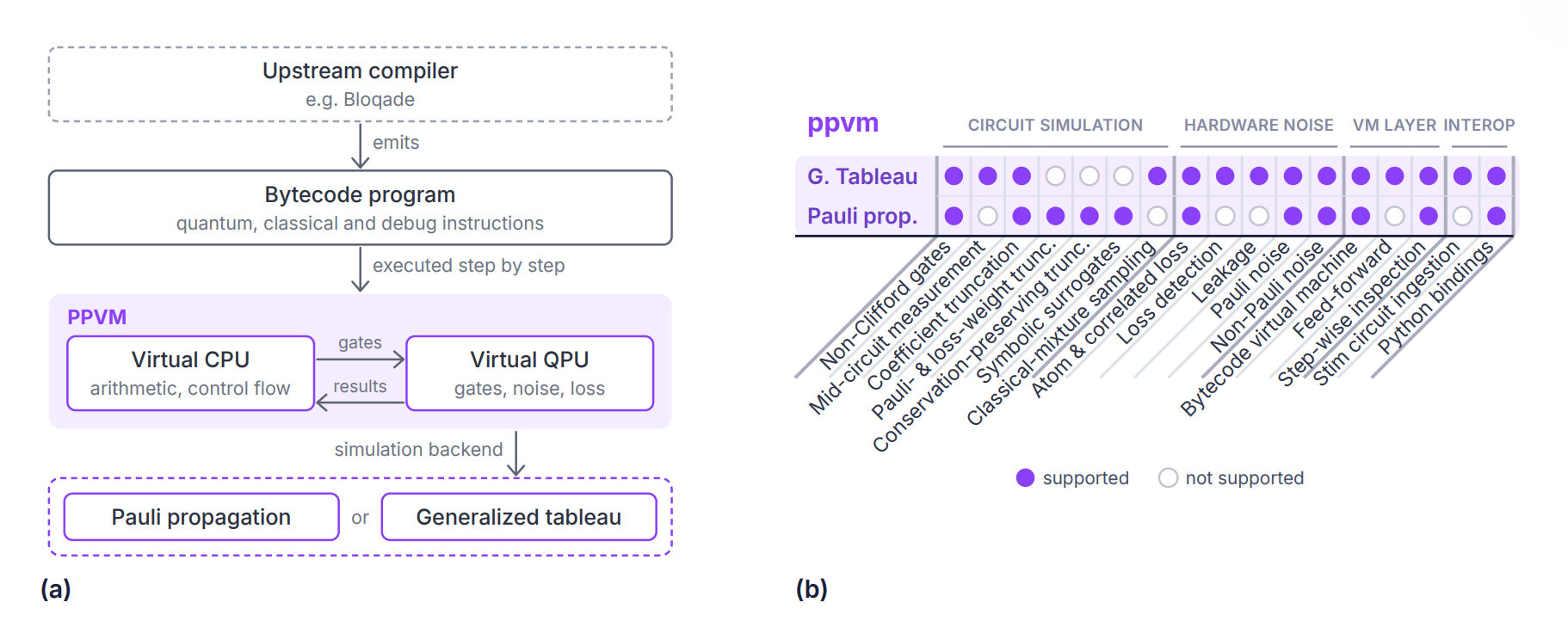
Researchers from QuEra Computing, NVIDIA, École Normale Supérieure (PSL University), and the University of Massachusetts Amherst have released the Programmable Pauli Virtual Machine (PPVM), an open-source circuit simulation and digital-twin framework designed to jointly emulate quantum processors, realistic hardware noise, and classical control logic. Built on a stack-based bytecode virtual machine separating a virtual CPU from a virtual QPU, PPVM unifies generalized stabilizer tableau simulation for measurement-conditioned feed-forward with Heisenberg-picture Pauli propagation for observable estimation.
| PPVM Simulation Backends & Benchmark Highlights | ||
|---|---|---|
| Simulation Mode / Workload | System Scale & Noise Model | Performance & Architectural Capabilities |
| Generalized Tableau Backend | 4.8.8 color-code 5-to-1 magic state distillation up to distance 23 (1,435 qubits) | ~0.1 s per shot on a single Apple M4 thread with independent/correlated atom loss, depolarization, and feed-forward. |
| Real-Time QEC Integration | Bloqade QEC Studio + deq decoder on [[17, 1, 5]] color & STAR bicycle codes | Persistent VM state branches on decoded logical outcomes and loss-detection flags mid-circuit. |
| GPU Pauli Propagation | 484-qubit (22 × 22) noisy Heisenberg spin lattice via NVIDIA cuPauliProp | Tracks 15 million Pauli terms in ~9 minutes on an NVIDIA GH200 Grace Hopper Superchip (up to 148× CPU speedup). |
| AI Autotuning Harness | Noisy generalized-tableau mixture construction (2,025 retained branches) | 5.04× speedup in mixture construction (~22 μs/shot sampling) verified against human-written physics tests. |
Tailored for early fault-tolerant neutral-atom architectures, PPVM incorporates explicit Kraus and adjoint channels for state-dependent independent atom loss, correlated two-qubit gate loss, leakage, and loss-triggered qubit resets, alongside protected Pauli sets that preserve conserved physical quantities under truncation. Because each shot tracks atom-loss flags natively without circuit recompilation, the tableau backend outperforms compiled simulators such as Clifft when per-shot atom-loss channels are active.
Exposed through Python and Rust interfaces alongside a step-by-step bytecode debugger, PPVM provides a unified execution target for testing adaptive error-correction protocols, hardware noise models, and classical control logic ahead of physical processor deployment.
Read the full research paper on arXiv here, access the open-source PPVM repository on GitHub here, and explore the PPVM documentation here.
November 20, 2026