

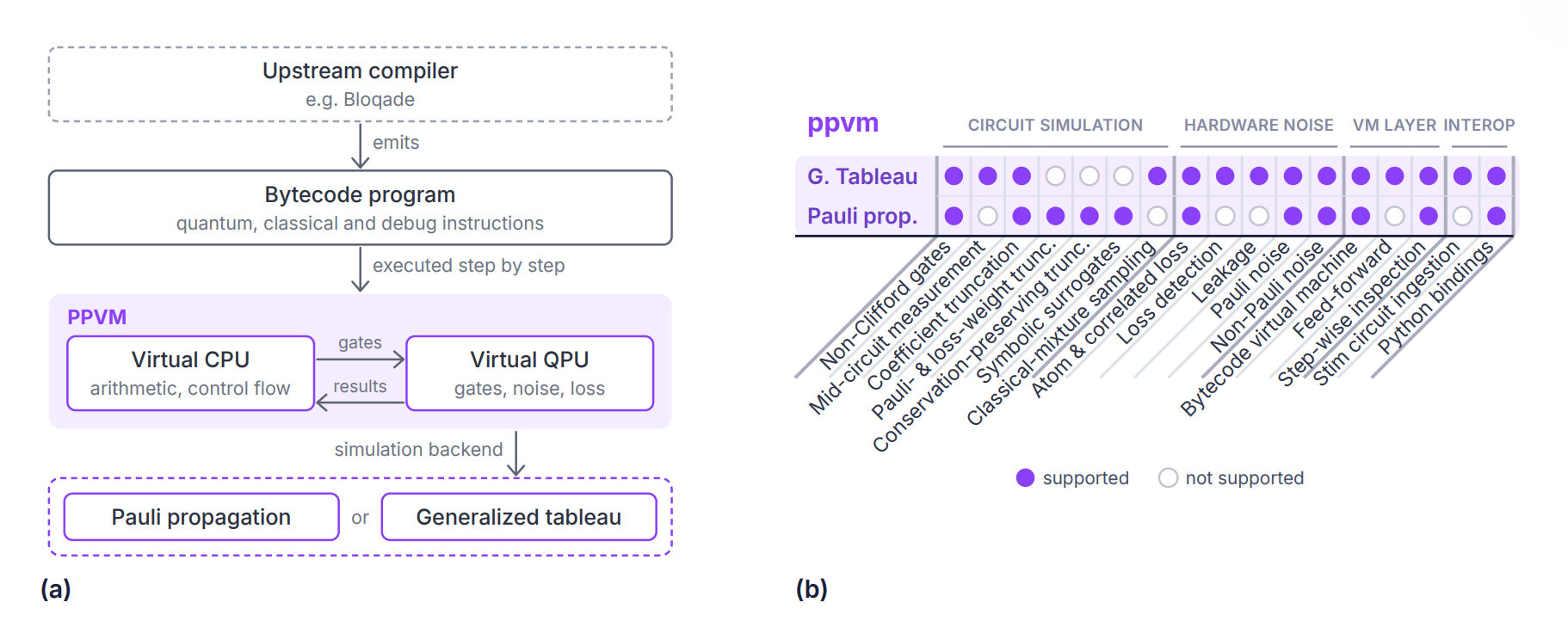
Researchers from QuEra Computing, NVIDIA, École Normale Supérieure (PSL University), and the University of Massachusetts Amherst have released the Programmable Pauli Virtual Machine (PPVM), an open-source circuit simulation and digital-twin framework designed to jointly emulate quantum processors, realistic hardware noise, and classical control logic. Built on a stack-based bytecode virtual machine separating a virtual CPU from a virtual QPU, PPVM unifies generalized stabilizer tableau simulation for measurement-conditioned feed-forward with Heisenberg-picture Pauli propagation for observable estimation.
| PPVM Simulation Backends & Benchmark Highlights | ||
|---|---|---|
| Simulation Mode / Workload | System Scale & Noise Model | Performance & Architectural Capabilities |
| Generalized Tableau Backend | 4.8.8 color-code 5-to-1 magic state distillation up to distance 23 (1,435 qubits) | ~0.1 s per shot on a single Apple M4 thread with independent/correlated atom loss, depolarization, and feed-forward. |
| Real-Time QEC Integration | Bloqade QEC Studio + deq decoder on [[17, 1, 5]] color & STAR bicycle codes | Persistent VM state branches on decoded logical outcomes and loss-detection flags mid-circuit. |
| GPU Pauli Propagation | 484-qubit (22 × 22) noisy Heisenberg spin lattice via NVIDIA cuPauliProp | Tracks 15 million Pauli terms in ~9 minutes on an NVIDIA GH200 Grace Hopper Superchip (up to 148× CPU speedup). |
| AI Autotuning Harness | Noisy generalized-tableau mixture construction (2,025 retained branches) | 5.04× speedup in mixture construction (~22 μs/shot sampling) verified against human-written physics tests. |
Tailored for early fault-tolerant neutral-atom architectures, PPVM incorporates explicit Kraus and adjoint channels for state-dependent independent atom loss, correlated two-qubit gate loss, leakage, and loss-triggered qubit resets, alongside protected Pauli sets that preserve conserved physical quantities under truncation. Because each shot tracks atom-loss flags natively without circuit recompilation, the tableau backend outperforms compiled simulators such as Clifft when per-shot atom-loss channels are active.
Exposed through Python and Rust interfaces alongside a step-by-step bytecode debugger, PPVM provides a unified execution target for testing adaptive error-correction protocols, hardware noise models, and classical control logic ahead of physical processor deployment.
Read the full research paper on arXiv here, access the open-source PPVM repository on GitHub here, and explore the PPVM documentation here.
In GQI Portal
The players behind the news
The team that writes QCR tracks every company, deal and technology in the GQI Factory, GQI's verified database of the quantum industry. Next up: every story linked to its players, coming to QCR's paid plans.
- Players Companies and institutions across the quantum industry, by segment.
- Scorecards How the players compare on hardware, software, funding and more.
Newsletter
QCR Alerts in your inbox
The latest reporting and analysis from Quantum Computing Report. Free, unsubscribe any time.