Deep-tech quantum company Terra Quantum AG has published a comprehensive white paper and companion research study analyzing the vulnerabilities of major blockchain platforms to cryptographically relevant quantum computers (CRQCs) and outlining post-quantum cryptography (PQC) migration frameworks.
The paper highlights that widely deployed public-key digital signature algorithms—including ECDSA (secp256k1) and Ed25519—are vulnerable to private key derivation via Shor’s algorithm. Recent quantum resource estimates indicate that breaking elliptic-curve discrete logarithms may require up to 20 times fewer physical qubits than previously projected, heightening urgency for decentralized networks, institutional custodians, and stablecoin issuers.
| [ Quantum Vulnerability & Exposure Analysis by Blockchain Protocol ] | ||
|---|---|---|
| Blockchain Platform | Exposed Cryptographic Assets | Primary Threat Model & Key Constraints |
| • Bitcoin Network | • ~6.9M BTC (~$500B equivalent) • 1.72M BTC in P2PK (8.6% circulating supply) | • At-Rest Attacks: Exposed public keys, dormant wallets, and reused addresses. • On-Spend Attacks: ~10-minute block confirmation window. |
| • Ethereum & EVM | • 41M ETH securing PoS consensus (BLS) • 21.4M ETH in top 1,000 EOAs • $200B+ in ERC-20 stablecoins & RWAs | • Consensus & Governance Attacks: Vulnerable validator keys, cross-chain bridges, and smart-contract admin/upgrade authorities. |
| • Solana Platform | • All Externally Owned Accounts (EOAs) • Validator voting & network signers | • At-Rest Account Exposure: Ed25519 addresses expose public keys continuously from creation; ~400 ms slot time mitigates on-spend risks. |
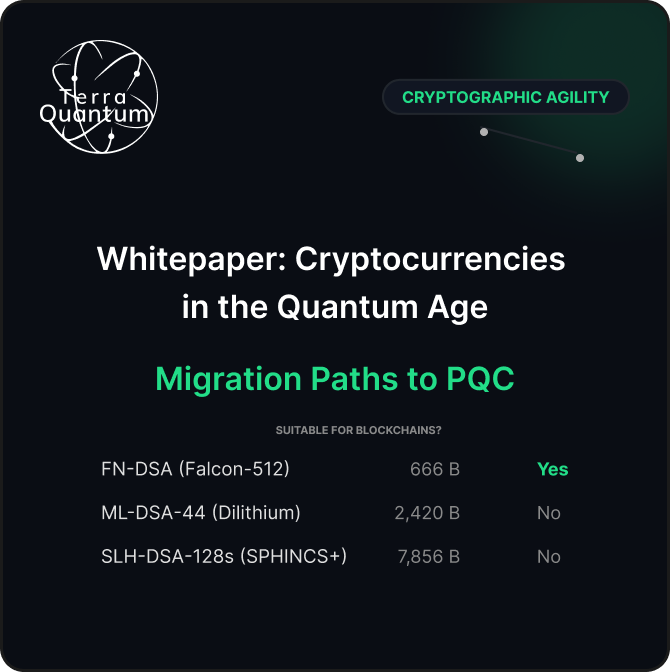
The analysis emphasizes that signature payload size is the primary technical bottleneck when integrating PQC into high-throughput ledgers. While finalized NIST standard ML-DSA-44 (Dilithium) generates 2,420-byte signatures (38x larger than Ed25519), the paper identifies FN-DSA (Falcon-512, under draft standard FIPS 206) as the most viable candidate for blockchain transaction layers due to its compact ≤666-byte signature footprint.
The publication also evaluates mitigation frameworks, including Solana’s application-level Winternitz One-Time Signature (WOTS) vaults, Algorand’s state proofs and native Falcon account roadmaps, and Ethereum’s EIP-8052 proposal for EVM-native Falcon-512 verification precompiles.
Review the full white paper release on the Terra Quantum Portal here and examine the technical manuscript on arXiv here.
September 15, 2026