

Deep-tech quantum company Terra Quantum AG has published a comprehensive white paper and companion research study analyzing the vulnerabilities of major blockchain platforms to cryptographically relevant quantum computers (CRQCs) and outlining post-quantum cryptography (PQC) migration frameworks.
The paper highlights that widely deployed public-key digital signature algorithms—including ECDSA (secp256k1) and Ed25519—are vulnerable to private key derivation via Shor’s algorithm. Recent quantum resource estimates indicate that breaking elliptic-curve discrete logarithms may require up to 20 times fewer physical qubits than previously projected, heightening urgency for decentralized networks, institutional custodians, and stablecoin issuers.
| [ Quantum Vulnerability & Exposure Analysis by Blockchain Protocol ] | ||
|---|---|---|
| Blockchain Platform | Exposed Cryptographic Assets | Primary Threat Model & Key Constraints |
| • Bitcoin Network | • ~6.9M BTC (~$500B equivalent) • 1.72M BTC in P2PK (8.6% circulating supply) | • At-Rest Attacks: Exposed public keys, dormant wallets, and reused addresses. • On-Spend Attacks: ~10-minute block confirmation window. |
| • Ethereum & EVM | • 41M ETH securing PoS consensus (BLS) • 21.4M ETH in top 1,000 EOAs • $200B+ in ERC-20 stablecoins & RWAs | • Consensus & Governance Attacks: Vulnerable validator keys, cross-chain bridges, and smart-contract admin/upgrade authorities. |
| • Solana Platform | • All Externally Owned Accounts (EOAs) • Validator voting & network signers | • At-Rest Account Exposure: Ed25519 addresses expose public keys continuously from creation; ~400 ms slot time mitigates on-spend risks. |
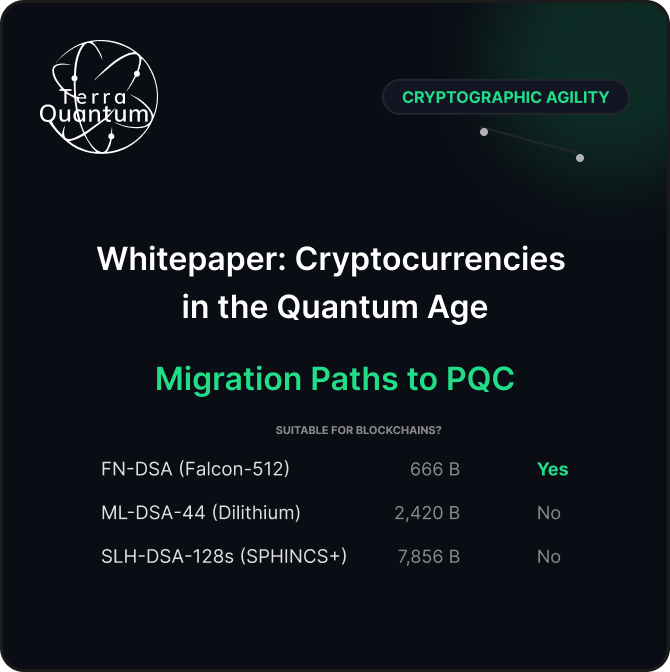
The analysis emphasizes that signature payload size is the primary technical bottleneck when integrating PQC into high-throughput ledgers. While finalized NIST standard ML-DSA-44 (Dilithium) generates 2,420-byte signatures (38x larger than Ed25519), the paper identifies FN-DSA (Falcon-512, under draft standard FIPS 206) as the most viable candidate for blockchain transaction layers due to its compact ≤666-byte signature footprint.
The publication also evaluates mitigation frameworks, including Solana’s application-level Winternitz One-Time Signature (WOTS) vaults, Algorand’s state proofs and native Falcon account roadmaps, and Ethereum’s EIP-8052 proposal for EVM-native Falcon-512 verification precompiles.
Review the full white paper release on the Terra Quantum Portal here and examine the technical manuscript on arXiv here.
September 15, 2026
In GQI Portal
The players behind the news
The team that writes QCR tracks every company, deal and technology in the GQI Factory, GQI's verified database of the quantum industry. Next up: every story linked to its players, coming to QCR's paid plans.
- Players Companies and institutions across the quantum industry, by segment.
- Scorecards How the players compare on hardware, software, funding and more.
Newsletter
QCR Alerts in your inbox
The latest reporting and analysis from Quantum Computing Report. Free, unsubscribe any time.