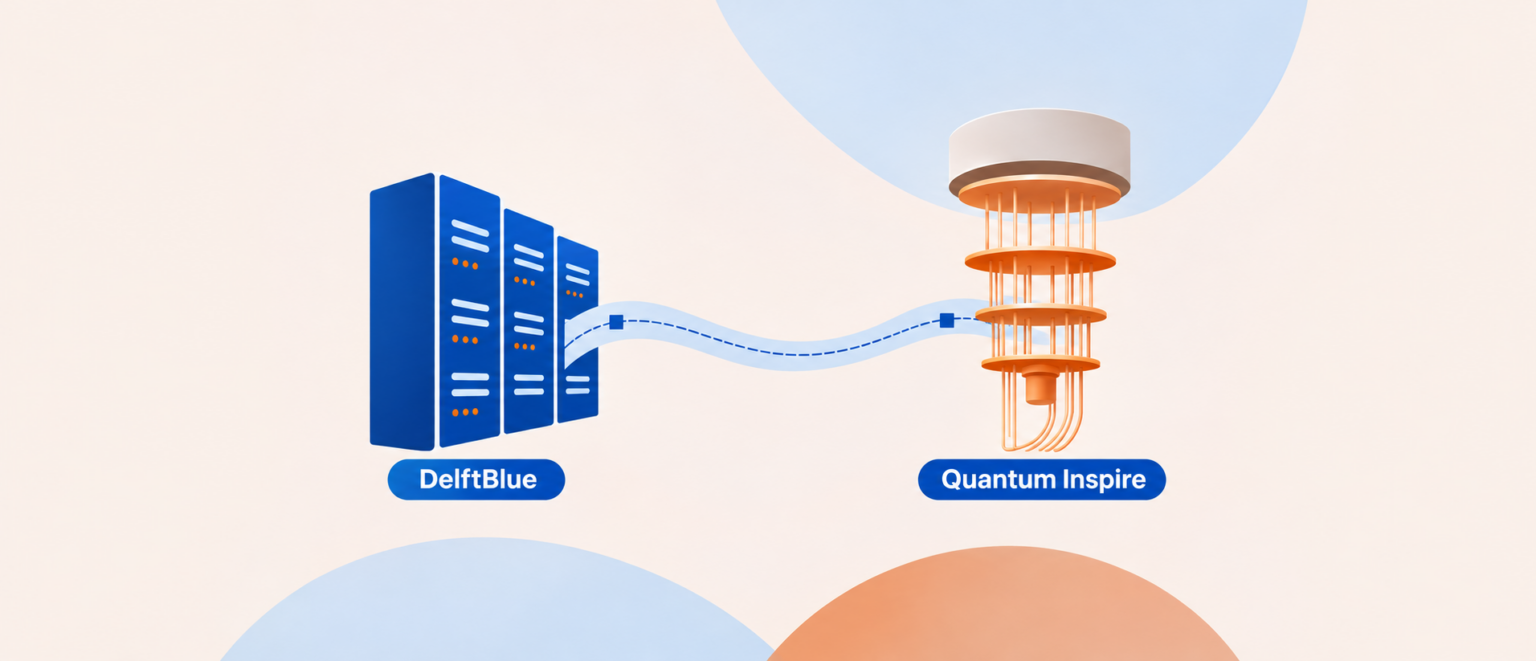
Researchers at Delft University of Technology and QuTech have completed the first user benchmark on the newly integrated hybrid infrastructure connecting TU Delft’s DelftBlue high-performance computer with QuTech’s cloud-accessible Quantum Inspire platform. Tested by TU Delft researcher Zeynab Kaseb on an electrical power-flow calculation, the workflow uses DelftBlue to formulate the mathematical objective and optimize circuit parameters before dispatching quantum circuits to QuTech’s 17-qubit Tuna-17 processor and decoding the resulting bitstrings back into grid voltage solutions.
Executing the Quantum Approximate Optimization Algorithm (QAOA) across 1,024 shots per run, the four-qubit encoding (30 circuit layers) recovered the optimal candidate state in 21 percent of measurements with a power-flow residual of 0.01053. A finer six-qubit encoding lowered the best residual to 0.003262, though its deeper 165-layer circuit reduced optimal-candidate sampling frequency to 1.56 percent due to hardware noise, establishing a baseline for hybrid HPC-quantum algorithm benchmarking on Delft’s integrated stack.
Read QuTech’s announcement here.
November 27, 2026