
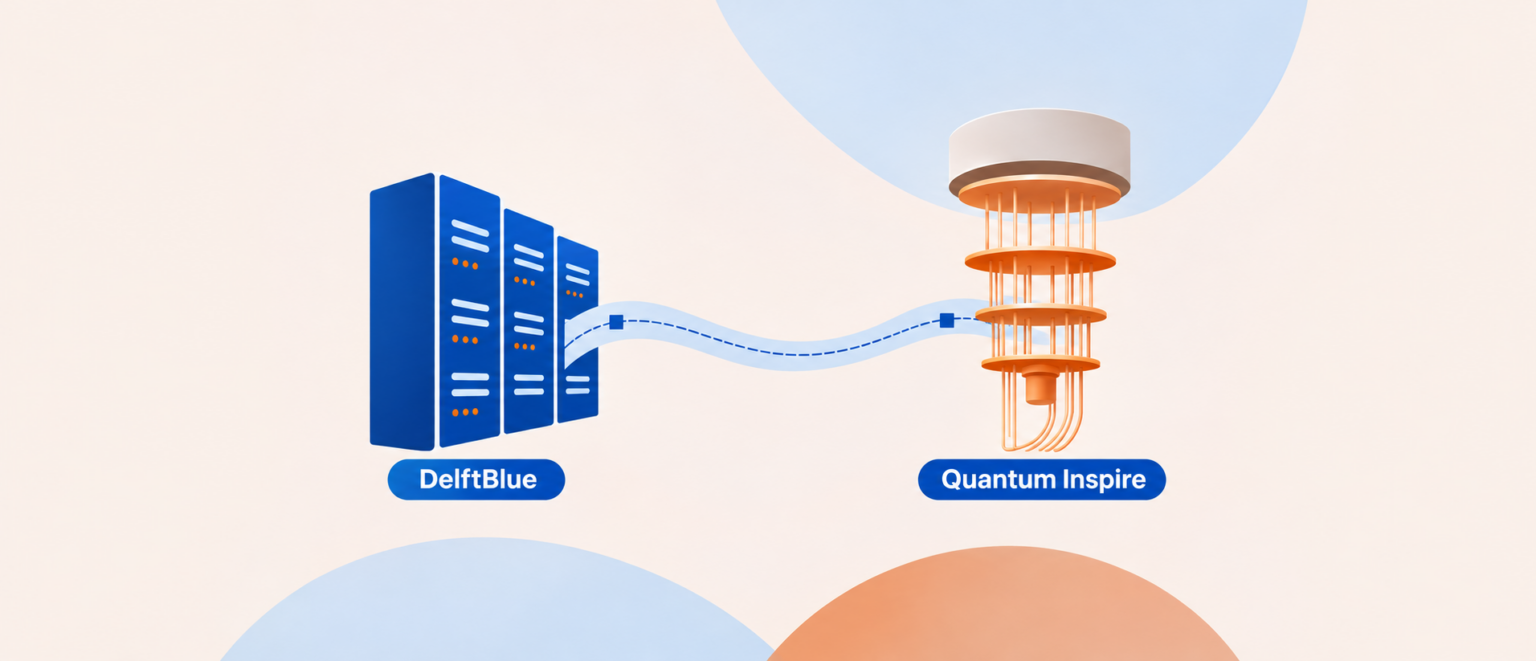
Researchers at Delft University of Technology and QuTech have completed the first user benchmark on the newly integrated hybrid infrastructure connecting TU Delft’s DelftBlue high-performance computer with QuTech’s cloud-accessible Quantum Inspire platform. Tested by TU Delft researcher Zeynab Kaseb on an electrical power-flow calculation, the workflow uses DelftBlue to formulate the mathematical objective and optimize circuit parameters before dispatching quantum circuits to QuTech’s 17-qubit Tuna-17 processor and decoding the resulting bitstrings back into grid voltage solutions.
Executing the Quantum Approximate Optimization Algorithm (QAOA) across 1,024 shots per run, the four-qubit encoding (30 circuit layers) recovered the optimal candidate state in 21 percent of measurements with a power-flow residual of 0.01053. A finer six-qubit encoding lowered the best residual to 0.003262, though its deeper 165-layer circuit reduced optimal-candidate sampling frequency to 1.56 percent due to hardware noise, establishing a baseline for hybrid HPC-quantum algorithm benchmarking on Delft’s integrated stack.
Read QuTech’s announcement here.
In GQI Portal
The players behind the news
The team that writes QCR tracks every company, deal and technology in the GQI Factory, GQI's verified database of the quantum industry. Next up: every story linked to its players, coming to QCR's paid plans.
- Players Companies and institutions across the quantum industry, by segment.
- Scorecards How the players compare on hardware, software, funding and more.
Newsletter
QCR Alerts in your inbox
The latest reporting and analysis from Quantum Computing Report. Free, unsubscribe any time.