
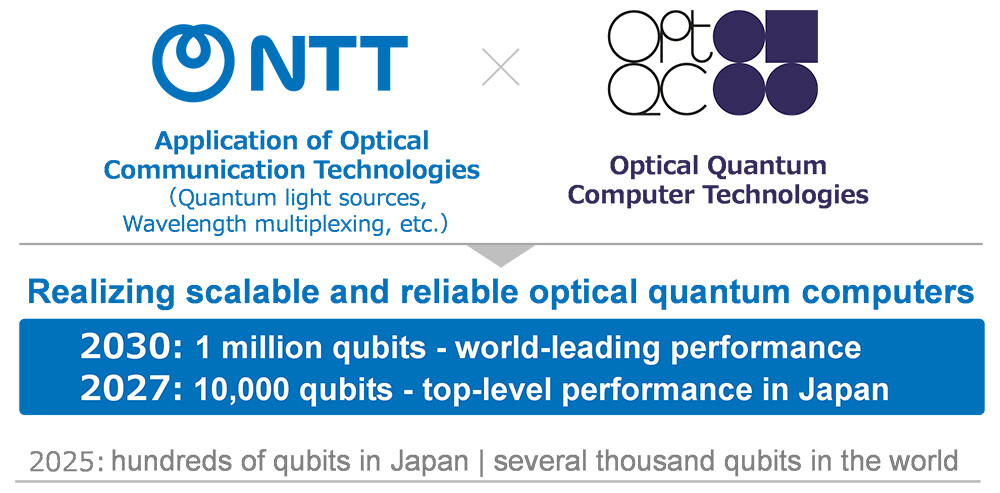
NTT, Inc. and OptQC Corp. have signed a collaboration agreement aimed at realizing scalable and highly reliable optical quantum computers, with a goal of achieving one million quantum bits (qubits) and establishing error-tolerant technologies by 2030. The partnership will leverage NTT’s advanced optical communication and error correction technologies with OptQC’s expertise in optical quantum computer development.
OptQC, a startup based on 25 years of optical quantum computing research at the University of Tokyo, is developing a highly scalable, room-temperature optical quantum computer. The company is currently advancing a large-scale processor targeting 10,000 quantum modes by 2028 and has raised $14.3 million in early funding rounds. NTT will contribute its innovations, such as optical amplification technology that previously achieved quantum entanglement generation 1,000× faster than conventional methods.
The joint study outlines a five-year roadmap with the following primary areas of collaboration:
- Development of multiplexing and error correction technologies applicable to optical quantum computers.
- Creation of use cases and development of algorithms and software.
- Building a supply chain for optical quantum computers.
Optical quantum computers, which operate at room temperature and atmospheric pressure with low power consumption, are positioned by the companies as a promising approach for addressing complex social challenges like drug discovery, new material design, and climate change prediction.
Read the full announcement from NTT here.
In GQI Portal
The players behind the news
The team that writes QCR tracks every company, deal and technology in the GQI Factory, GQI's verified database of the quantum industry. Next up: every story linked to its players, coming to QCR's paid plans.
- Players Companies and institutions across the quantum industry, by segment.
- Scorecards How the players compare on hardware, software, funding and more.
Newsletter
QCR Alerts in your inbox
The latest reporting and analysis from Quantum Computing Report. Free, unsubscribe any time.