

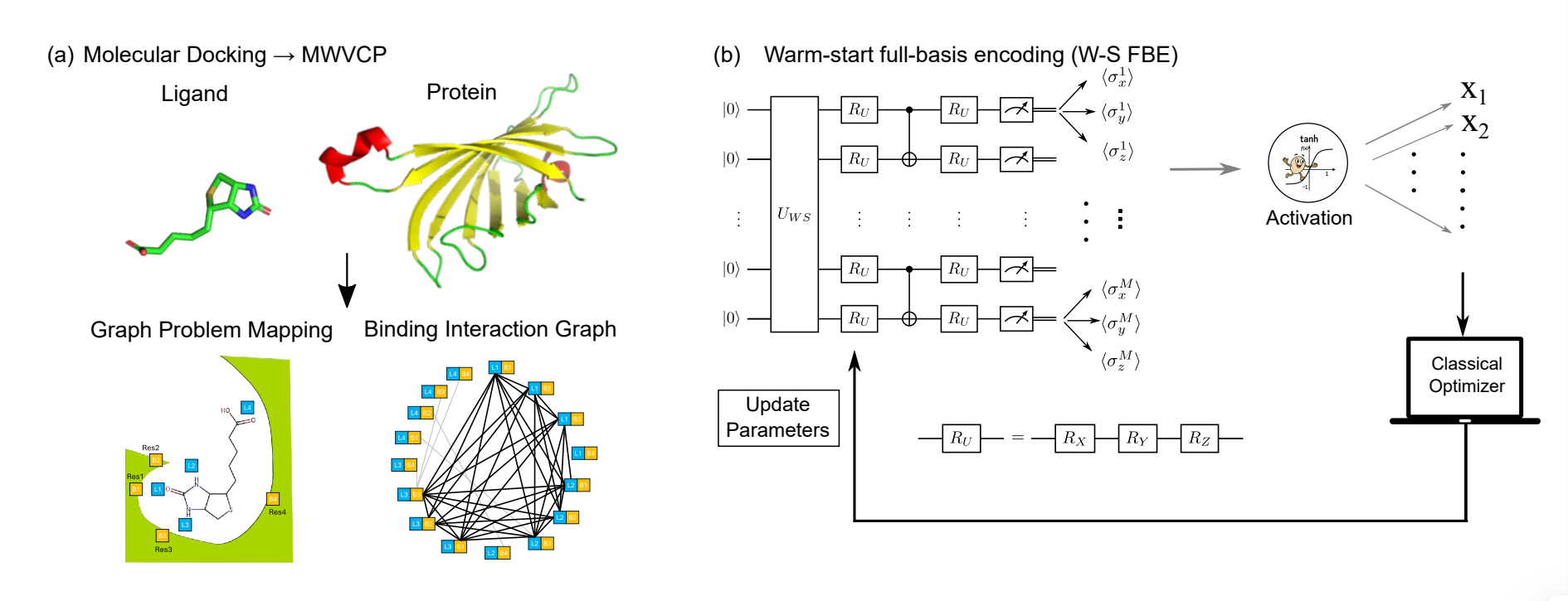
Researchers from Singapore’s Agency for Science, Technology and Research (A*STAR) and the National University of Singapore (NUS) have introduced a hybrid quantum-classical framework that compresses the qubit footprint required for structure-based drug discovery. Published on arXiv (arXiv:2608.19868), the study demonstrates resource-efficient bio-molecular docking—identifying optimal binding configurations between a ligand and a target protein—on digital NISQ hardware using IBM’s 156-qubit Heron r2 processor (ibm_kingston).
| [ Warm-Start Full-Basis Encoding (W-S FBE) Framework ] | ||
|---|---|---|
| Optimization Mapping | Quantum Qubit Encoding | Hardware & Verification |
| • Maximum Vertex-Weighted Clique (MVWCP) | • Full-Basis Encoding (3 Variables / Qubit) | • IBM Heron r2 Processor (ibm_kingston) |
| • Binding Interaction Graph (BIG) Construction | • ⌈N/3⌉ Physical Qubit Requirement | • 1stp (Biotin, N=18 Solved via 6 Qubits) |
| • QUBO / Ising Cost Hamiltonian Reduction | • qDRIFT-Inspired MPS Warm-Start | • 9aw2 (Benzamidine, N=14 Solved via 5 Qubits) |
Three-Variable Qubit Compression via Full-Basis Encoding
Molecular docking requires searching vast combinatorial spaces to find mutually compatible pharmacophore interaction sets. While classical approaches recast docking as a Maximum Vertex-Weighted Clique Problem (MVWCP) on a compatibility graph, traditional quantum mappings assign one binary variable per physical qubit, quickly exceeding near-term hardware limits:
- Full-Basis Encoding (FBE): Rather than reading out a single observable per qubit (⟨σz⟩), FBE assigns classical variables across all three orthogonal Bloch-sphere expectation values (⟨σx⟩, ⟨σy⟩, ⟨σz⟩). This allows up to three decision variables to be hosted on a single physical qubit, reducing an N-variable optimization problem to just ⌈N/3⌉ physical qubits.
- Mathematical Proof of Pure Product Ground States: The authors provide a rigorous proof establishing that at least one global minimizer of the continuous FBE objective can always be represented as a pure product state. This proves that complex multi-qubit entanglement is not required to represent the optimal discrete solution, justifying shallow unitary variational circuits.
- Stochastic Imaginary-Time Evolution Warm-Start: To bypass barren plateaus and accelerate training convergence, the optimization initializes via a Trotterized stochastic drift (qDRIFT) imaginary-time evolution step calculated classically using Matrix Product States (MPS).
Execution on IBM Heron QPU and Benchmark Systems
The team validated the framework on two biologically relevant protein-ligand complexes derived from the Protein Data Bank (PDB):
- Streptavidin–Biotin Complex (1stp): Mapped to an N=18 binding interaction graph and executed on the IBM Heron processor using 6 physical qubits.
- Trypsin–Benzamidine Complex (9aw2): Mapped to an N=14 binding interaction graph and executed on hardware using 5 physical qubits.
For both complex structures, the hardware measurements recovered the exact ground-truth clique assignments calculated by classical graph solvers under real gate infidelities and readout errors, outperforming standard two-basis (ZX) encodings under identical circuit-depth and training budgets.
The research was supported by the National Research Foundation, Singapore, and A*STAR’s Quantum Innovation Centre (Q.InC).
Review the complete open-access paper on arXiv:2608.19868 here.
In GQI Portal
The players behind the news
The team that writes QCR tracks every company, deal and technology in the GQI Factory, GQI's verified database of the quantum industry. Next up: every story linked to its players, coming to QCR's paid plans.
- Players Companies and institutions across the quantum industry, by segment.
- Scorecards How the players compare on hardware, software, funding and more.
Newsletter
QCR Alerts in your inbox
The latest reporting and analysis from Quantum Computing Report. Free, unsubscribe any time.