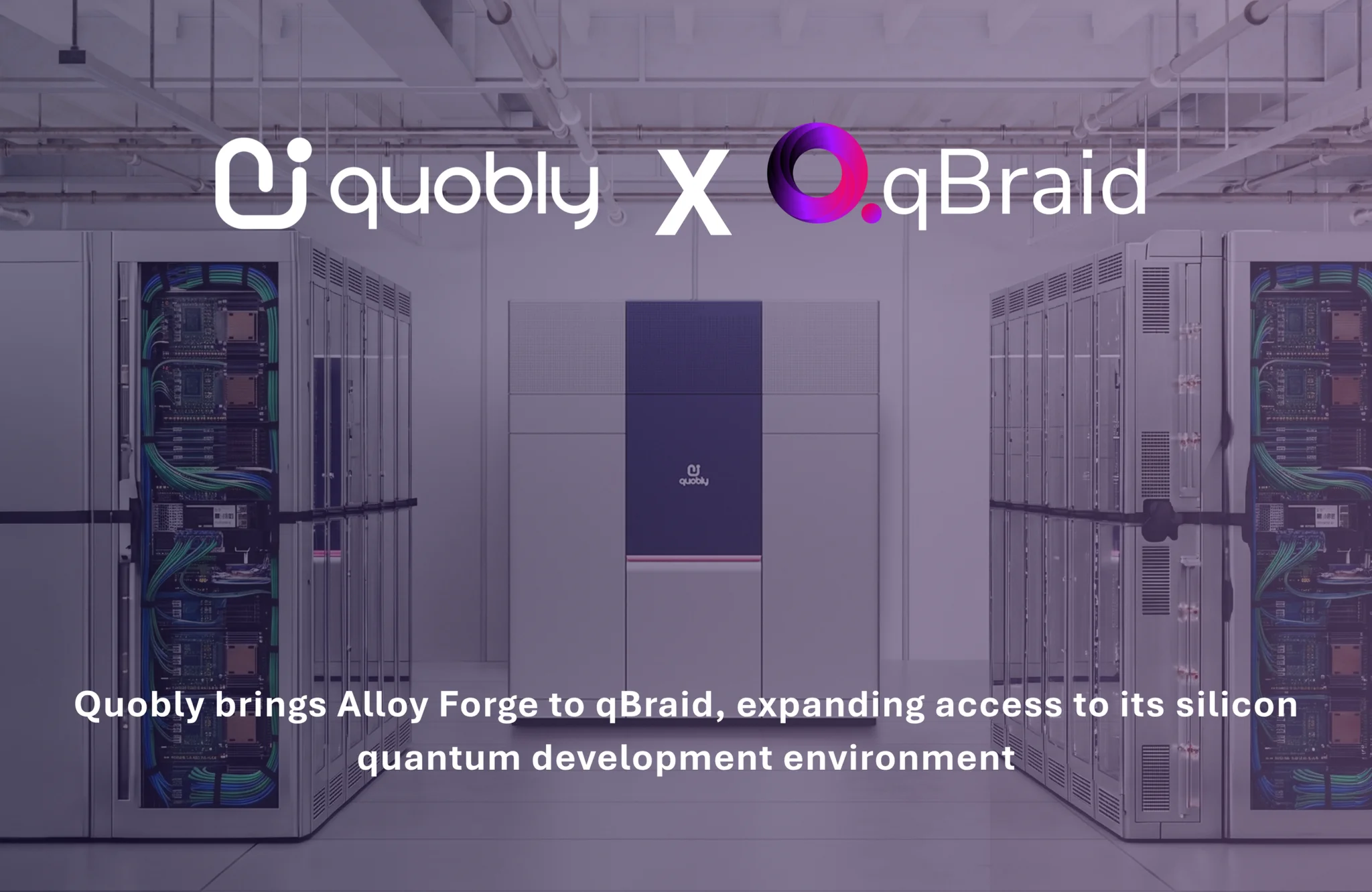
French silicon quantum computer developer Quobly and quantum software platform qBraid have expanded cloud access to Alloy Forge, Quobly’s hardware-aware quantum emulation environment. Integrated directly into the qBraid ecosystem, the platform enables global developers and enterprise researchers to validate applications under physical semiconductor constraints ahead of the commercial rollout of Quobly’s 10-qubit Alloy Pioneer quantum processing unit (QPU).
Built on top of Quobly’s open-source pulse-level simulation framework, SpinPulse, Alloy Forge models a 15-qubit 1D linear array of silicon spin qubits manufactured on 300mm Fully Depleted Silicon-on-Insulator (FD-SOI) CMOS technology. Unlike generic noiseless state-vector simulators, Alloy Forge applies Quobly’s empirical semiconductor noise model by default—capturing non-Markovian noise channels, physical decoherence, and hardware gate errors across its native single-qubit (RX, RY, RZ) and two-qubit (RZZ) gate set. Accessible via the open-source qbraid-sdk under the endpoint qbraid:quobly:sim:alloy-forge, the emulator allows users to quantify noise accumulation and test transpilation routing without requiring dedicated hardware credentials.
| [ Quobly Alloy Forge & qBraid Runtime Specifications ] | ||
|---|---|---|
| Platform Parameter | Emulation Architecture | Software & Runtime Configuration |
| Qubit Count & Geometry | • 15 Emulated Qubits (vs. 10 Qubits on Pioneer QPU) • 1D Linear Nearest-Neighbor Coupling Map | • Native RZZ two-qubit interactions on adjacent pairs • Automated transpilation for non-local gate routing |
| Noise & Physics Modeling | • Silicon Spin-Qubit Semiconductor Noise • Driven by SpinPulse Pulse-Level Framework | • Default hardware noise model enabled (opt-out available) • Deterministic seed controls for reproducible noisy runs |
| Cloud & SDK Access | • Integrated into qBraid Provider & Scaleway QaaS • Compatible with Qiskit, Cirq, PennyLane, CUDA-Q | • Endpoint: qbraid:quobly:sim:alloy-forge• Zero-credit access via standard qBraid API key |
The qBraid deployment serves as the software precursor to Quobly’s commercial hardware release, providing an environment where application code can transition directly from classical emulation to physical quantum processors without refactoring. The emulator automatically transpiles higher-level quantum circuits into the native RZZ interaction basis while charging the appropriate error penalty for non-adjacent qubit routing across the linear array layout.
Supported by a €115 million Series A financing round completed in mid-2026 (backed by Bpifrance, STMicroelectronics, and SEALSQ), Quobly continues to establish its cloud software presence through parallel distribution partnerships with qBraid and European cloud provider Scaleway. The dual-track strategy prepares high-performance computing (HPC) and enterprise users for on-demand cloud execution on Alloy Pioneer, supporting Quobly’s long-term roadmap toward Very Large-Scale Integration (VLSI) silicon quantum processors targeting one million physical qubits by 2032.
Review the press release on qBraid Press Room here, inspect technical SDK documentation at qBraid Docs here, explore software repositories via Quobly GitHub here, and read corporate announcements on Quobly Press here.
September 22, 2026

Leave A Comment