

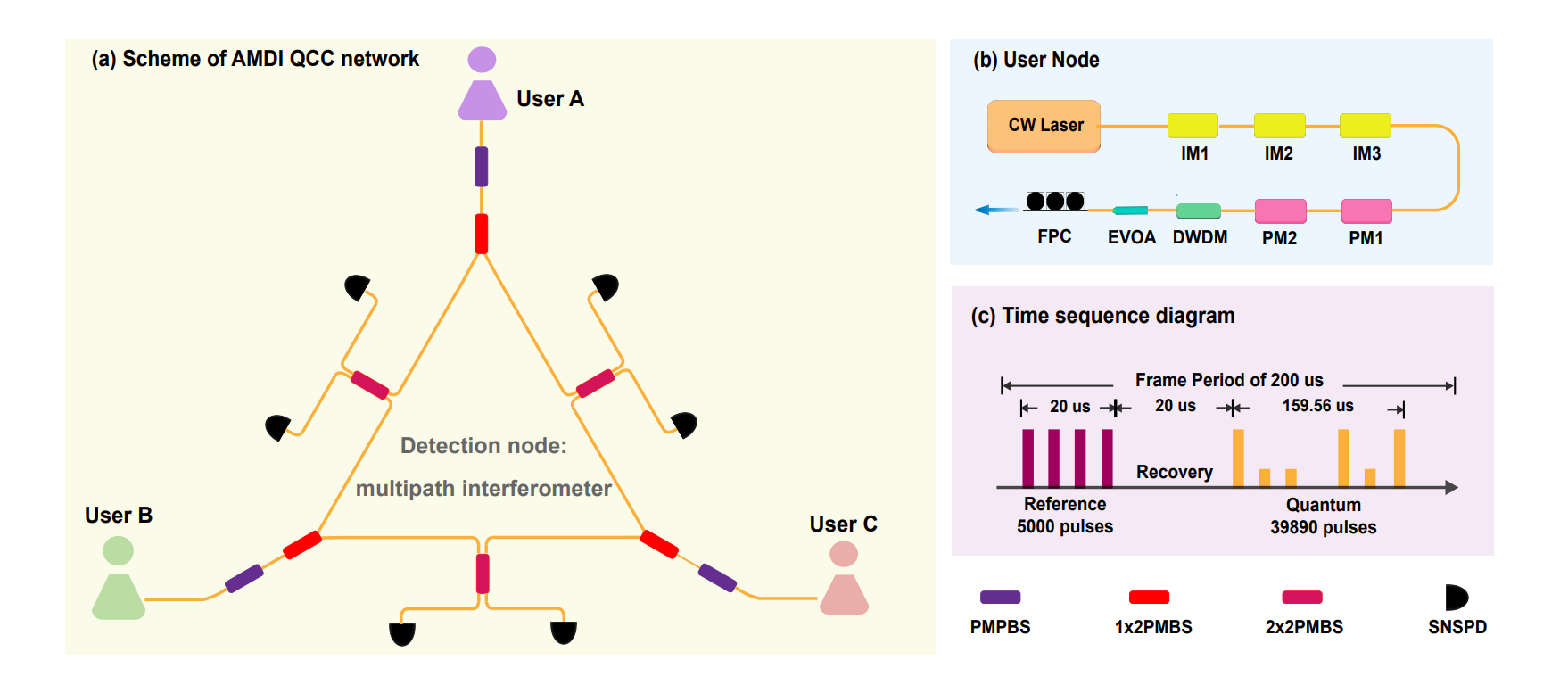
QCC).
A research team at Nanjing University, led by Professor Xiao-Song Ma, has experimentally demonstrated an Asynchronous Measurement-Device-Independent Quantum Cryptographic Conferencing (AMDI QCC) network across three independent user nodes. Detailed in a paper published in Physical Review Letters, the protocol resolves two major bottlenecks in multi-party quantum communication: scaling key generation rates over high optical channel losses and eliminating the need for active, complex global phase locking across independent lasers.
In conventional multi-user MDI quantum conferencing protocols, key generation relies on simultaneous multi-photon coincidence events across all N users, causing the key rate R to scale as O(ηN), where η represents single-user channel transmittance. The asynchronous mode-pairing protocol decoupling time-stamped single-photon detection events during classical post-processing fundamentally changes this scaling behavior to O(η)—rendering loss scaling independent of the total number of network participants. The experimental system tolerated a maximum total loss of 59.6 dB across the three-user network, delivering a secure key rate of 4.470 × 10-9 bits per pulse and expanding loss tolerance by more than 38 dB compared to prior polarization-encoded MDI conferencing setups.
| [ Nanjing University 3-User AMDI QCC Performance Benchmarks ] | ||
|---|---|---|
| Channel Loss Profile (dB) | Secure Key Rate (R, bits per pulse) | Key Technical Innovations |
| • 39.3 dB Total System Loss | • R = 3.940 × 10⁻⁸ bpp | • O(η) Scaling: Asynchronous single-photon mode pairing |
| • 48.6 dB Total System Loss | • R = 3.937 × 10⁻⁸ bpp | • FFT Frequency Drift Estimation: 0.4s interval tracking |
| • 59.6 dB Total System Loss | • R = 4.470 × 10⁻⁹ bpp | • Post-Phase Drift Compensation: Passive thermal stability |
To operate without global optical phase locking across free-running continuous-wave lasers, the team implemented a fast Fourier transform (FFT) algorithm on interleaved reference pulses to track inter-laser frequency differences and compensate for phase drift within the central GHZ multipath fiber interferometer. By transforming dynamical phase noise into software corrections during post-processing, the setup reduced the X-basis quantum bit error rate (QBER) from 50.02% to 40.76%, offering a practical, hardware-efficient path toward scaling intercity multi-party quantum networks.
Review the peer-reviewed study on Physical Review Letters here, read the open-access preprint on arXiv here, and inspect public data releases on EurekAlert! here.
In GQI Portal
The players behind the news
The team that writes QCR tracks every company, deal and technology in the GQI Factory, GQI's verified database of the quantum industry. Next up: every story linked to its players, coming to QCR's paid plans.
- Players Companies and institutions across the quantum industry, by segment.
- Scorecards How the players compare on hardware, software, funding and more.
Newsletter
QCR Alerts in your inbox
The latest reporting and analysis from Quantum Computing Report. Free, unsubscribe any time.