

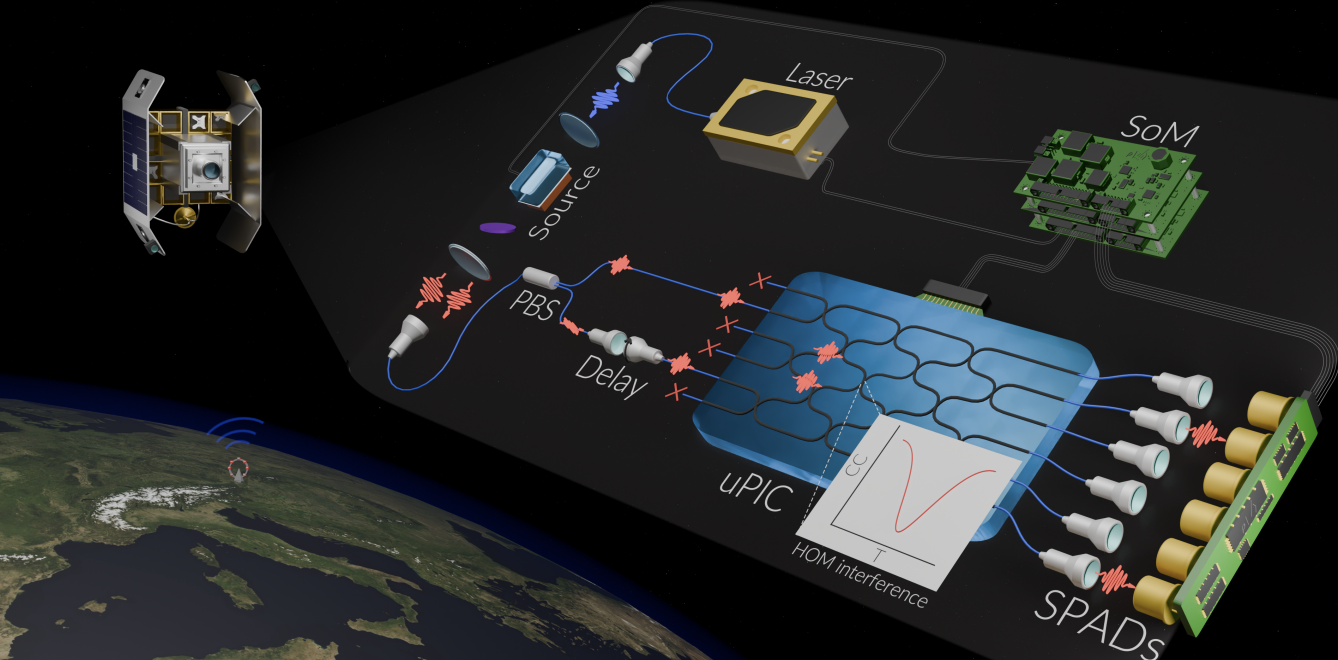
A research team led by the University of Vienna and the Vienna Center for Quantum Science and Technology (VCQ) has achieved the first demonstration of two-photon quantum interference and programmable matrix execution in low Earth orbit (LEO). Deployed aboard a 3U nanosatellite payload hosted on D-Orbit’s ION SCV platform (launched via SpaceX Transporter-14 to a 510 km sun-synchronous orbit), the experiment transitions spaceborne quantum hardware from state-distribution communications (such as satellite QKD) to active, on-board edge quantum processing.
Operating under strict Size, Weight, and Power (SWaP) constraints—weighing 9.8 kg, occupying a 15 cm × 15 cm × 45.3 cm footprint, and consuming 10 Watts—the hybrid system combines a 405 nm continuous-wave pumped spontaneous parametric down-conversion (SPDC) single-photon source, a 6-mode universal photonic integrated circuit (uPIC), and a passively quenched single-photon avalanche diode (SPAD) array. The femtosecond laser-written glass circuit incorporates 15 Mach-Zehnder interferometers (MZIs) driven by thermo-optic micro-heaters, enabling arbitrary 3 × 3 sub-unitary matrix programming with an average classical fidelity of 0.949. Over eight months in orbit, the payload successfully observed non-classical two-photon Hong-Ou-Mandel (HOM) interference (visibility = 0.908 ± 0.191) at a crystal degeneracy temperature of 32.5°C, proving that photon indistinguishability can be maintained amidst rocket launch vibrations, thermal cycling, and space radiation.
| [ Spaceborne Quantum Photonic Hardware Specifications & Orbital Benchmarks ] | ||
|---|---|---|
| Subsystem / Parameter | Hardware Specification | Orbital Operational Metrics |
| SWaP Envelope & Orbit | • Form Factor: 3U (15 cm × 15 cm × 45.3 cm) • Mass: 9.8 kg | Power: 10 W average | • LEO Altitude: 510 km Sun-Synchronous • Host: D-Orbit ION SCV (Transporter-14) |
| Photonic QPU Circuit | • 6-mode uPIC (15 thermal-phase MZIs) • Femtosecond laser-inscribed borosilicate glass | • Universal unitary fidelity: F = 0.949 • Phase shifter 2π dissipation: <11.5 mW |
| Source & Interference | • Type-II ppKTP SPDC photon-pair source (810 nm) • Active TEC & 1 cm AA7075 Al radiation shield | • HOM Visibility: V = 0.908 ± 0.191 • Degeneracy Point: 32.5°C crystal temp |
Developed alongside IFN-CNR Milano, DLR, and Politecnico di Milano, the project establishes the hardware primitive for onboard satellite image analysis and Earth-observation data reduction. By executing linear optical transformations passively in orbit, photonic processors can run onboard quantum machine learning inference to compress high-volume remote-sensing data prior to downlink, bypassing ground-transmission latency bottlenecks.
Review the research preprint on arXiv:2609.25248 here.
In GQI Portal
The players behind the news
The team that writes QCR tracks every company, deal and technology in the GQI Factory, GQI's verified database of the quantum industry. Next up: every story linked to its players, coming to QCR's paid plans.
- Players Companies and institutions across the quantum industry, by segment.
- Scorecards How the players compare on hardware, software, funding and more.
Newsletter
QCR Alerts in your inbox
The latest reporting and analysis from Quantum Computing Report. Free, unsubscribe any time.