

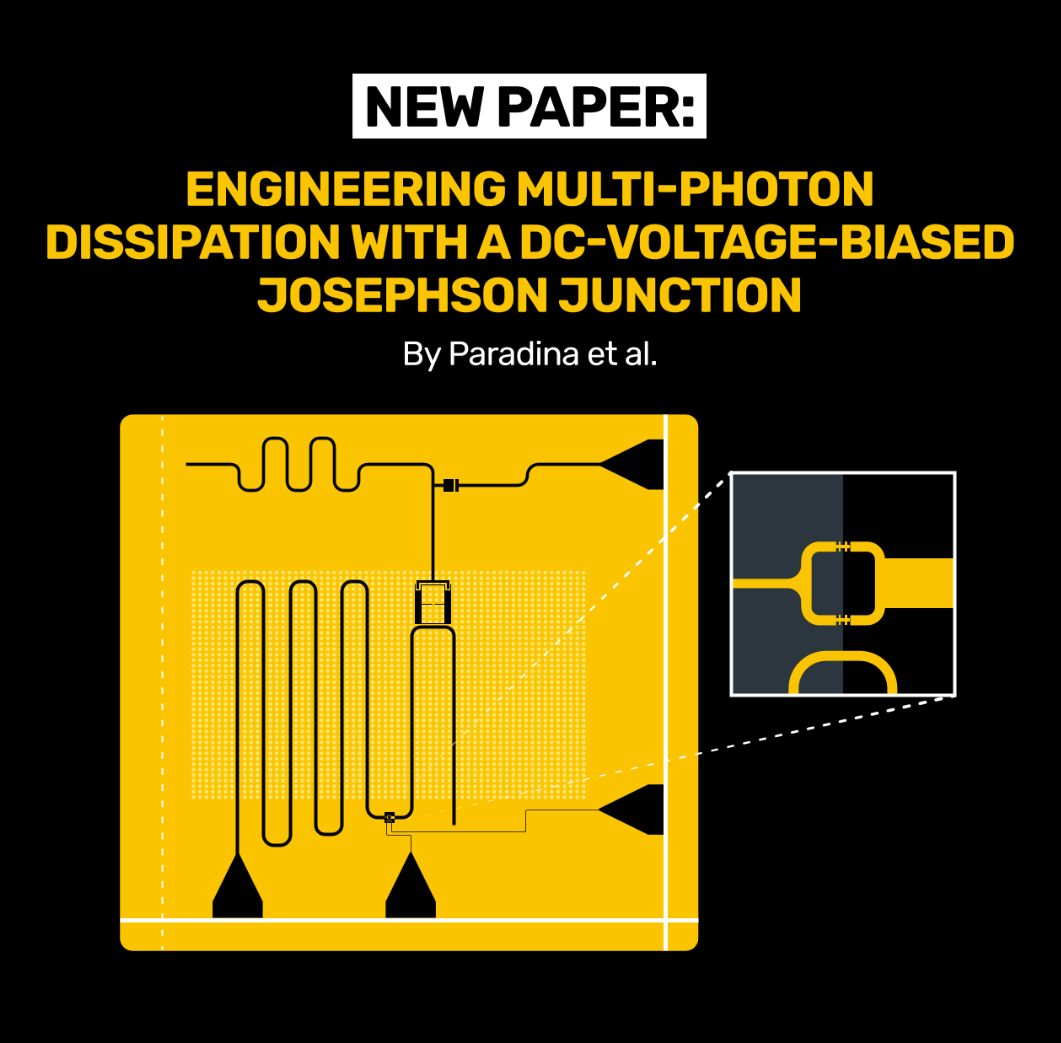
Fault-tolerant quantum hardware developer Alice & Bob, in collaboration with researchers at the École Normale Supérieure de Lyon (ENS Lyon), has published experimental results demonstrating a direct-current (DC) voltage-biased SQUID coupler to engineer multi-photon dissipation for cat-qubit stabilization. The physical architecture replaces traditional microwave parametric pump drives with a microvolt-scale DC voltage bias, eliminating drive-induced parasitic Kerr nonlinearities while providing a scalable control mechanism for superconducting bosonic codes.
In standard cat-qubit implementations, continuous two-photon dissipation is activated using strong microwave pump tones to remove photon pairs from a memory cavity into a lossy buffer mode. However, high-power microwave pumping introduces unwanted self-Kerr and cross-Kerr non-linear frequency shifts that degrade quantum state fidelity. By applying a steady DC voltage bias across the Josephson junction SQUID, tunneling Cooper pairs exchange discrete energy (2eV) matching the energy difference between memory and buffer photon states. Because the Josephson frequency rotates continuously, first-order parasitic Kerr terms and flux detunings average out dynamically.
The experimental setup couples a high-Q memory waveguide resonator (4.0429 GHz) to a lossy buffer resonator (7.56 GHz) through a flux-tunable SQUID. By tuning the DC voltage bias, the team demonstrated selective activation of 1-to-1, 2-to-1, and 4-to-1 photon conversion processes. Wigner state tomography confirmed deterministic pair-photon extraction, achieving a maximum two-photon swap rate of 18.2 MHz and an effective two-photon dissipation rate of 0.48 MHz.
| [ DC-Biased Josephson Junction Circuit Benchmarks & Operating Parameters ] | ||
|---|---|---|
| Circuit / Physical Parameter | Experimental Value & Operating Point | Engineering Impact & Architecture Implications |
| • 1-to-1 Photon Swap | • Coupling split 2g1 / 2π ≈ 85 MHz • Critical coupling rate g1 / 2π = 4.8 MHz | • Demonstrates strong memory-buffer hybridization without microwave drives |
| • 2-to-1 Photon Swap | • Effective dissipation rate κ2 / 2π = 0.48 MHz • Peak swap rate g2 / 2π = 18.2 MHz | • Autonomous two-photon extraction to stabilize cat-qubit error-correcting states |
| • Higher-Order Modes | • 4-to-1 photon conversion activated • Bias condition matching 4-photon transition | • Provides a direct physical pathway to four-component cat codes (four-legged cats) |
| • Kerr Nonlinearity Bounds | • Memory self-Kerr K / 2π < 3 kHz • Kerr terms average to zero at first order | • Suppresses drive-induced frequency shifts and phase-dephasing degradation |
| • On-Chip Filter Bandwidth | • 4-stage band-stop filter (2 GHz bandwidth) • Buffer decay rate κb / 2π = 85 MHz | • Isolates memory mode (1 kHz leakage) while enabling rapid buffer dissipation |
Replacing microwave lines with DC voltage bias wiring simplifies hardware layout and reduces cryostat heat loads inside dilution refrigerators. Furthermore, isolated 4-to-1 photon swaps enable four-component cat qubits—encoding information across four coherent states to increase error-protection capacity without complex multi-frequency microwave control schemes.
Review the full corporate announcement via the Alice & Bob Newsroom here, inspect the technical research manuscript on arXiv here, and examine our previous coverage on Alice & Bob’s Helium co-design research platform here.
In GQI Portal
The players behind the news
The team that writes QCR tracks every company, deal and technology in the GQI Factory, GQI's verified database of the quantum industry. Next up: every story linked to its players, coming to QCR's paid plans.
- Players Companies and institutions across the quantum industry, by segment.
- Scorecards How the players compare on hardware, software, funding and more.
Newsletter
QCR Alerts in your inbox
The latest reporting and analysis from Quantum Computing Report. Free, unsubscribe any time.