

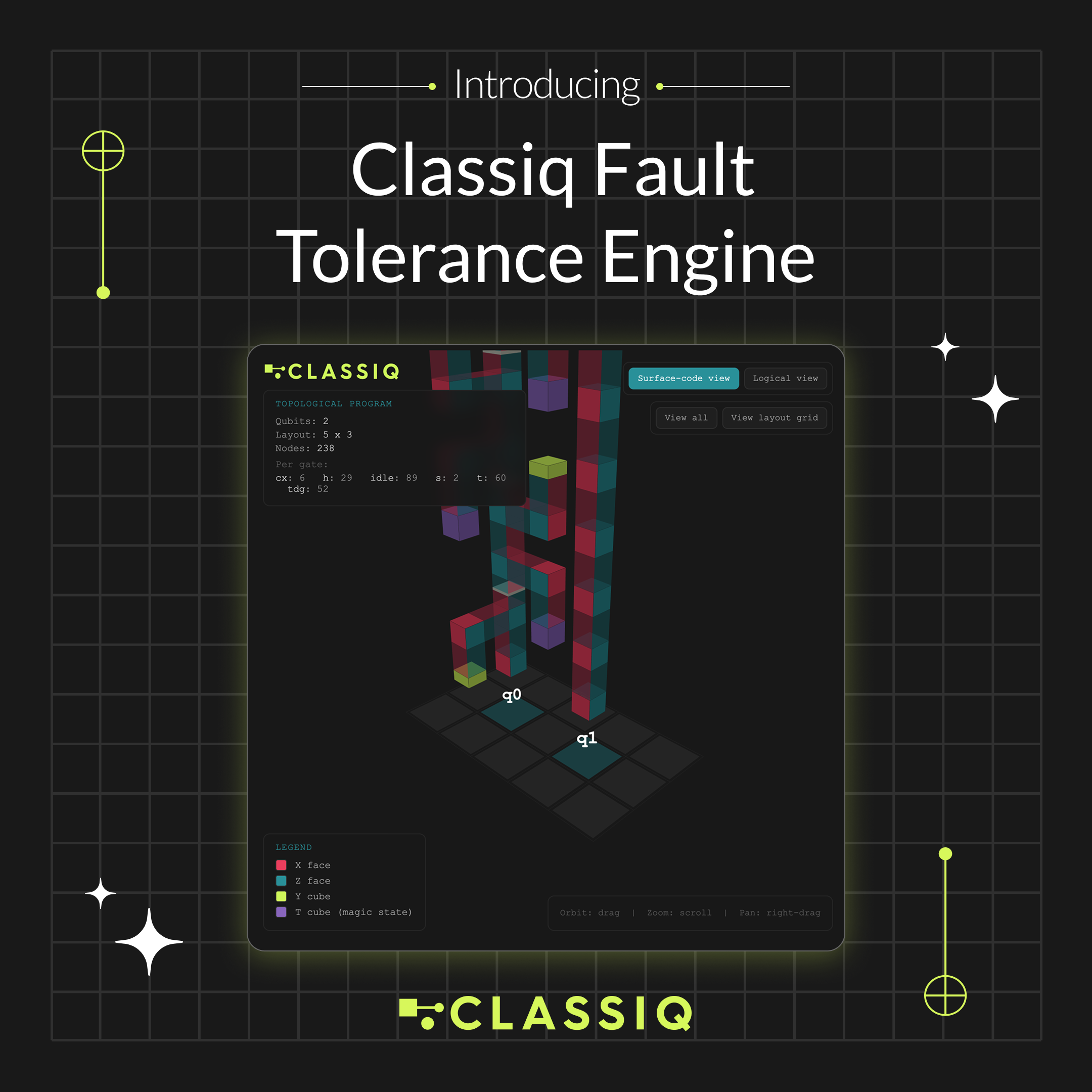
Quantum software synthesis provider Classiq has introduced its Fault Tolerance Engine, a compiler and translation suite integrated directly into the Classiq SDK. The tool maps high-level, optimized logical quantum circuits (written in Classiq’s Qmod language or Clifford+T QASM) into concrete, three-dimensional spatial-temporal execution plans across fault-tolerant quantum processing units (QPUs). By moving beyond static algorithmic resource formulas, the engine generates hardware-aware routing schedules, magic-state cultivation plans, and empirical physical qubit and error-rate estimates.
The Fault Tolerance Engine bridges high-level functional synthesis and physical quantum error correction (QEC). Logical circuits are mapped onto a 3D surface-code lattice where physical qubits are grouped into patches, and multi-qubit gates are executed via lattice surgery (merging and splitting patches over repeated syndrome extraction cycles). The engine automates 3D routing and scheduling for T-gate magic state cultivation alongside Clifford operations, producing an execution plan optimized to minimize total physical qubit overhead and total runtime.
| [ Classiq Fault Tolerance Engine Technical Specifications & Capabilities ] | ||
|---|---|---|
| Technical Domain | Engine Specification & Modality Scope | Strategic Architecture & Workflow Functions |
| • QEC Code Schemes | • Currently supported: 3D Surface Code • In active development: QLDPC codes & Color codes | • Maps logical qubits to spatial-temporal surface-code patches; automates lattice surgery routing |
| • Hardware Modalities | • Modality-agnostic across hardware supporting surface-code QEC (superconducting, neutral atoms, trapped ions, silicon spin) | • Integrates customizable physical noise models (1Q/2Q depolarizing, measurement, idle readout errors) |
| • Routing & Scalability Benchmarks | • Tensor hypercontraction chemistry workload: – 219 logical qubits – 2.5M–2.6M logical gates (~1.3M CX gates) – Routed in ~1 hour | • Evaluates physical qubit counts, code distance (d), total error-correction cycles, and magic state factory bottlenecks |
| • SDK Integration | • Native Qmod high-level modeling • Clifford+T transpilation export • Interactive 3D lattice surgery visualizer | • Evaluates total accumulated logical error across physical noise profiles prior to hardware availability |
According to technical clarifications provided by Classiq QEC Team Lead Ron Cohen and executive team members, the engine currently targets 3D surface-code schemes across all compatible physical qubit hardware modalities. Development is underway to extend support to Quantum Low-Density Parity-Check (QLDPC) and color codes. By providing complete execution plans for large-scale workloads, the engine allows application developers and hardware design teams to identify physical resource bottlenecks, optimize code distance parameters, and determine real-world hardware requirements prior to fault-tolerant QPU availability.
Review the primary release announcement here, read the technical insight blog here, access the end-to-end tutorial notebook here, inspect the user guide here, and examine the SDK reference manual here.
In GQI Portal
The players behind the news
The team that writes QCR tracks every company, deal and technology in the GQI Factory, GQI's verified database of the quantum industry. Next up: every story linked to its players, coming to QCR's paid plans.
- Players Companies and institutions across the quantum industry, by segment.
- Scorecards How the players compare on hardware, software, funding and more.
Newsletter
QCR Alerts in your inbox
The latest reporting and analysis from Quantum Computing Report. Free, unsubscribe any time.