

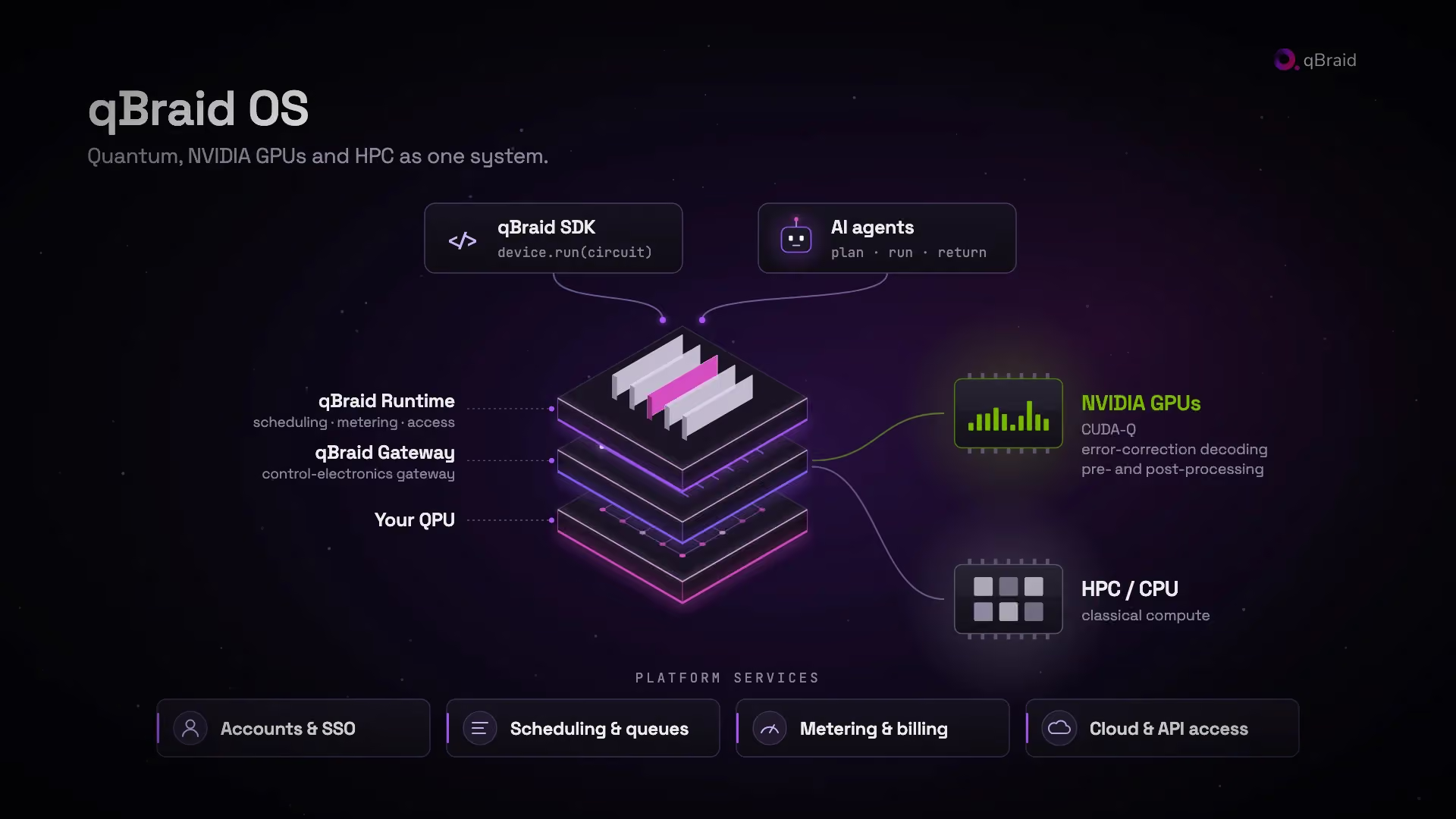
Quantum cloud orchestration platform qBraid has introduced qBraid OS, an agentic operating system designed for quantum hardware manufacturers and supercomputing centers to manage, schedule, and operate quantum processing units (QPUs). Unveiled at NVIDIA GTC Berlin, the software bridges physical quantum processors with CPU and GPU supercomputing clusters using the NVIDIA CUDA-Q platform and low-latency NVIDIA NVQLink interconnects.
In tandem, qBraid launched two hosted GPU-accelerated quantum simulators running on NVIDIA GH200 Grace Hopper Superchips in its Leo cluster: an exact state-vector simulator (`gpu-sv`) supporting up to 35 qubits and a tensor-network simulator (`gpu-tn`) supporting weakly entangled circuits up to 500 qubits.
| [ qBraid OS Architecture & Hosted GPU Simulator Capabilities ] | |||
|---|---|---|---|
| Product / Module | Underlying Infrastructure | Core Technical Function | Target User / Endpoint |
| • qBraid OS | • qBraid Runtime & Gateway + NVIDIA CUDA-Q / NVQLink | • Manages QPU job scheduling, user reservations, metering, billing, and real-time sub-millisecond QEC decoding. | • Hardware vendors (Early access: Diraq, Quobly, IBM, MemQ, Quantum Machines, Equal1, IonQ). |
| • gpu-sv Simulator (`qbraid:qbraid:sim:gpu-sv`) | • NVIDIA GH200 Grace Hopper (cuStateVec + Grace CPU Memory) | • Exact state-vector simulation up to 35 qubits in single precision (34 in double precision); 60x faster than 32-core CPU at 32 qubits. | • Enterprise algorithm validation before physical QPU submission. |
| • gpu-tn Simulator (`qbraid:qbraid:sim:gpu-tn`) | • NVIDIA GH200 Grace Hopper (cuTensorNet / MPS & Exact) | • Matrix product state (MPS, default bond dimension 64) and exact tensor contraction up to 500 qubits. | • Researchers evaluating wide, low-entanglement circuits (e.g., GHZ states). |
qBraid OS Platform Infrastructure and GPU Simulation Benchmarks
Developed to replace fragmented, custom-built quantum control stacks, qBraid OS provides an integrated operational framework spanning account management, job queue scheduling, usage metering, and control-electronics interfaces. By integrating NVIDIA CUDA-Q and NVQLink, qBraid OS enables classical GPU nodes to perform real-time quantum error-correction (QEC) decoding and classical co-processing during active QPU execution cycles. Operational workflows and system setup can be automated via AI coding agents within operator-defined permission boundaries.
Complementing the operating system release, qBraid’s hosted GPU simulators deliver significant performance gains over classical CPU execution. On a 32-qubit random circuit (20 layers deep), the `gpu-sv` state-vector simulator executed in 2.7 seconds on a GH200 node compared to 2 minutes 43 seconds across 32 CPU server cores. To extend state-vector simulation beyond the GPU’s 96 GB HBM3 memory limit (which caps out at 33 qubits in single precision), `gpu-sv` leverages the GH200 superchip’s high-speed CPU-to-GPU coherent interconnect to store remaining amplitudes directly in the 72-core Grace CPU’s RAM, reaching 35 qubits without manual configuration.
For circuits exceeding 35 qubits, `gpu-tn` uses matrix product state (MPS) representations to scale up to 500 qubits, dropping low-weight entanglement contributions when bond dimensions exceed configurable thresholds (`maxBondDim`). Developers can access both simulators using OpenQASM 2, OpenQASM 3, or native Qiskit circuits via the standard `QbraidProvider` SDK.
Review the operating system launch on the qBraid Pressroom here, read the product announcement on qBraid Insights here, inspect technical specifications on qBraid OS Portal here, examine the simulator launch on qBraid Blog here, review simulator device options on qBraid GPU-SV Portal here and qBraid GPU-TN Portal here, and consult developer documentation on qBraid Docs here.
In GQI Portal
The players behind the news
The team that writes QCR tracks every company, deal and technology in the GQI Factory, GQI's verified database of the quantum industry. Next up: every story linked to its players, coming to QCR's paid plans.
- Players Companies and institutions across the quantum industry, by segment.
- Scorecards How the players compare on hardware, software, funding and more.
Newsletter
QCR Alerts in your inbox
The latest reporting and analysis from Quantum Computing Report. Free, unsubscribe any time.