

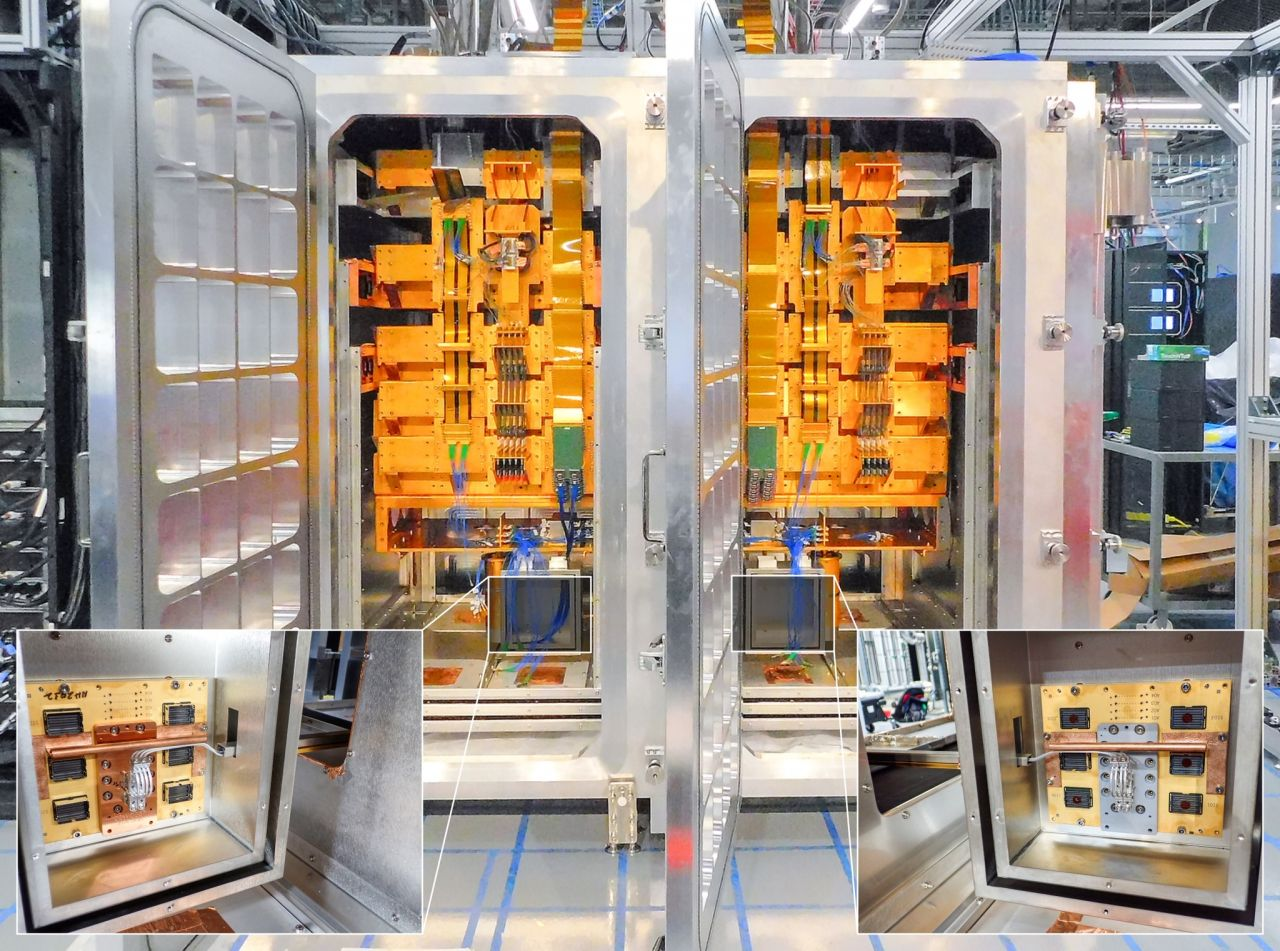
IBM Quantum has demonstrated a crucial engineering milestone on its path toward modular fault-tolerant quantum computing, operating four meter-scale cryogenic quantum interconnects—designated L-couplers—between two full 120-qubit IBM Quantum Nighthawk R1 superconducting processors. Detailed in an arXiv preprint and an accompanying IBM Research technical overview, the deployment achieved an average inter-chip quantum state transfer fidelity of 99.00% (peaking at 99.29%) and supported inter-processor distant CZ entangling gates averaging 94.75% fidelity.
While previous academic and industrial demonstrations have linked few-qubit superconducting chips on laboratory benches, IBM’s implementation represents the first multi-channel, meter-scale interconnect architecture engineered specifically for the mechanical and thermal constraints of large, production-grade quantum processors mounted inside shared dilution refrigerators. The modular architecture serves as the physical backbone for IBM’s upcoming fault-tolerant processor, IBM Quantum Starling, planned for 2029.
| [ IBM L-Coupler Interconnect: Architecture & Benchmark Performance ] | ||
|---|---|---|
| System Parameter | Engineering Implementation | Benchmark Metric & Performance |
| • Physical Interconnect | • 80 cm aluminum-aluminum coax with low-density PTFE (Hqubit System) | • Operates near 5 GHz; standing mode internal quality factor (Qi) averages 0.94 × 10⁶ (single test cable reached 2.0 × 10⁶). |
| • Packaging & Assembly | • Perpendicular cable-to-chip join via room-temperature indium-to-indium pressure bonds | • Installed after modules are mounted in cryostat using spring-loaded holders; survived three full thermal cycles without degradation. |
| • Coupler Circuitry | • Dedicated frequency-tunable “L-qubits” and “i2m” inductive RF-SQUID couplers | • Negative geometric mutual inductance (M0) makes the off-state coupling first-order flux insensitive, suppressing idling dephasing. |
| • State Transfer Fidelity | • Relay-based state transfer protocol benchmarked via Network Benchmarking (NB) | • Mean transfer fidelity across 4 links: 99.00% (best link: 99.29 ± 0.07%); coherence model shows 77% of error driven by L-qubit dephasing. |
| • Distant Two-Qubit Gates | • Inter-module CZ gates composed of 2 state transfers, 3 local CZs, and 4 single-qubit gates | • Mean distant CZ fidelity: 94.75% (best link: 96.42 ± 0.28%); enabled simultaneous Bell-pair generation on adjacent links. |
| • Multipartite Entanglement | • Inter-module Greenberger-Horne-Zeilinger (GHZ) state distribution | • 4-qubit GHZ state across chips: 77.2% raw (91.7% mitigated); 6-qubit GHZ ring state: 67.7% raw (90.9% mitigated). |
Engineering for Assembly: Perpendicular Indium Joins and Cooldown Shielding
A primary bottleneck in multi-chip superconducting scaling has been mechanical: traditional wire-bonding and horizontal planar connectors consume valuable chip perimeter, preventing dense two-dimensional packing. IBM solved this by developing a perpendicular cable-to-chip mating geometry. Aluminum coaxial lines are mounted using spring-loaded fixtures that apply an indium-to-indium pressure bond directly to the chip surface at room temperature after both processor payloads are secured inside the cryostat.
The researchers also identified a critical, previously undocumented loss mechanism: ambient magnetic fields present while aluminum cables cool through their superconducting transition temperature (Tc ≈ 1.2 K) freeze trapped magnetic flux into the coax. In uncontrolled fields, cable Qi degraded by a factor of six (from 1.5 × 10⁶ at zero field down to 2.5 × 10⁵ at 14 Gauss). IBM mitigated this degradation by jacketing the coax lines in multi-layer high-permeability magnetic shielding braids, preserving internal quality factors near 106 in operational environments.
Deconstructing the Gate Fidelity Trade-Off
While the 99.00% state transfer fidelity represents a best-in-class benchmark for meter-scale superconducting links, the resulting distant two-qubit CZ gate fidelity (averaging 94.75%) is lower than typical on-chip transmon gates (~99.5%).
This gap is primarily an architectural trade-off resulting from the use of buffer qubits. In this prototype, Nighthawk lattice qubits did not connect directly to the cable; instead, each distant CZ operation required transferring quantum information from a lattice qubit to an auxiliary tunable “L-qubit,” executing the cable transfer, and reversing the operation on the second module. A constituent error budget demonstrates that two state transfers (accounting for 53% of total error) and three local CZ gates (40% of error) compound to create the gate infidelity.
IBM noted that these dedicated L-qubits were fabricated without standard coherence-optimization steps to expedite development cycles, with L-qubit dephasing driving over 56% to 76% of the modeled transfer error. By integrating L-coupler junctions directly into native lattice qubits and extending L-qubit lifetimes to 100 μs, IBM projects state transfer errors can drop below 10−3, pushing distant CZ fidelities above 99%.
Strategic Implications for Starling and Modular Fault Tolerance
In fault-tolerant architectures utilizing quantum Low-Density Parity-Check (qLDPC) or bivariate bicycle codes, sparse long-range interconnects do not require the ultra-high gate fidelities of internal nearest-neighbor lattices. Theoretical analysis indicates that modular architectures can comfortably tolerate inter-module link error rates that are up to an order of magnitude higher than internal gates while still reducing the overall physical qubit overhead of error correction by an order of magnitude.
By validating that multiple high-coherence links can be assembled post-mounting, survive repeated thermal cycling, and operate simultaneously without cross-link interference, IBM has demonstrated the foundational physical connectivity required to transition from monolithic processors to distributed quantum supercomputers.
Review the complete research paper on the arXiv repository here, explore the technical breakdown via the IBM Quantum Research Blog here, and view executive commentary on Jay Gambetta’s LinkedIn briefing here.
In GQI Portal
The players behind the news
The team that writes QCR tracks every company, deal and technology in the GQI Factory, GQI's verified database of the quantum industry. Next up: every story linked to its players, coming to QCR's paid plans.
- Players Companies and institutions across the quantum industry, by segment.
- Scorecards How the players compare on hardware, software, funding and more.
Newsletter
QCR Alerts in your inbox
The latest reporting and analysis from Quantum Computing Report. Free, unsubscribe any time.