

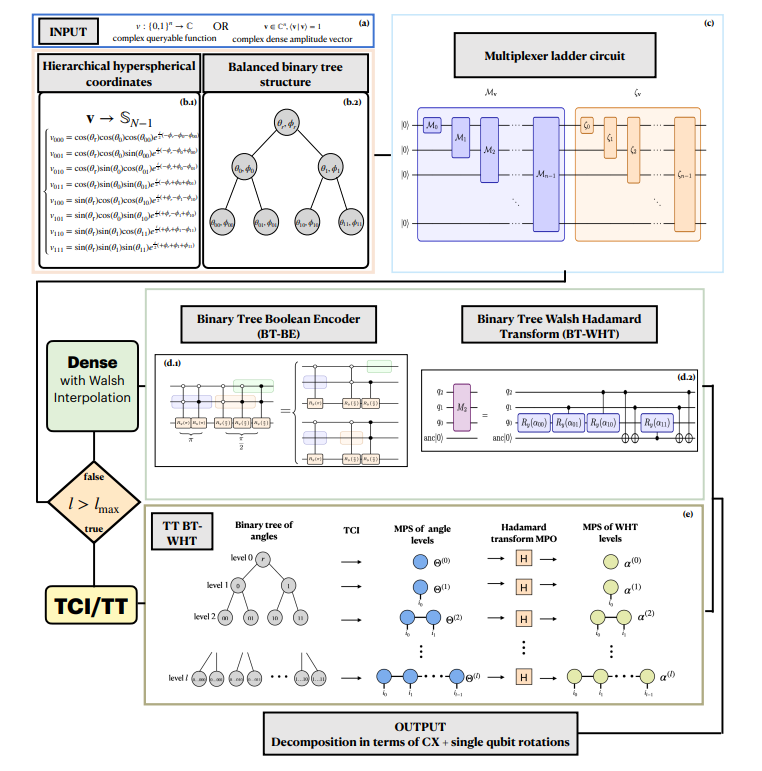
Researchers at the German Aerospace Center (DLR) Institute of Software Technology and the University of Cologne have introduced a deterministic quantum state-preparation framework to mitigate the exponential circuit-depth bottleneck inherent to classical data loading. Published on arXiv in the paper “Scalable Unitary State-Encoding for Generic Large Data,” the architecture combines tensor-network representations with Boolean logic minimization and Walsh–Hadamard transformations, reducing two-qubit gate depth by up to two orders of magnitude compared to standard multiplexer compilers and achieving sub-linear depth scaling across structured function classes.
| DLR Scalable State-Encoding Architecture & Benchmark Profile | ||
|---|---|---|
| Module / Benchmark | Technical Specification | Operational Function & Scaling Impact |
| Angle Hierarchy | Hierarchical hyperspherical coordinates over balanced binary trees | Parametrizes arbitrary complex states into l-controlled multiplexer layers; prunes zero-norm subtrees to compress angle volume. |
| BT-BE Algorithm | Finite-precision basis projection mapped to Disjoint Sum of Products (DSOP) logic | Eliminates redundant controls across identical rotation angles; synthesizes multi-controlled rotations via clean-ancilla Toffoli ladders. |
| BT-WHT Algorithm | Walsh–Hadamard transform (WHT) decomposed via a single clean ancilla | Extracts dominant spectral components; executes controlled rotations through parity CNOT ladders ordered by greedy Hamming cycles. |
| Memory Compression | Tensor Cross Interpolation (TCI) over Tensor Train / Matrix Product State (MPS) | Reduces classical memory scaling from O(2l) to O(2lχ2) for bond dimension χ; enables encoding of out-of-core queryable datasets up to 36 qubits. |
| Physical QPU Validation | IQM Emerald (20 qubits, square-lattice superconducting architecture) | Executes 2D Gaussian state encoding at total circuit depth 56 (CZ depth 26); measures state infidelity I = 0.011 ± 0.002 across 256,000 shots. |
Data loading represents a structural bottleneck for algorithms that rely on state initialization, including the Harrow-Hassidim-Lloyd (HHL) linear solver, quantum partial differential equation (PDE) integration, and quantum machine learning models. Exact state preparation for generic data is theoretically lower-bounded by a gate depth of Θ(2n/n) on n qubits, a threshold that rapidly exceeds hardware coherence budgets before computation begins. Existing compilers mitigate this only by introducing exponential ancilla overheads or non-deterministic measurement loops.
The DLR framework circumvents exponential depth limits by permitting bounded, tunable infidelities across continuous and discrete data profiles. For shallow multiplexer layers, the pipeline applies BT-BE to minimize multi-controlled rotation counts through Boolean logic heuristics. For deeper layers, BT-WHT truncates the high-frequency spectral tail of the rotation angles, executing the surviving coefficients along an optimized Hamming path. When operating on complex high-dimensional datasets, Tensor Cross Interpolation samples the angle tree directly to construct MPS representations without populating dense arrays.
In comparative benchmarks across Lorentzian, polynomial, and financial jump-diffusion distributions, the hybridized compiler demonstrated asymptotic depth plateaus at fixed infidelity levels (~5 × 10⁻³), breaking the exponential scaling curves produced by standard state-preparation tools in Qiskit. Hardware-level viability was confirmed on the 20-qubit IQM Emerald processor, where a compiled 2D Gaussian distribution operated within coherence limits (median T1 = 48.96 μs, median T2 = 14.78 μs) under Pauli twirling and dynamical decoupling.
Algorithmic formulations, circuit proofs, and benchmark datasets are available in the technical paper here.
In GQI Portal
The players behind the news
The team that writes QCR tracks every company, deal and technology in the GQI Factory, GQI's verified database of the quantum industry. Next up: every story linked to its players, coming to QCR's paid plans.
- Players Companies and institutions across the quantum industry, by segment.
- Scorecards How the players compare on hardware, software, funding and more.
Newsletter
QCR Alerts in your inbox
The latest reporting and analysis from Quantum Computing Report. Free, unsubscribe any time.