

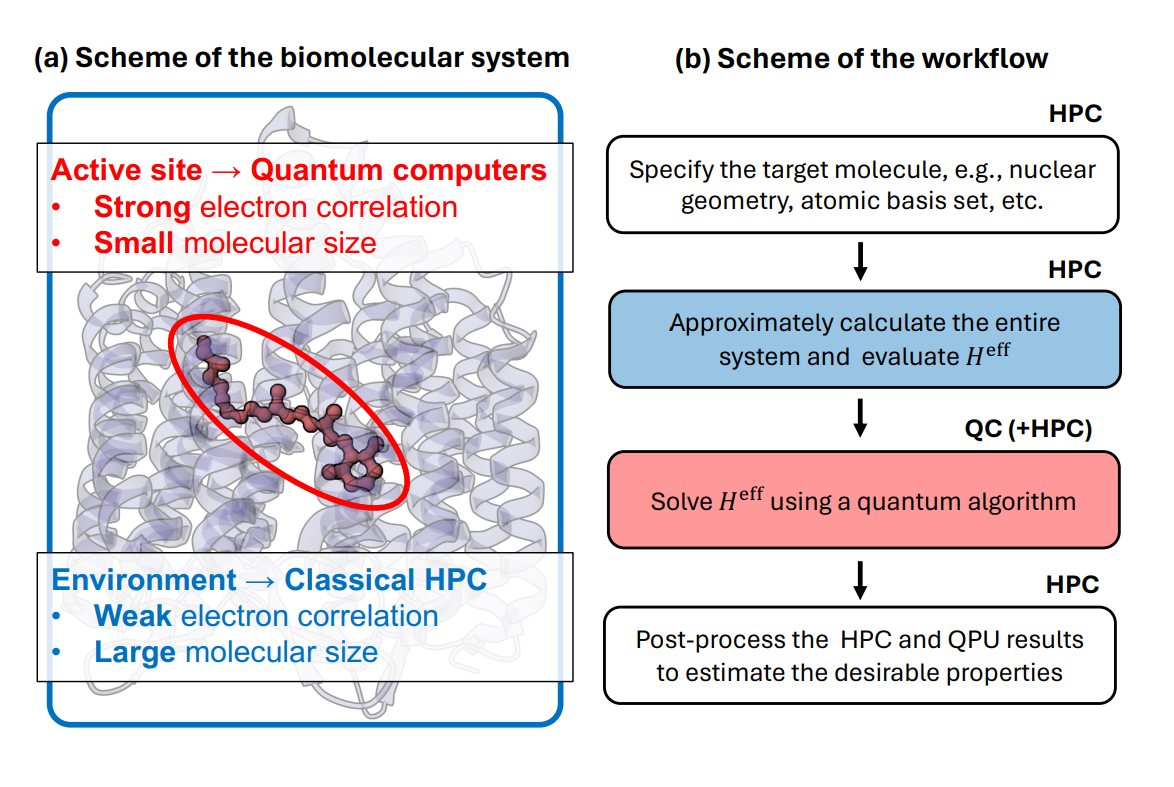
Quantinuum and RIKEN have demonstrated an integrated quantum-classical workflow linking Japan’s flagship supercomputer, Fugaku, with Quantinuum’s on-premises Reimei trapped-ion quantum processor. Detailed in an arXiv preprint titled “Quantum-HPC hybrid computation of biomolecular excited-state energies,” the collaboration executed a layered electronic-structure calculation simulating biomolecular excited states, integrating high-performance classical nodes with a physical quantum coprocessor via direct-access APIs.
| Fugaku-Reimei Hybrid Quantum-HPC Architecture & Benchmark Profile | ||
|---|---|---|
| System Dimension | Technical Specification | Operational Role & Performance Metrics |
| Classical Infrastructure | Supercomputer Fugaku (96 A64FX compute nodes) | Executes geometry optimization, Hartree–Fock, and configuration interaction singles via the NTChem suite. |
| Quantum Coprocessor | Quantinuum Reimei (20 trapped-ion physical qubits) | Deploys 16 logical qubits with all-to-all connectivity installed on-site at RIKEN. |
| Workflow Orchestration | Tierkreis dataflow framework with TKET compilation | Manages asynchronous job scheduling between Fugaku’s workload manager and Reimei’s direct-access API. |
| Chemical Model | Subtractive ONIOM (QM1/QM2) partitioning | Separates weakly correlated environmental modes (carbon nanotube wall) from the strongly correlated active site (retinal). |
| Quantum Algorithm | Time-Evolved Quantum Selected CI (TE-QSCI) | Samples Krylov subspace configurations under Trotterized time evolution to expand classical active-space baselines. |
| Error Detection | [[18, 16, 2]] “iceberg” code with post-selection | Detects weight-one errors with a 67.9% average survival rate across 12,214 physical measurement shots. |
| Target Accuracy | Excited-state fidelity ≥ 0.995 (S1 and T0) | Reduces classical baseline excitation energy errors from 0.18 eV down to 0.03 eV relative to full CASCI(8,8). |
Simulating complex chemical reactions—such as photoisomerization in visual reception and enzyme catalysis—presents a structural divide: the reactive active site exhibits strong multiconfigurational electron correlation requiring high-level quantum mechanical treatment, while the surrounding molecular scaffolding is large but weakly correlated. The project, commissioned under the New Energy and Industrial Technology Development Organization (NEDO) initiative, resolved this boundary by pairing classical supercomputing with quantum coprocessing inside the ONIOM (Our own N-layered Integrated molecular Orbital and Molecular mechanics) computational framework.
In this workflow, 96 Fugaku nodes performed initial molecular geometry optimizations and evaluated baseline environment energy contributions for a retinal molecule embedded in a carbon nanotube matrix. To compute the strongly correlated active site, the system deployed TE-QSCI on Reimei. Rather than relying on single-reference ansatz states, the algorithm initialized an approximate complete active space wavefunction on 16 logical qubits and evolved it under the target electronic Hamiltonian. This process sampled electronic configurations across higher-order Krylov subspaces that were subsequently returned to Fugaku for subspace Hamiltonian matrix diagonalization.
Logical circuits were protected using an [[18, 16, 2]] error-detection code, filtering weight-one faults through measurement post-selection. Out of 12,214 shots, TE-QSCI identified 2,149 new electronic configurations outside the initial classical active space, accurately capturing the leading six configurations of the full CASCI(8,8) reference. The resulting eigenstate fidelities reached 0.994 for the singlet ground state (S0), 0.995 for the first singlet excited state (S1), and 0.996 for the triplet ground state (T0), aligning excitation energies within 0.03 eV of exact benchmarks.
The implementation replaces cloud-based multi-tenant job queues with direct API orchestration, demonstrating coordinated job scheduling, error-detected execution, and hybrid data interchange across an active national supercomputing center.
Technical details and experimental datasets are available in the research preprint here and through Quantinuum’s Technical Brief here.
In GQI Portal
The players behind the news
The team that writes QCR tracks every company, deal and technology in the GQI Factory, GQI's verified database of the quantum industry. Next up: every story linked to its players, coming to QCR's paid plans.
- Players Companies and institutions across the quantum industry, by segment.
- Scorecards How the players compare on hardware, software, funding and more.
Newsletter
QCR Alerts in your inbox
The latest reporting and analysis from Quantum Computing Report. Free, unsubscribe any time.