

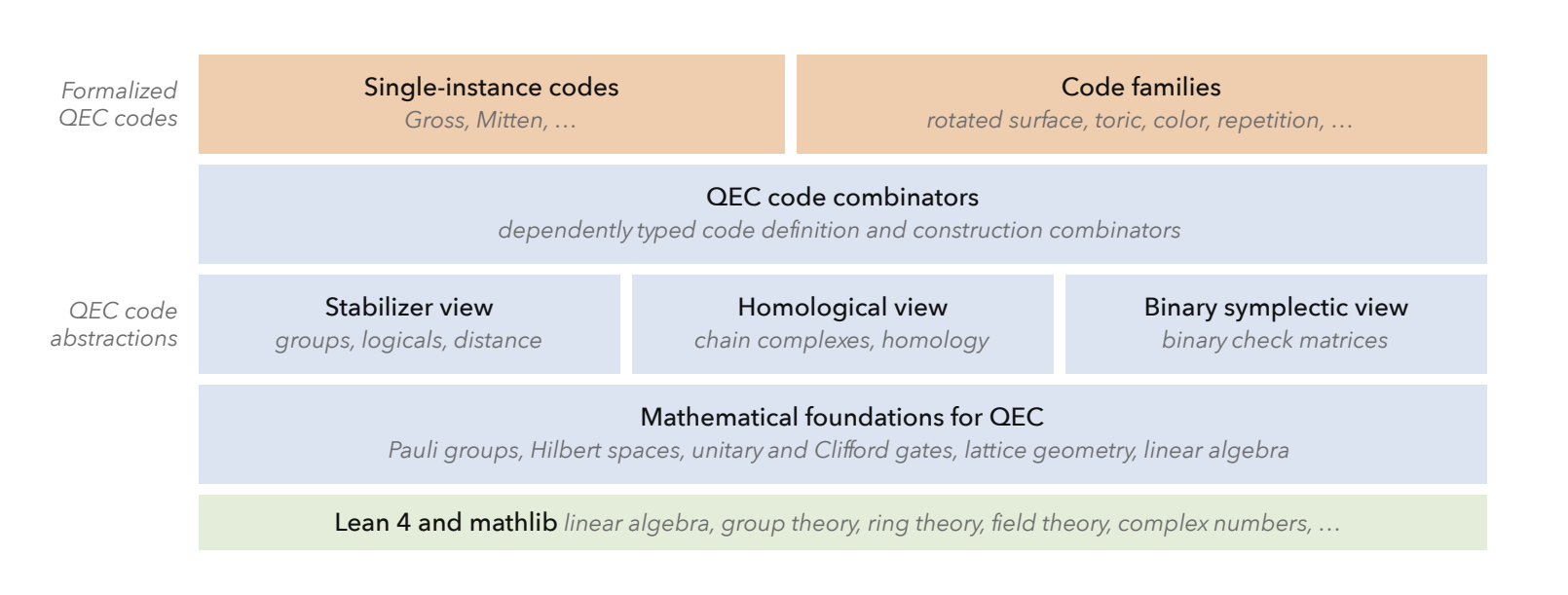
Researchers from the University of Wisconsin-Madison and the University of Arizona (alongside QEC Labs) have introduced QECLean, an open-source formal verification framework built on the Lean 4 proof assistant to mechanically prove the parameters of quantum error-correcting (QEC) codes. Detailed in a technical preprint following a tutorial at IEEE Quantum Week 2026, the library addresses the growing challenge of verifying complex, algorithmically discovered QEC codes whose code distances are often too large for brute-force enumeration or constraint solvers.
| Quantum Error-Correcting Codes Formally Verified in QECLean | ||
|---|---|---|
| Code or Infinite Code Family | Verified Parameters [[n, k, d]] | Verification Approach & Significance |
| IBM 360-Qubit Bivariate Bicycle Code | [[360, 12, 24]] | Proved exact distance 24 via double-cover combinators (previously known only as an upper bound ≤ 24). |
| IBM Gross Code (Bivariate Bicycle) | [[144, 12, 12]] | Verified as a double cover of a [[72, 12, 6]] base code using kernel-checked certificates. |
| Oratomic Mitten Code | [[150, 30, 10]] | Verified high-rate (1/5) non-abelian lifted-product code via homological chain complexes. |
| Rotated Surface Code Family | [[L2, 1, L]] (odd L ≥ 3) | First machine-checked parametric distance proof across an infinite planar code family. |
| Toric & Triangular Color Families | [[2L2, 2, L]] and [[3r(r+1)+1, 1, 2r+1]] | Parametrically verified via homological wrapping invariants and boundary maps. |
Because computing minimum code distance is NP-hard in general, conventional integer linear programming and satisfiability solvers typically stall on codes with distances above 18 and cannot certify infinite code families. QECLean bridges this gap by linking three mathematical representations within Lean’s dependent type system: stabilizer groups, binary symplectic check matrices, and homological chain complexes, allowing researchers to specify a code once and prove each property in the most tractable representation.
To scale verification to large quantum low-density parity-check (qLDPC) architectures, Stavan Jain, Nithin Raveendran, and Aws Albarghouthi developed compositional code combinators, including a generalized double-cover combinator that derives the distance of a 2n-qubit lifted code from an n-qubit base code. While the current release verifies algebraic code distance rather than physical circuit-level fault tolerance or noise thresholds, the framework comprises roughly 57,000 lines of Lean code and 312,000 lines of kernel-checked certificates designed to validate AI-discovered codes and future verified quantum compilers.
Read the full research paper on arXiv here, access the open-source QECLean repository on GitHub here, and view the IEEE Quantum Week 2026 tutorial materials here.
In GQI Portal
The players behind the news
The team that writes QCR tracks every company, deal and technology in the GQI Factory, GQI's verified database of the quantum industry. Next up: every story linked to its players, coming to QCR's paid plans.
- Players Companies and institutions across the quantum industry, by segment.
- Scorecards How the players compare on hardware, software, funding and more.
Newsletter
QCR Alerts in your inbox
The latest reporting and analysis from Quantum Computing Report. Free, unsubscribe any time.