
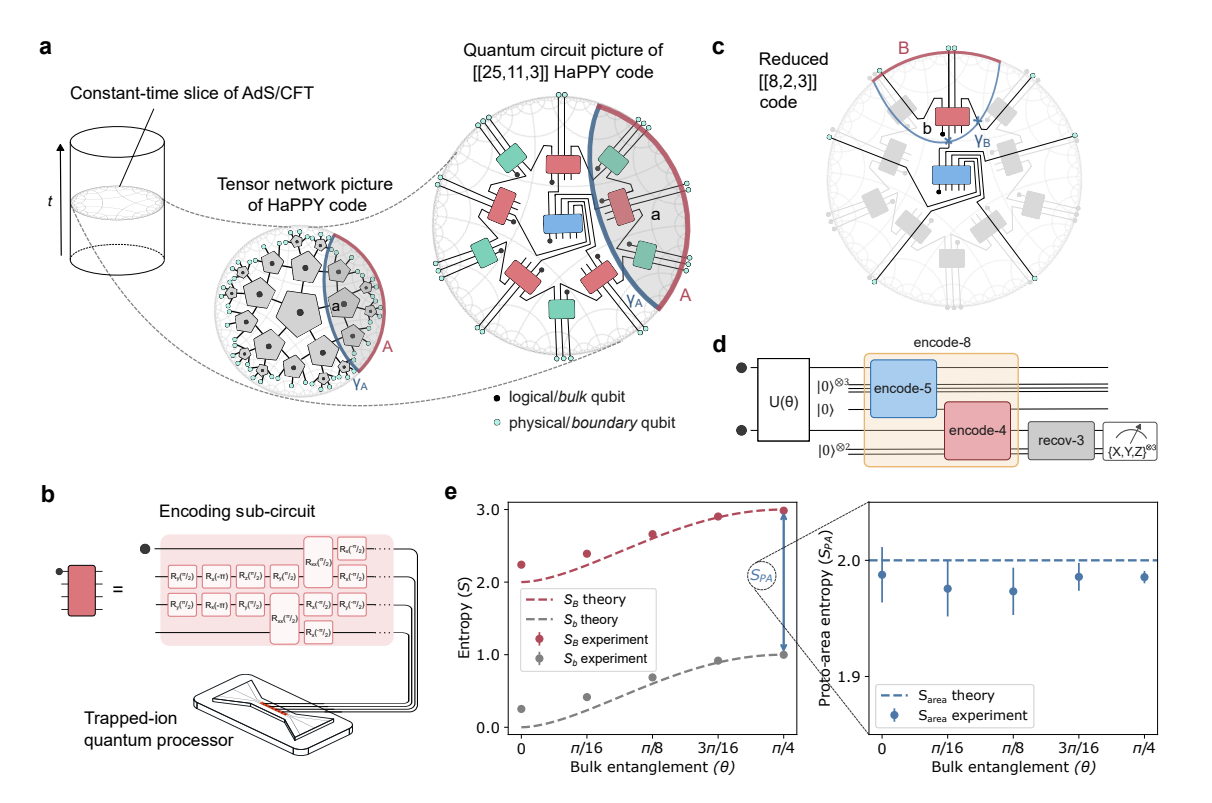
Researchers from Duke University, Virginia Tech, the University of Maryland (QLab), BlueQubit, IonQ, and Caltech have experimentally realized stabilizer and non-stabilizer holographic quantum error-correcting codes on IonQ’s Forte trapped-ion quantum processor, observing entropy signatures analogous to gravitational backreaction and wormhole connectivity. By exploiting the isometric structure of the two-layer 25-qubit Harlow-Pastawski-Preskill-Yoshida (HaPPY) code to compress boundary-subregion measurements into resource-efficient 8-, 10-, and 16-qubit circuits, the team demonstrated how programmable quantum hardware can serve as an experimental testbed for emergent spacetime models under the AdS/CFT correspondence.
| Holographic HaPPY Code Trapped-Ion Experiments (IonQ Forte-1) | |
|---|---|
| Experimental Protocol | Code Configuration & Measured Holographic Signature |
| FLM Formula Verification | Isometrically reduced [[8, 2, 3]] stabilizer HaPPY code (23 native ZZ gates; 2,100 shots/Pauli basis); confirms state-independent proto-area entropy SPA ≈ 2 bits across bulk entanglement θ ∈ [0, π/4] |
| Single-Copy Magic Enrichment | Non-Clifford gate angle offsets (total magic M = 2.23 and 5.79) induce positive slope in SPA(θ), modeling state-dependent gravitational backreaction on minimal surface area |
| Two-Sided Wormhole Analogues | Coupled 10-qubit (2 × [[5, 1, 3]], up to 31 ZZ gates) and 16-qubit (2 × [[8, 2, 3]], up to 56 ZZ gates, M = 1.95) codes show decreasing SPA(θ) as inter-code bulk entanglement increases |
| Hardware & Compilation | IonQ Forte-1 trapped-ion QPU (mean cumulative 2Q ZZ fidelity 0.9960–0.9966); custom compiler cuts single-qubit gate counts by ≥60% over standard Qiskit transpilation |
In their first experiment, the researchers verified the Faulkner-Lewkowycz-Maldacena (FLM) relation on a stabilizer HaPPY code, confirming via maximum-likelihood quantum state tomography that the proto-area entropy separating boundary and recoverable bulk entropies remains fixed regardless of bulk entanglement. Because pure stabilizer codes represent rigid background geometries without gravitational backreaction, the team subsequently injected non-stabilizer resources (“magic”) by applying controlled coherent angle offsets to the encoding gates, observing a state-dependent increase in proto-area entropy that scales with both total and non-local magic.
Extending the framework to two coupled copies of the magic-enriched HaPPY code to test the ER=EPR entanglement-geometry correspondence, the team entangling bulk logical qubits across both sides observed the opposite trend: proto-area entropy decreased as inter-code entanglement grew, mirroring the shortening of a cross-wormhole geodesic in holographic duality. Cross-checks against unconstrained optimal recovery channels confirmed that the state-dependent signals persist beyond variational recovery ansatz approximations, pointing toward larger-scale tomographic and correlation-based probes of emergent geometry.
Access the technical paper on arXiv here.
In GQI Portal
The players behind the news
The team that writes QCR tracks every company, deal and technology in the GQI Factory, GQI's verified database of the quantum industry. Next up: every story linked to its players, coming to QCR's paid plans.
- Players Companies and institutions across the quantum industry, by segment.
- Scorecards How the players compare on hardware, software, funding and more.
Newsletter
QCR Alerts in your inbox
The latest reporting and analysis from Quantum Computing Report. Free, unsubscribe any time.