

D-Wave Quantum Inc. (NYSE: QBTS) has unveiled a gate-model development roadmap aimed at the production of commercial, fault-tolerant quantum computing systems. Announced at the firm’s inaugural Investor Day at the New York Stock Exchange, the strategic plan outlines a trajectory to deliver a 100-logical-qubit system capable of executing over one million operations by 2032. This long-term system architecture incorporates the asset portfolio of recent acquisition Quantum Circuits, Inc., combining D-Wave’s existing cryogenic infrastructure with a specialized superconducting dual-rail qubit design and integrated quantum error correction (QEC).
Technical Architecture & Dual-Rail Qubit Error Detection
The technical roadmap focuses on hardware-level error reduction to decrease the physical qubit overhead typically required for error correction. While standard superconducting transmon architectures cannot inherently identify errors during active gate cycles, D-Wave’s superconducting dual-rail architecture embeds error-detection mechanisms directly into the individual qubit components. This hardware-level layout is engineered to identify approximately 90% of physical errors as they occur during computation. By isolating errors at the single-qubit level, the dual-rail system has demonstrated a baseline 99.9% two-qubit gate fidelity across early testing configurations.
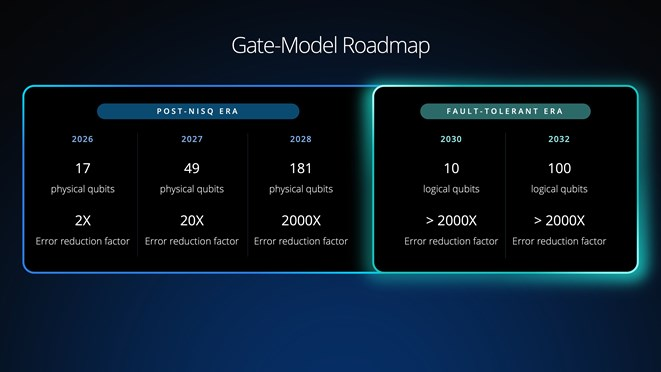
A core metric guiding D-Wave’s scaling framework is Lambda (λ), which measures the rate of error reduction achieved per increment of added error-correction capability. While contemporary multi-qubit platforms operate at a Lambda value of approximately 2—halving errors with each correction step—D-Wave’s roadmap targets a Lambda value of 10. This error-suppression metric leverages the fast cycle times of superconducting circuits, which execute error correction routines 100 to 1,000 times faster than neutral-atom or trapped-ion alternatives. The phased development timeline schedules a 17-physical-qubit system in 2026 to achieve a 2x logical error reduction, scaling to a 49-physical-qubit array in 2027 (20x error reduction), and a 181-physical-qubit architecture in 2028 to establish a 2,000-fold error suppression blueprint.
Enterprise Integration & Dual-Platform Positioning
The execution of this gate-model roadmap establishes D-Wave as a dual-platform hardware provider, supplementing its established line of commercial quantum annealing systems, such as the Advantage2™ processor. The completed gate-model chips will be integrated directly into the company’s existing Leap™ quantum cloud service infrastructure, allowing enterprise users to run hybrid classical-quantum workflows. By targeting a 10-logical-qubit array by 2030 to execute early fault-tolerant algorithms, followed by the 100-logical-qubit tier by 2032, the platform is designed to offload dense matrix calculations for quantum artificial intelligence and molecular chemistry simulations, positioning the hardware to address optimization and gate-model workloads simultaneously.
You can review the official corporate strategy release via the D-Wave Quantum newsroom here. Learn more about D-Wave’s gate-model roadmap and technology here.
In GQI Portal
The players behind the news
The team that writes QCR tracks every company, deal and technology in the GQI Factory, GQI's verified database of the quantum industry. Next up: every story linked to its players, coming to QCR's paid plans.
- Players Companies and institutions across the quantum industry, by segment.
- Scorecards How the players compare on hardware, software, funding and more.
Newsletter
QCR Alerts in your inbox
The latest reporting and analysis from Quantum Computing Report. Free, unsubscribe any time.