

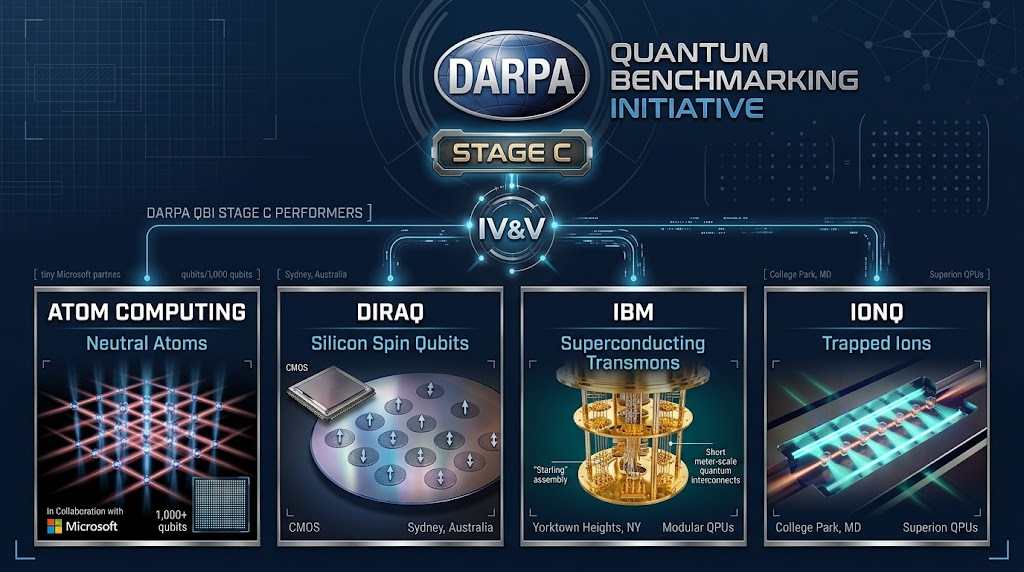
The Defense Advanced Research Projects Agency (DARPA) has selected four commercial quantum hardware developers—Atom Computing, Diraq, IBM, and IonQ—to advance to Stage C of the Quantum Benchmarking Initiative (QBI). Stage C represents the final verification phase of DARPA’s evaluation framework, transitioning the assessment from theoretical R&D blueprint audits to direct physical testing, system measurement, and empirical validation of candidate fault-tolerant quantum computing (FTQC) architectures.
Launched in 2024 as an expansion of the Underexplored Systems for Utility-Scale Quantum Computing (US2QC) program, QBI evaluates whether commercial hardware platforms can achieve utility-scale operation by 2033. DARPA defines utility scale as the operational threshold where a quantum system’s computational output value exceeds its total capital and operational expenditures. The newly selected four-company cohort joins initial US2QC pilot participants Microsoft and PsiQuantum in Stage C verification.
1. DARPA QBI Program Structure & Selected Performer Matrix
Following a yearlong Stage B assessment that audited detailed R&D execution plans, risk mitigation models, and prototype data, DARPA’s Independent Verification and Validation (IV&V) team will evaluate four distinct physical qubit modalities under long-term testing agreements:
| [ DARPA QBI Stage C Performers & Qubit Architecture Matrix ] | ||
|---|---|---|
| Performer / Entity | Qubit Architecture & Physical Modality | Technical Validation & Agreement Terms |
| • Atom Computing (Boulder, CO) | • Neutral-atom qubit arrays • Optical tweezer spatial confinement | • Stage C agreement ceiling up to $300M; evaluates neutral-atom scaling, 3D optical registers, and logical qubit error correction with Microsoft algorithmic support. |
| • Diraq (Sydney, Australia) | • Silicon spin qubits • Industrial 300mm CMOS foundry process | • Stage C agreement up to $300M (initial $51M tranche); tests monolithic multi-million qubit CMOS scaling toward a 2031 utility-scale target. |
| • IBM (Yorktown Heights, NY) | • Modular superconducting transmons • Low-overhead QEC & multi-cell cryogenics | • Evaluates 2029 Starling roadmap targets (200 logical qubits, 100M gate operations, FPGA real-time decoders). |
| • IonQ (College Park, MD) | • Trapped-ion processors • Reconfigurable optical shuttling | • Stage C agreement ceiling up to $300M through 2029; audits multiple generations of Superion QPUs following 99.99% two-qubit fidelity benchmarks. |
2. Hardware Roadmaps & Empirical IV&V Testing Protocols
Managed by QBI Director Micah Stoutimore, Stage C subjects each performer’s physical QPUs, control electronics, cryogenic packaging, and software decoders to direct physical testing. Key technical parameters evaluated across the four performer roadmaps include:
- Atom Computing (Neutral Atoms): Benchmarking system scaling across 1,200+ physical neutral-atom arrays held in optical tweezers, evaluating high-fidelity two-qubit gates, mid-circuit measurement, and sub-threshold quantum error correction (QEC) execution. Microsoft provides algorithmic support and error correction codes for the neutral-atom platform.
- Diraq (Silicon Spin Qubits): Testing 300mm CMOS foundry-fabricated silicon-on-insulator (SOI) spin-qubit chips, validating a scaling path from an 8-qubit commercial data center deployment with Equinix in Sydney to 150,000 physical qubits by 2029 and over 2 million physical qubits on a single die by 2031. Supported by a $38 million CHIPS Act Letter of Intent for onshore manufacturing.
- IBM (Superconducting Transmons): Auditing the 2029 IBM Quantum Starling system architecture, testing short meter-scale quantum interconnects, multi-cell cryostats operating below 15 millikelvin, and FPGA-based real-time quantum error correction decoders integrated within Qiskit.
- IonQ (Trapped Ions): Testing multi-generation Superion QPU platforms through 2029 (including the Superion 256 architecture), evaluating 99.99% two-qubit gate fidelities, reconfigurable optical shuttling networks, and simplified hardware manufacturing economics for volume deployment.
Review the program announcement on the DARPA Official Portal here, examine technical updates in the IBM Newsroom here, inspect silicon metrics on the Diraq Newsdesk here, check trapped-ion parameters via IonQ Press Releases here, review neutral-atom benchmarks on the Atom Computing Newsroom here, and read our previous coverage on IBM’s 2029 Starling modular cryogenic architecture here, and Diraq’s 8-qubit deployment with Equinix here.
In GQI Portal
The players behind the news
The team that writes QCR tracks every company, deal and technology in the GQI Factory, GQI's verified database of the quantum industry. Next up: every story linked to its players, coming to QCR's paid plans.
- Players Companies and institutions across the quantum industry, by segment.
- Scorecards How the players compare on hardware, software, funding and more.
Newsletter
QCR Alerts in your inbox
The latest reporting and analysis from Quantum Computing Report. Free, unsubscribe any time.