

Florida State University (FSU) has been awarded $2.1 million in federal Community Project Funding through the National Institute of Standards and Technology (NIST) to construct a campus-scale quantum communication testbed. Supported in Congress by U.S. Representative Daniel Webster (FL-11), the infrastructure creates the first dedicated, real-world quantum communications and optical networking testbed facility in the southeastern United States.
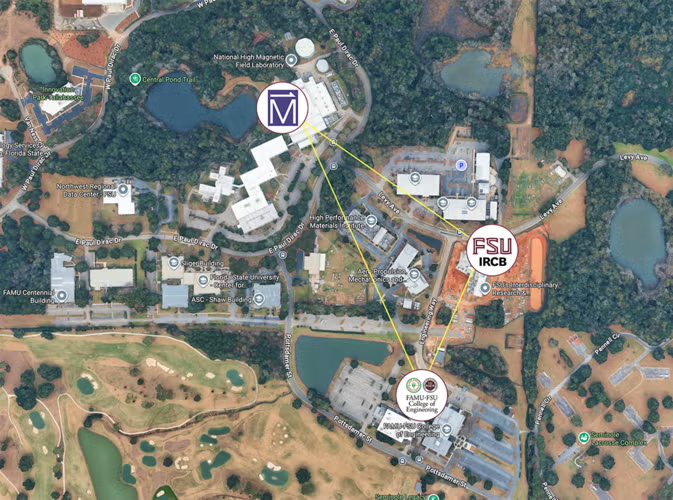
The experimental network will connect a central quantum optics hub inside FSU’s Interdisciplinary Research and Commercialization Building (IRCB) to distant receiver nodes located at the joint FAMU-FSU College of Engineering and the National High Magnetic Field Laboratory (MagLab) in Tallahassee, Florida. Utilizing existing campus dark fiber and reconfigurable free-space optical channels, the testbed will distribute entangled photon pairs across nodes to evaluate quantum key distribution (QKD) and quantum networking hardware under severe operational stresses, including atmospheric turbulence, high magnetic fields, and cryogenic thermal cycling.
| [ FSU Campus Quantum Communication Testbed Architecture ] | ||
|---|---|---|
| Network Node / Infrastructure | Hardware & Technical Function | Environmental Stress Testing Parameters |
| • Central Quantum Hub (FSU IRCB Building) | • Entangled photon pair generation source • Quantum state preparation & control stack | • Baseline lab environment & link-reliability monitoring |
| • Receiver Node 1 (FAMU-FSU College of Eng.) | • Reconfigurable optical receiver & detector arrays • Real-time network telemetry analysis | • Atmospheric air turbulence & free-space optical degradation |
| • Receiver Node 2 (National MagLab) | • High-field cryogenic receiver terminals • Sub-kelvin and high-Tesla QPU interfaces | • High magnetic fields (up to 45+ Tesla) & cryo-thermal cycling |
Leveraging MagLab’s ultra-low temperature and extreme magnetic field infrastructure, the testbed provides a unique testing regime for investigating how strong magnetic fields alter optical polarization states (Faraday rotation) and affect the performance of superconducting nanowire single-photon detectors (SNSPDs). Simultaneously, the link to the College of Engineering focuses on adaptive optics for free-space channel stabilization and full-stack protocol validation under dynamic environmental attenuation. The facility supports Florida’s broader quantum strategy, complementing the 45-faculty FSU Quantum Initiative and the statewide Florida Alliance for Quantum Technology (FAQT) workforce pipeline.
Review official press coverage on FSU News here and inspect engineering program updates at FAMU-FSU College of Engineering here.
In GQI Portal
The players behind the news
The team that writes QCR tracks every company, deal and technology in the GQI Factory, GQI's verified database of the quantum industry. Next up: every story linked to its players, coming to QCR's paid plans.
- Players Companies and institutions across the quantum industry, by segment.
- Scorecards How the players compare on hardware, software, funding and more.
Newsletter
QCR Alerts in your inbox
The latest reporting and analysis from Quantum Computing Report. Free, unsubscribe any time.