
An international research consortium led by IBM Quantum, Zuse Institute Berlin (ZIB), Technische Universität Berlin, and Purdue University—alongside global academic and industrial partners—has introduced the Quantum Optimization Benchmarking Library (QOBLIB). Published in Nature Computational Science (“The Quantum Optimization Benchmarking Library“), the open-source initiative establishes a standardized, model-independent benchmarking framework to evaluate quantum, classical, and hybrid algorithms across ten NP-hard combinatorial optimization problem classes.
| QOBLIB Model-Independent Benchmarking Architecture | ||
|---|---|---|
| Benchmarking Pillar | Technical Scope & Scale | Evaluation & Tracking Capabilities |
| The “Intractable Decathlon” | 10 NP-hard combinatorial classes (20 to 3,000,000+ variables) | Supports MIP, ILP, MIQP, and QUBO formulations across diverse constraint densities. |
| Repository & Web Portal | 1,264 curated instances and 2,600+ initial submissions | Provides live best-known solution registries and automated pull-request validation. |
| Cross-Paradigm Baselines | Classical solvers (Gurobi, CPLEX, ABS2) & IBM Heron QPUs | Tracks runtime, wall-clock TTS, and optimality gaps across quantum and classical hardware. |
Structuring the “Intractable Decathlon”
QOBLIB addresses a critical gap in quantum optimization: while heuristic algorithms like the Quantum Approximate Optimization Algorithm (QAOA) or quantum annealing lack theoretical performance guarantees, empirical advantage claims require rigorous comparisons against state-of-the-art classical solvers. The library curates specific problem instances that become computationally hard for classical solvers at scales ranging from tens to tens of thousands of decision variables:
- Market Split (Multidimensional Subset Sum): Hard binary integer linear programming (ILP) instances with dense constraint matrices (20 to 140 variables).
- Low-Autocorrelation Binary Sequences (LABS): A canonical spin-glass benchmark with applications in radar and signal processing (2 to 100 variables).
- Minimum Birkhoff Decomposition: Doubly stochastic matrix decomposition coupling assignment structures with cardinality objectives (3 to 100 variables).
- Steiner Tree Packing: Modeling VLSI wire-routing density and non-conflicting grid demand networks (16 to 2.6M variables).
- Sports Tournament Scheduling: Highly constrained round-robin timetabling and satisfaction problems (408 to 16,680 variables).
- Portfolio Optimization: Financial models incorporating multi-period transaction costs, short selling, and borrowing constraints (711 to 4,666 variables).
- Maximum Independent Set (MIS): Unweighted graph stability problems mapped directly to compact Quadratic Unconstrained Binary Optimization (QUBO) formulations (17 to 4,000 variables).
- Network Design: Traffic-routing and degree-constrained telecommunication infrastructure planning (101 to 13,249 variables).
- Capacitated Vehicle Routing (CVRP): Logistics optimization combining route selection, time windows, and capacity constraints (441 variables).
- Topology Design (Graph Golf): Degree-diameter optimization models targeting low-latency communication architectures (22,261 to 3.0M variables).
Model-Independent Framework and Public Tracking
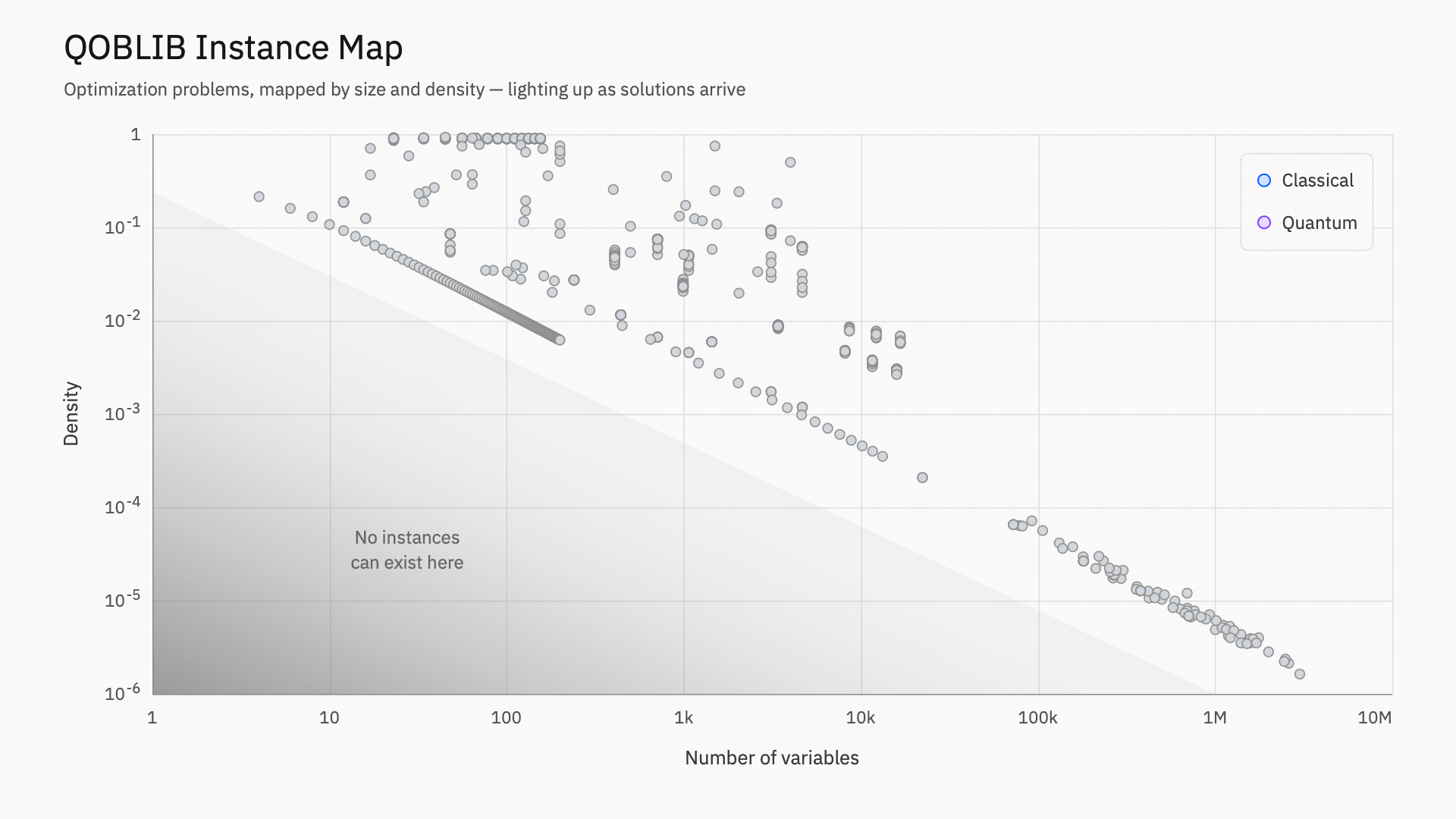
Unlike hardware-specific benchmarks, QOBLIB decouples problem definitions from solver-specific encodings so researchers can choose the mathematical representation best suited to their execution platform. To track community progress, the consortium launched a public web portal featuring an interactive complexity-landscape visualization that maps instances by variable dimension and matrix density, paired with solution-checking scripts to verify feasibility before results enter the leaderboard.
Broad Ecosystem Adoption, Quantum Baselines, and OMMX Integration
At launch, the library logged submissions across 24 contributing institutions. Early contributors include industrial end-users (E.ON Digital Technology), national supercomputing centers (STFC Hartree Centre, Forschungszentrum Jülich), academic groups (National University of Singapore, University of Southern California, City University of Hong Kong), and commercial quantum software providers (Q-CTRL, Kipu Quantum, Aqarios, Qunova Computing, ParityQC, JIJ, and Qoro Quantum).
To establish reproducible quantum reference points alongside classical solvers, the consortium benchmarked three problem classes on IBM Heron processors. Using Kipu Quantum’s bias-field digitized counterdiabatic quantum optimization (BF-DCQO) on ibm_marrakesh, researchers solved 20-variable LABS instances in an average of 61.22 seconds (9.1 seconds excluding circuit payload preparation). On ibm_cusco, a variational permutation-sampling workflow solved 68-qubit Minimum Birkhoff Decomposition instances (n = 5), identifying a 5-permutation decomposition that improved upon classical Birkhoff+ baselines (7 permutations). Depth-one QAOA runs on ibm_fez also recovered optimal solutions for 17- and 52-variable Maximum Independent Set graphs after greedy classical post-processing.

To streamline cross-solver testing, Japanese optimization software developer JIJ contributed benchmark submissions and released the open-source OMMX Quantum Benchmarks package (ommx-quantum-benchmarks), translating 1,205 instances across eight QOBLIB problem classes into the solver-independent Open Mathematical Programming eXchange (OMMX) format. Demonstrating the evolving nature of classical baselines, solver advancements since QOBLIB’s initial preprint release have nearly doubled the largest solved Market Split instances from 60 to 110 variables, elevating the performance target required for quantum processors to claim practical advantage.
Co-authored by researchers across the founding consortium, including lead authors Thorsten Koch (ZIB/TU Berlin) and Stefan Woerner (IBM Quantum), QOBLIB builds on the Quantum Optimization Working Group’s earlier theoretical framework to serve as an open standard as hardware scales.
Review the peer-reviewed QOBLIB study here, the full technical monograph on arXiv here, and the consortium’s foundational quantum optimization review in Nature Reviews Physics here.
Explore the interactive benchmark portal here, the official QOBLIB GitHub repository here, and the original Zuse Institute Berlin GitLab archive here. Additional background is available on the IBM Quantum Blog here, JIJ’s QOBLIB benchmark announcement here, and JIJ’s OMMX Quantum Benchmarks repository on GitHub here.
August 15, 2026 / Update: November 13, 2026
In GQI Portal
The players behind the news
The team that writes QCR tracks every company, deal and technology in the GQI Factory, GQI's verified database of the quantum industry. Next up: every story linked to its players, coming to QCR's paid plans.
- Players Companies and institutions across the quantum industry, by segment.
- Scorecards How the players compare on hardware, software, funding and more.
Newsletter
QCR Alerts in your inbox
The latest reporting and analysis from Quantum Computing Report. Free, unsubscribe any time.