

By/ André M. König
Global Quantum Intelligence (GQI) has released its Q3 2026 Quantum State of Play (SoP) Highlights, presenting a rigorous, data-driven assessment of global quantum technology trends. Supported by proprietary market modeling, the report details an industry navigating a pivotal transition: capital is concentrating into mega-rounds and corporate consolidation, first-generation physical hardware is giving way to fault-tolerant modular architectures, and collapsing cryptanalytic horizons are forcing governments to mandate aggressive post-quantum migration schedules.


Market Consolidation and Capital Inflows
Substantial capital inflows are catalyzing market consolidation across the quantum computing stack. Strategic mergers, acquisitions, and joint ventures—including IonQ’s acquisition of Oxford Ionics, Google’s partnership with Atlantic Quantum, D-Wave combining forces with Quantum Computing Inc. (QCI), and Intel’s definitive agreement to acquire Classiq for $2.3 billion—demonstrate a shift toward combining balance-sheet scale with complementary IP portfolios.
Access to public markets has injected critical growth funding into category leaders. Large-scale capital events—including underwritten offerings from IonQ ($2B), public market deployments for Quantinuum ($1.68B), mega-raises by PsiQuantum ($1B), and SPAC transactions involving Infleqtion, Xanadu, Horizon Quantum, IQM, and Pasqal—reflect an environment where well-capitalized challengers are mobilizing resources to compete alongside hyperscale technology primes.
| [ GQI Q3 2026 Architectural Matrix: Transition to 2nd-Generation Hardware ] | ||
|---|---|---|
| Hardware Modality | 1st-Generation Constraints | 2nd-Generation Architecture Solutions |
| • Superconducting Circuits | • Transmon charge noise, frequency crowding, cryogenic I/O wiring bottleneck. | • Dual-rail qubits, fluxonium circuits, and tantalum-on-sapphire planar designs to suppress bit-flip and phase noise. |
| • Trapped Ions | • Bulk free-space optical routing, beam alignment drift, vibrational heating in long chains. | • Integrated on-chip waveguides, multi-zone shuttling trap topologies, and native multi-qubit entangling operations. |
| • Neutral Atoms | • Finite optical trap lifetime, atom loss replenishment latency, slow cycle rates. | • AI-driven constant-time spatial sorting, planar metasurface tweezer arrays (>11,000 traps), and dual-species continuous-loading conveyors. |
| • Silicon Spin & NV Centers | • Nanofabrication variability, short-range exchange constraints, low optical extraction. | • Commercial 300mm foundry EUV fabrication, coherent spin shuttling, and photonic Bell-state measurement interconnects. |

Architectural Transition: Monolithic Scaling vs. Distributed Quantum Computing (DQC)
Across the physical layer, first-generation architectures are encountering thermodynamic and physical limits. A defining architectural debate has formed around two scaling pathways:
- Monolithic and Pseudo-Monolithic Scaling: Scaling compute registers by packing qubits on single dies or stitching discrete chiplets via high-density microwave flex and cryogenic edge-couplers. While compact, this architecture faces severe thermal dissipation limits and constrained connectivity.
- Distributed Quantum Computing (DQC): Networking discrete QPU modules across optical fibers via photonic interfaces and Bell State Measurement (BSM) switching stations. DQC decouples thermal loads and enables all-to-all logical connectivity, serving as a core architectural focus for players like Photonic Inc., Nu Quantum, and Quantinuum.
Defining the “Quops” Eras: Early Utility to Scalable Teraquop Systems
To establish rigorous benchmarks across disparate hardware architectures, GQI models system progress across defined Quantum Computing Eras based on system size and Quops (defined by GQI as 1/LER, where LER is the logical error rate):
- Pioneer to Kiloquop Era (103 Quops): Near-term hybrid exploration. Early practical utility is demonstrating value across chemistry, materials science, and optimization via Sample-based Quantum Diagonalization (SQD), QAOA warm starts, Out-of-Time-Order Correlators (OTOC) for NMR readout, and quantum-boosted DMRG.
- Megaquop (106) and Gigaquop (109) Eras: Early fault-tolerant systems running active syndrome extraction and transversal logical gates.
- Teraquop Era (1012 Quops): Identified in GQI’s baseline Bull Pathway market model as the definitive commercial inflection point, unlocking large-scale materials design and unconstrained cryptanalytic scale.
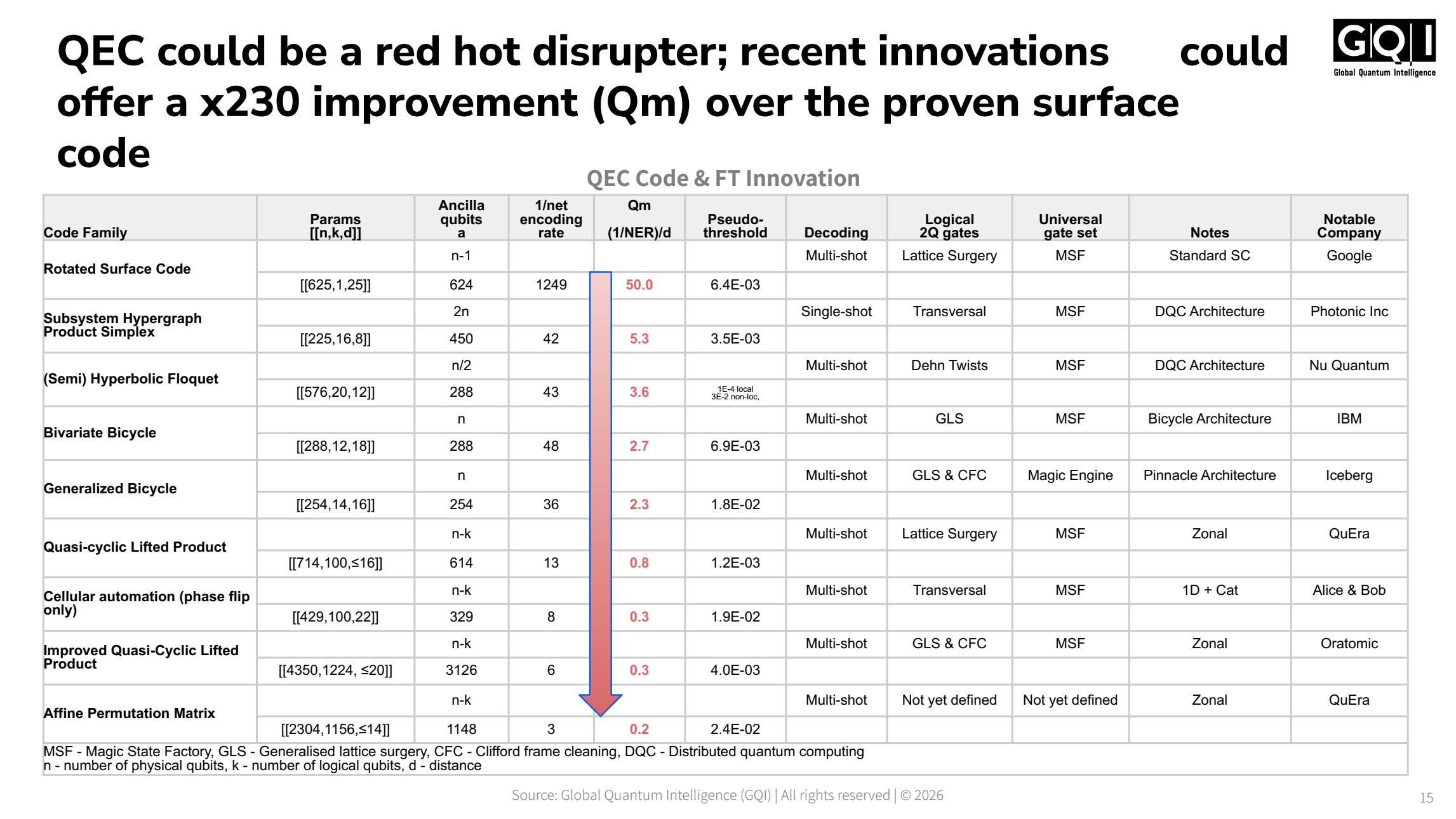
Underpinning this progression is rapid innovation in Quantum Error Correction (QEC). GQI tracking reveals that advanced quantum Low-Density Parity-Check (qLDPC) codes—such as QuEra’s Affine Permutation Matrix and Alice & Bob’s Cellular Automaton architectures—achieve up to a 230-fold reduction in physical qubit overhead ($Q_m \le 0.3$) compared to standard Rotated Surface Codes ($Q_m = 50.0$), substantially lowering the physical threshold to fault tolerance.

Accelerating Q-Day Horizons and Sovereign PQC Mandates
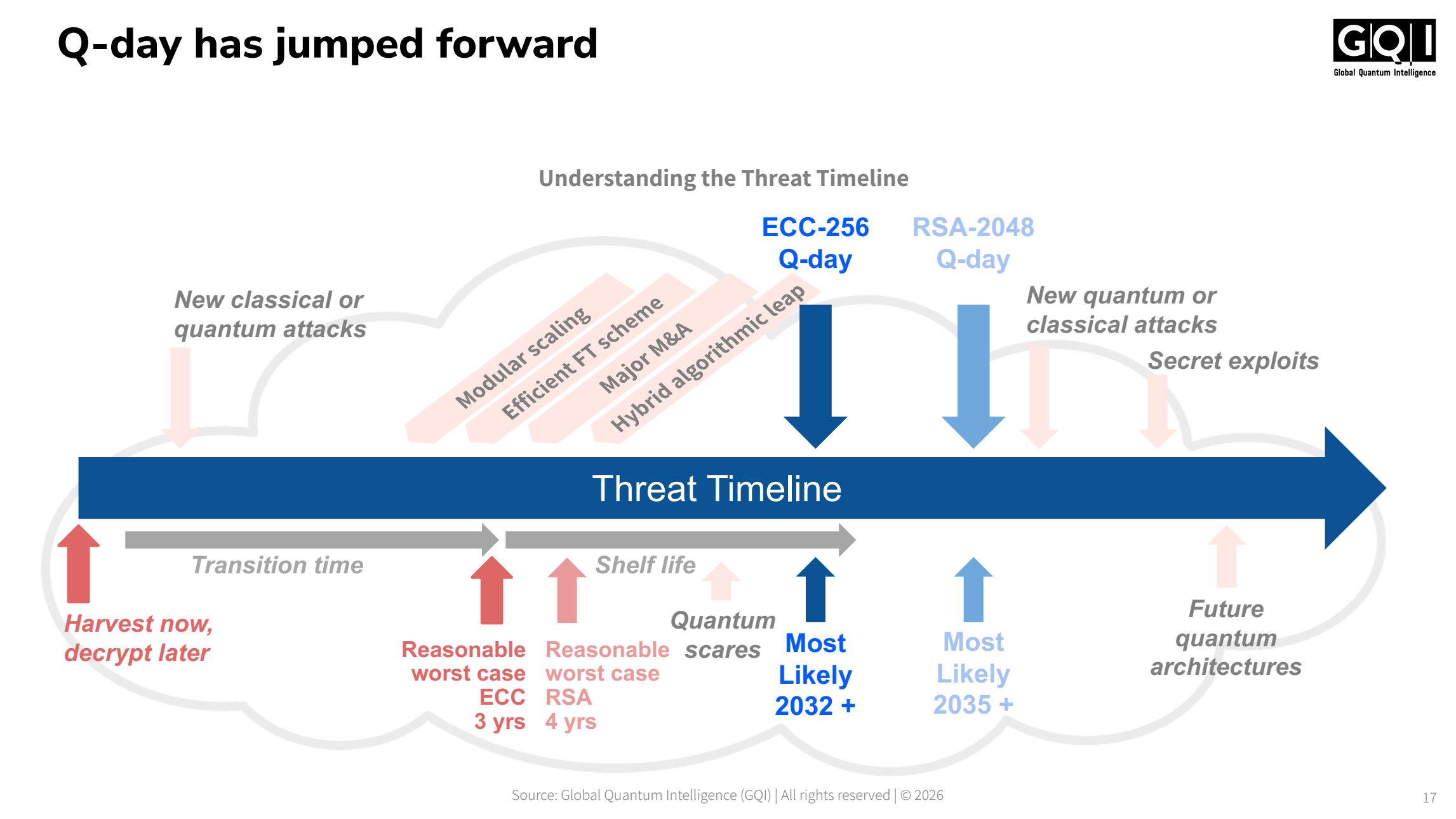
Algorithmic refinements targeting Shor’s algorithm for ECC-256 and RSA-2048 have compressed perceived Q-Day threat horizons. Recent pre-prints analyzing the Dihedral Coset Problem—notably Daniel R. Simon’s July 2026 paper (IACR 2026/1591) and subsequent technical reviews from MIT and Google—reinforce the principle that mathematical assumptions underpinning lattice cryptography require vigilant review. GQI emphasizes that regardless of specific theoretical rebuttals, enterprise risk demands immediate, non-negotiable crypto-agility.
National governments have responded by accelerating compliance schedules:
- United States: A White House Executive Order issued on June 22, 2026, accelerated migration for all high-value federal civilian assets, mandating complete Key Encapsulation Mechanism (KEM) deployment by December 31, 2030, and Digital Signature Algorithm (DSA) migration by December 31, 2031.
- International Alignment: The UK National Cyber Security Centre (NCSC) requires initial organizational roadmaps by 2028 and high-priority migrations by 2031. Parallel directives from the European Union (ENISA), France (ANSSI), and Germany (BSI) are establishing strict PQC security certifications.
Concurrently, GQI models a multi-tiered communications market spanning Consumer-Grade, Enterprise-Grade, High-Assurance (HA), and Tactical Comms. While enterprise software migrations will absorb the majority of near-term spend, High-Assurance quantum communications (satellite-assisted QKD and quantum-secured networks) represent an enduring strategic defense vertical poised for rapid adoption through 2035–2045.
Geopolitical Alignment: Sovereign Testbeds and Allied Blocs
State-backed programs are shifting away from open exploratory research toward sovereign industrial capabilities and defensive procurement screening. Key vehicles driving this include DARPA’s Quantum Benchmarking Initiative (QBI Stage B/C) and US2QC in the United States, the UK’s ProQure and NQCC testbeds, France’s PROQCIMA, Germany’s DLR QCI, and the EU EuroHPC Joint Undertaking.
As quantum hardware and quantum sensing (PNT, gravimetry, and RF detection) establish clear dual-use strategic defense capabilities, international access agreements are increasingly bounded by established geopolitical partnerships—specifically Five Eyes, the Quad, AUKUS, and NATO.
Strategic Directives for Ecosystem Stakeholders
GQI outlines clear operational imperatives across four core market groups:
- Hardware & Software Developers: Accelerate transitions toward second-generation modalities and modular DQC architectures; build dedicated, multidisciplinary midstack teams specializing in qLDPC decoding; and proactively structure global operations to navigate tightening multilateral export controls.
- Institutional Investors: Evaluate portfolio companies under a rigorous “double down or exit” framework; prioritize entities with validated hardware-software co-design or viable roll-up opportunities in critical component supply chains.
- Sovereign Policy Leads: Formulate resilient domestic roadmaps addressing single-source supply chain bottlenecks (dilution refrigeration, optical modulators, specialty isotopes) while solidifying bilateral technology-sharing agreements.
- Enterprise End Users: Implement GQI’s structured Discover → Decide → Execute → Incorporate framework; benchmark early hybrid algorithms (SQD, warm-start QAOA) on near-term hardware; and complete cryptographic asset inventories ahead of binding 2030 compliance deadlines.
Review the complete presentation deck on the GQI Quantum State of Play Portal here.
In GQI Portal
The players behind the news
The team that writes QCR tracks every company, deal and technology in the GQI Factory, GQI's verified database of the quantum industry. Next up: every story linked to its players, coming to QCR's paid plans.
- Players Companies and institutions across the quantum industry, by segment.
- Scorecards How the players compare on hardware, software, funding and more.
Newsletter
QCR Alerts in your inbox
The latest reporting and analysis from Quantum Computing Report. Free, unsubscribe any time.