

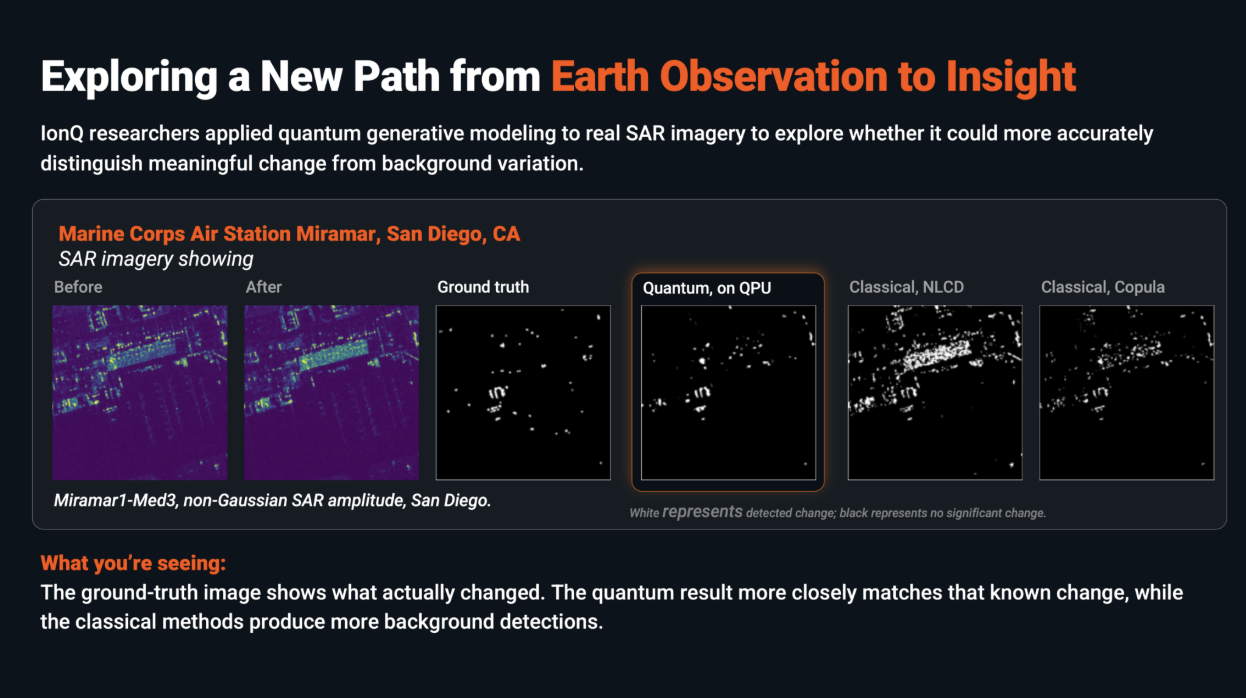
Quantum computing platform developer IonQ, Inc. (NYSE: IONQ) has published breakthrough research demonstrating that quantum generative machine learning models can outperform classical statistical baselines in detecting ground-level changes from satellite-based Synthetic Aperture Radar (SAR) and Interferometric SAR (InSAR) imagery. Published on arXiv (arXiv:2609.05313), the study validates that Quantum Circuit Born Machines (QCBMs) executed on IonQ trapped-ion quantum processing units achieve superior change-detection accuracy under conditions where high-resolution radar data produces sparse or non-Gaussian pixel statistics.
The research addresses a fundamental bottleneck in satellite Earth Observation (EO). While SAR provides persistent, all-weather, day-and-night imaging by measuring microwave backscatter, sub-meter high-resolution acquisitions generate heavy-tailed, non-Gaussian pixel distributions. Traditional classical background estimators (such as Non-Linear Change Detection, NLCD) rely on joint histogram lookup tables, which degrade when pixel statistics are sparsely populated. By encoding bi-temporal satellite image pairs in Copula space using a 20-qubit to 24-qubit QCBM architecture, IonQ’s quantum model generates synthetic reference samples to construct accurate background expectations without requiring spatial smoothing or sacrificing fine resolution detail.
| [ IonQ QCBM Radar Change Detection Benchmarking & QPU Performance ] | ||
|---|---|---|
| Dataset & Target Scene | Statistical Character & Modality | Filtered F1 Benchmark Results |
| • MCAS Miramar Airfield (San Diego, CA) | • Capella Space 1.2m X-Band Stripmap • Strongly Non-Gaussian, Heavy-Tailed • ~0.80% Histogram Bin Occupancy | • IonQ QPU Execution: 0.37 / 0.32 • Classical Copula Baseline: 0.24 • Classical NLCD Baseline: 0.16 |
| • Piton de la Fournaise (Réunion Island Eruption) | • Capella Space InSAR Coherence Loss • Surface Deformation / Lava Flow • Broad Threshold Operating Window | • IonQ QPU Execution: ~0.66 • Classical Copula Baseline: ~0.66 • Classical NLCD Baseline: ~0.66 |
| • Cross-Scene Generalization (Miramar Chip 2 → Chip 1) | • Model trained on Chip 2 (Miramar2) • Zero-shot inference on unseen Chip 1 • Evaluates spatial transferability | • QCBM Zero-Shot Inference: 0.27 • Classical Copula Baseline: 0.20 • Classical NLCD Baseline: 0.14 |
To evaluate hardware execution, IonQ researchers performed both training and inference on an IonQ Forte Enterprise trapped-ion QPU using 20-qubit circuits (10 bits per image variable) containing 50 single-qubit gates and 28 two-qubit entangling gates. On an un-smoothed airfield dataset from Marine Corps Air Station Miramar, fully hardware-executed QCBM inference achieved a filtered F1 score of 0.37 (ideal simulation reaching 0.41), significantly outperforming classical Copula (0.24) and NLCD (0.16) baselines. On an InSAR dataset tracking volcanic lava flows from Piton de la Fournaise, the QCBM matched classical peak F1 scores (~0.66) while sustaining near-peak detection accuracy across a much broader threshold range. Furthermore, cross-chip generalization experiments confirmed that a QCBM trained on one geographic chip could directly inference unseen satellite scenes without retraining, retaining its performance lead over classical methods.
The study bridges capabilities between IonQ’s quantum computing platform and its satellite Earth Observation business (Capella Space, acquired by IonQ in 2025), demonstrating practical quantum generative machine learning workflows for defense, intelligence, critical infrastructure monitoring, and disaster response.
Review the news announcement via IonQ Newsroom here, explore technical workflow details on IonQ Blog here, and inspect the full peer-reviewed preprint on arXiv:2609.05313 here.
In GQI Portal
The players behind the news
The team that writes QCR tracks every company, deal and technology in the GQI Factory, GQI's verified database of the quantum industry. Next up: every story linked to its players, coming to QCR's paid plans.
- Players Companies and institutions across the quantum industry, by segment.
- Scorecards How the players compare on hardware, software, funding and more.
Newsletter
QCR Alerts in your inbox
The latest reporting and analysis from Quantum Computing Report. Free, unsubscribe any time.