

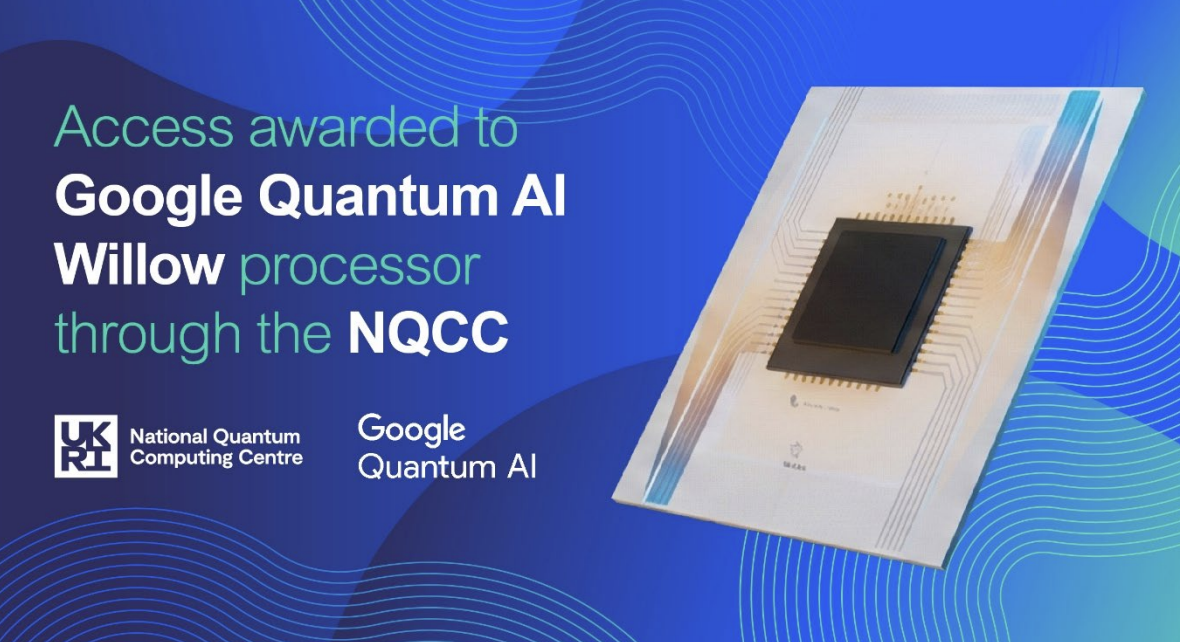
The National Quantum Computing Centre (NQCC) and Google Quantum AI have announced that King’s College London (King’s) has been awarded exclusive early access to Google’s next-generation Willow quantum processor. Marking the first time Google has formally partnered with a British government institution to share its premium quantum hardware, the initiative was launched as a competitive call for proposals to accelerate progress toward practical quantum advantage. The winning research team, selected over a broad field of rival UK academic consortia, will utilize the error-corrected processor to simulate intricate many-body quantum mechanical interactions, providing a foundational software blueprint to map complex biological, chemical, and materials science dynamics.
Technical Architecture & “Willow” Processing Metrics
The joint research project will run on Google Quantum AI’s Willow architecture, a specialized superconducting quantum processor engineered with 105 physical transmon qubits arranged in a square grid formation. Developed as the successor to Google’s historical Sycamore chip, the Willow platform delivers an average five-fold expansion in T1 coherence lifespans (extending parameters up to 100 microseconds). Crucially, Willow represents the industry’s first physical hardware to demonstrate below-threshold quantum error correction (QEC) using a distance-7 surface code structure, achieving an exponential error suppression factor (Λ) of 2.14±0.02. This structural capability allows the processor to suppress operational noise as more physical qubits are added, enabling real-time error decoding with a latency of just 63 microseconds.
The King’s research initiative, led by Quantum Computing Lecturer Dr. Eleanor Crane and co-directed by Dr. Alexander Schuckert (ENS Paris)—both of whom are active finalists in the international Google XPRIZE Quantum Applications challenge—will leverage this error-suppressed substrate to map complex multi-particle configurations. In collaboration with Dr. Chris Timmermann at the University College London (UCL) Centre for Consciousness Research, the group will program a mathematical analogy for biological neurons in the human brain. By utilizing the 105-qubit array to model the non-linear, interacting feedback loops typical of neural networks, the project investigates how advanced quantum simulation routines can track highly entangled, non-equilibrium quantum dynamics that are completely intractable on classical supercomputers.
Strategic Positioning & Sovereign Research Frameworks
The deployment represents an important milestone for the UK’s National Quantum Technologies Programme (NQTP), a comprehensive government infrastructure initiative backed by a £2.5 billion capital commitment. Headquartered at its purpose-built campus in Harwell, Oxfordshire, the NQCC (jointly delivered via UKRI’s research councils, EPSRC and STFC) will embed its own technical specialists alongside Google’s engineering team to optimize the experimental compilation loops.
By utilizing the Willow processor’s fast matrix sampling speeds—which can resolve specialized random circuit benchmarks thousands of times faster than frontier classical supercomputing clusters—the King’s consortium aims to bridge the gap between computational neuroscience and physical chemistry. Laying bare the fundamental quantum mechanical interactions that dictate plant photosynthesis, molecular transport, and target drug-receptor bindings, the collaborative software framework establishes a public-domain scientific blueprint. This cooperative foundation is designed to enable external research entities to design highly efficient photovoltaics, lower transmission losses in sovereign power grids, and isolate molecular treatments for previously untreatable biological pathlines.
You can review the official institutional research announcement via the King’s College London media portal here. For the comprehensive press release outlining the selection metrics, joint support protocols, and the overarching mission parameters of the UK national lab, access the formal NQCC document repository here.
In GQI Portal
The players behind the news
The team that writes QCR tracks every company, deal and technology in the GQI Factory, GQI's verified database of the quantum industry. Next up: every story linked to its players, coming to QCR's paid plans.
- Players Companies and institutions across the quantum industry, by segment.
- Scorecards How the players compare on hardware, software, funding and more.
Newsletter
QCR Alerts in your inbox
The latest reporting and analysis from Quantum Computing Report. Free, unsubscribe any time.