

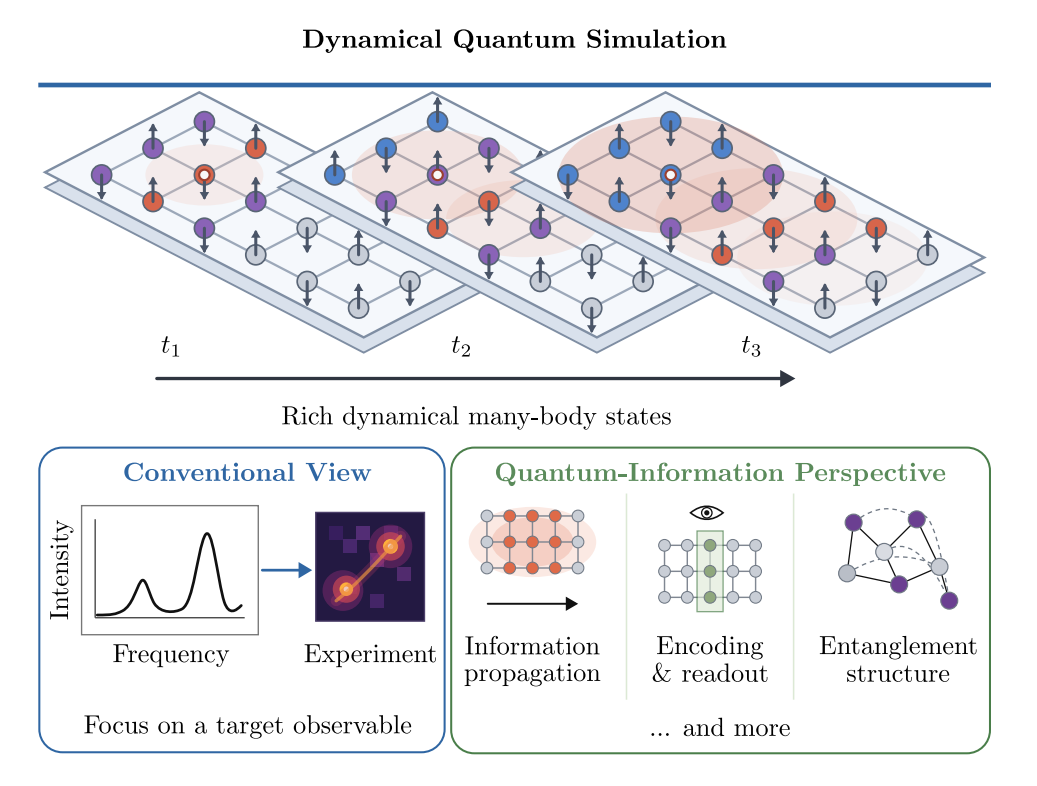
Researchers at Los Alamos National Laboratory (LANL) and Cornell University have published an analytical and numerical framework demonstrating that intermediate many-body states prepared during dynamical quantum simulations can be repurposed to interrogate quantum information metrics. In a preprint titled Dynamical quantum simulations as laboratories for quantum information, the team analyzed local-pulse protocols traditionally executed on quantum hardware to calculate retarded spin Green functions and inelastic neutron scattering dynamical structure factors. By reframing opposite local spin rotations as the encoding of a classical bit or a continuous parameter into evolving many-body states, the study tracks how quantum information propagates, reorganizes across spatial partitions, and responds to physical measurement constraints in 50-spin XX and XXX (isotropic Heisenberg) chains.
Information Propagation, Representation-Readout Inversion, and Multipartite Entanglement
The investigation establishes that conventional local response functions capture only a restricted projection of the underlying quantum record. As the spatial observation aperture expands from a single site (k = 1) to seven sites (k = 7), the trace distance ΔR and Holevo information χR reveal persistent multi-site correlations that remain present even when local single-spin response functions vanish. A central finding is an inversion between mathematical representation complexity and physical measurement efficiency: while the free-fermionic XX chain admits an exact, compact description via two-point fermionic covariance matrices, simple product-Pauli spin measurements recover a larger fraction of available distinguishability, Holevo information, and quantum Fisher information (QFI) in the strongly interacting XXX chain. Furthermore, the prepared dynamical states allow direct certification of evolving quantum resources, demonstrating that localized perturbations reduce internal entanglement while establishing genuine five-partite entanglement across spatial blocks.
| Quantum Information Metrics Extracted from Dynamical Spin-Chain Simulations | ||
|---|---|---|
| Analytical Dimension | Observed Physical Behavior | Quantum Information & Computational Significance |
| Spatial Aperture Scaling | Median ΔR grows from 0.037 to 0.294 (XX) and 0.054 to 0.230 (XXX) between k = 1 and k = 7. | Confirms information spreads into non-local multi-qubit correlations inaccessible to single-site Green function probes. |
| Representation vs. Readout | Covariance matrices fully describe XX but fail in XXX (operator error eGξ ≈ 0.70); yet product-Pauli measurements extract more information in XXX. | Proves that simplicity in a theoretical quasiparticle basis (Jordan-Wigner) does not guarantee operational measurement accessibility on physical qubits. |
| Quantum Fisher Information (QFI) | Infinitesimal pulse-angle sensitivity ∂θρR relates directly to the signed response operator ξR; product-Pauli efficiency ηprodPF is higher in XXX at matched QFI. | Bridges condensed-matter response functions to precision bounds in quantum metrology and parameter estimation. |
| Channel Capacity Duality | Coherent information I(A‘ ⟩ AR) and quantum capacity Q satisfy Q(NR,t) = 1 − χR(t) under spin-flip symmetry. | Links the classical decodability of a lost spatial block to the exact quantum capacity and Bell-state distillation rate of the complementary system. |
| Entanglement Reorganization | Block-exterior entropy increases (ΔSR > 0) while internal logarithmic negativity decreases (ΔEN,med < 0); multipartite Rains and log-GMN remain positive. | Certifies that local reduced states preserve genuine multipartite entanglement even as the propagating wavefront redistributes entanglement globally. |
Experimental Validation Pathways and Quantum Hardware Realities
The analytical framework builds directly upon experimental pulse sequences previously deployed on superconducting quantum processors to benchmark magnetic materials such as KCuF3 against neutron scattering facilities. By treating quantum simulation platforms as multi-purpose quantum information laboratories rather than single-observable estimators, the methodology extracts transport velocities, error-correcting thresholds, and channel capacities without requiring dedicated state preparation circuits. However, implementing full quantum information reconstruction on physical hardware introduces experimental bottlenecks: calculating exact trace distances, multipartite Rains bounds, and Holevo capacities requires full density matrix reconstruction, which scales exponentially with block size 2k. Extending these diagnostics to larger materials models or higher-dimensional lattices will require transitioning from full quantum state tomography to randomized measurement protocols and symmetry-adapted classical shadow estimation.
The preprint is indexed on arXiv, with experimental context detailed via the Neutron-Scattering Quantum Simulation Benchmark here.
In GQI Portal
The players behind the news
The team that writes QCR tracks every company, deal and technology in the GQI Factory, GQI's verified database of the quantum industry. Next up: every story linked to its players, coming to QCR's paid plans.
- Players Companies and institutions across the quantum industry, by segment.
- Scorecards How the players compare on hardware, software, funding and more.
Newsletter
QCR Alerts in your inbox
The latest reporting and analysis from Quantum Computing Report. Free, unsubscribe any time.