

model.
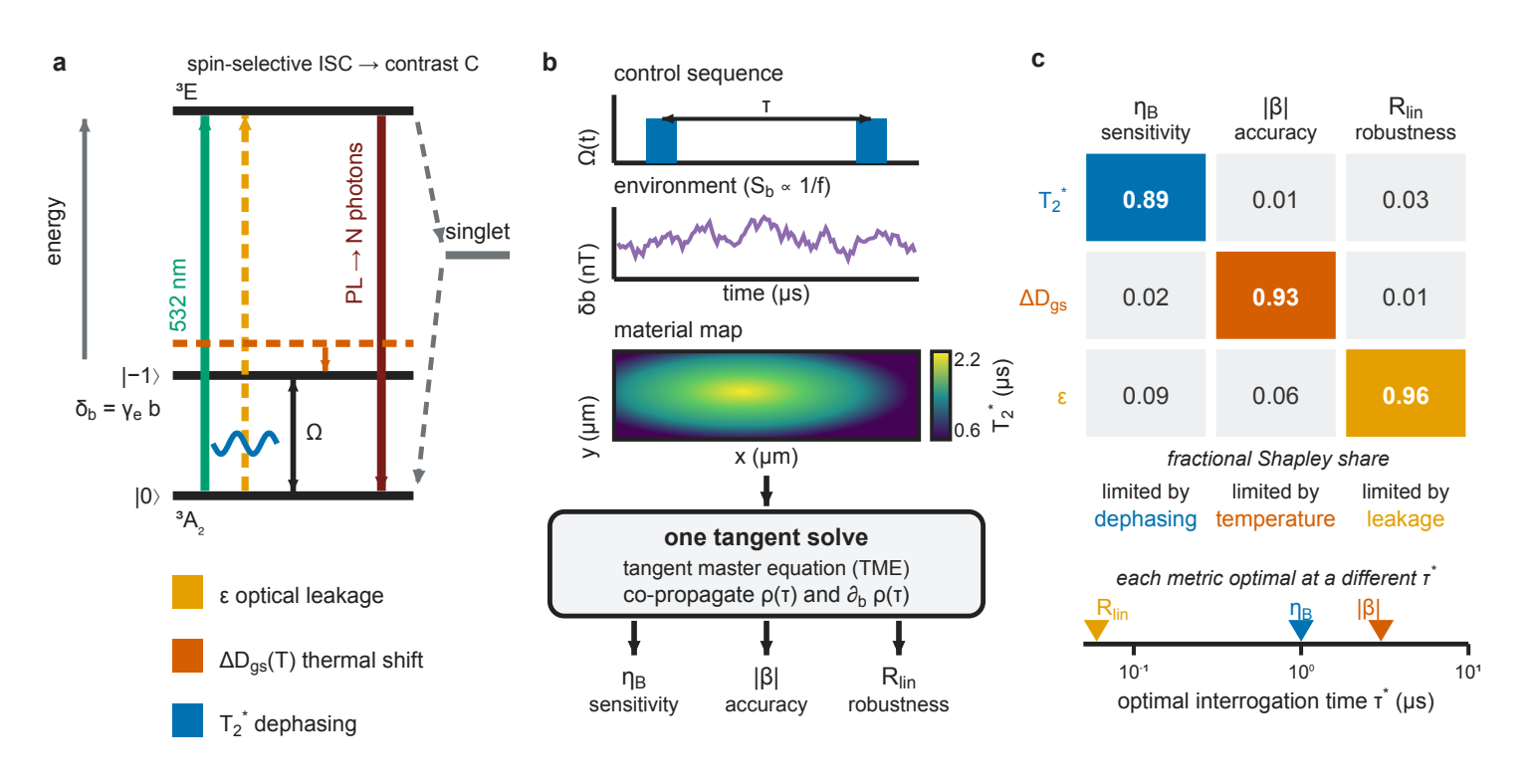
A multi-institution collaboration led by MITRE—alongside Quantum Brilliance, NVIDIA, and SandboxAQ—has published an open-system simulation framework to automate mechanism-resolved error budgeting for quantum sensors. Detailed in a preprint published on arXiv (arXiv:2608.28519), the methodology evaluates three simultaneous Measures of Performance (MoPs)—sensitivity (ηB), systematic accuracy bias (β), and parameter-drift robustness (Rlin)—from a single propagation of the Tangent Master Equation (TME). The computational core is accelerated by NVIDIA GPUs using the cuQuantum cuDensityMat backend.
The framework resolves how interacting physical error mechanisms combine by applying cooperative-game Shapley value allocations to open quantum system models. Applied across nitrogen-vacancy (NV) diamond ensembles, the attribution demonstrates that performance limiters invert depending on the targeted metric: T₂* spin dephasing limits sensitivity (accounting for ~89% of the budget), ground-state thermal zero-field splitting shifts (ΔDgs(T)) limit systematic accuracy, and acousto-optic optical modulator leakage (ε) limits drift robustness. Along a fixed sensitivity locus (100 pT/√Hz), the recovered-field bias ranges over two orders of magnitude (8 to 1500 nT at a ΔT = 0.1 K drift specification), demonstrating that optimizing for sensitivity alone fails to guarantee accuracy targets.
| [ Multi-Platform Quantum Sensor Error Attribution Parameters ] | ||
|---|---|---|
| Sensing Platform & Modality | Open-System Physics & Solver Engine | Primary Metric Limiters & Attribution |
| NV Diamond Ensemble (Magnetometry & Spectroscopy) | • 10-Level Lindblad Model & TME • NVIDIA cuQuantum cuDensityMat GPU Batching | • Sensitivity: T₂* Dephasing (89% Share) • Accuracy: Thermal Shift ΔDgs(T) (282 nT / 0.1 K) • Robustness: Optical Leakage ε (96% Share) |
| Scalar Cesium OPM Array (Biomagnetic MCG Imaging) | • Ground-State Breit-Rabi Hamiltonian • 26-Channel Unshielded Cardiac Array | • Atomic Floor: ~1.1 fT/√Hz Spin Projection • System Floor: ~4.4 pT/√Hz via Software CMR • Clinical Target: 5 mm Dipole Localization Error |
The framework was validated cross-platform on an unshielded 26-channel scalar cesium optically pumped magnetometer (OPM) array developed by SandboxAQ for magnetocardiography (MCG). The digital twin showed that clinical millimeter-scale arrhythmia localization is limited by ambient noise rejection rather than the atomic spin-projection floor (~1.1 fT/√Hz), verifying that software common-mode rejection (CMR) suppressing noise to ~4.4 pT/√Hz satisfies the 5 mm surgical ablation target.
Review the research preprint on arXiv here.
September 14, 2026
In GQI Portal
The players behind the news
The team that writes QCR tracks every company, deal and technology in the GQI Factory, GQI's verified database of the quantum industry. Next up: every story linked to its players, coming to QCR's paid plans.
- Players Companies and institutions across the quantum industry, by segment.
- Scorecards How the players compare on hardware, software, funding and more.
Newsletter
QCR Alerts in your inbox
The latest reporting and analysis from Quantum Computing Report. Free, unsubscribe any time.