

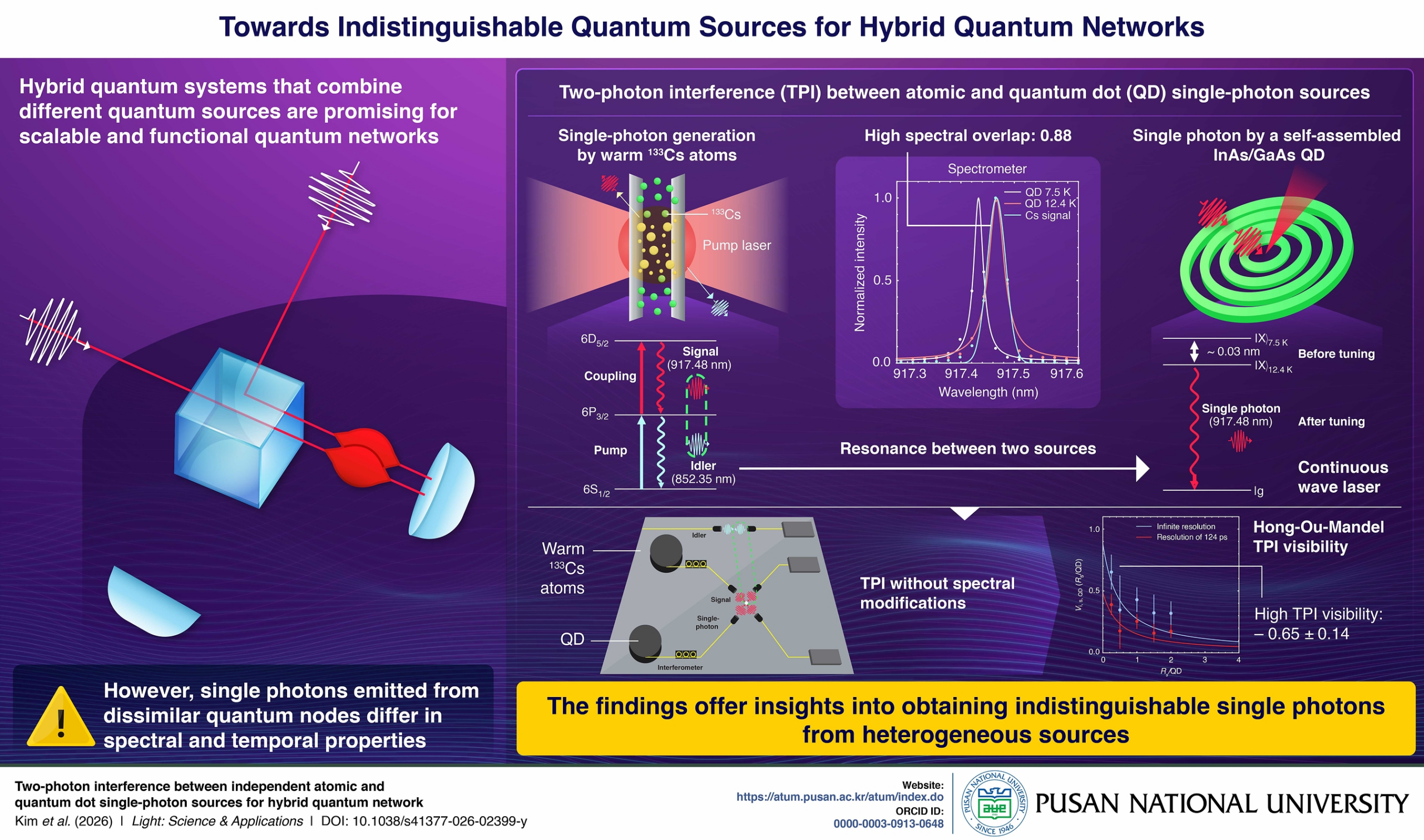
Researchers at Pusan National University and the Ulsan National Institute of Science and Technology (UNIST) have demonstrated direct two-photon interference between two physically distinct, un-synchronized quantum light sources: a warm cesium atomic vapor ensemble and a semiconductor quantum dot (QD). Published in Light: Science & Applications, the breakthrough achieves photon indistinguishability across dissimilar quantum hardware platforms without relying on active spectral or temporal modification, establishing a critical building block for hybrid quantum networking architectures.
The experimental setup pairs self-assembled indium arsenide/gallium arsenide (InAs/GaAs) quantum dots with warm cesium (Cs) vapor cells to balance the trade-offs of single-photon generation versus quantum memory storage. While quantum dots excel at high-rate, on-demand single-photon emission, they lack native long-duration storage capabilities. Conversely, warm atomic vapor cells provide natural frequency standards and efficient quantum storage channels. By cooling the quantum dots down to 12.5 K, the team spectrally tuned their emission to 917.48 nm, matching the 917 nm heralded signal photons emitted from the continuous-wave-excited cesium atoms and achieving a spectral overlap of 0.88 between the two independent emitters.
To validate photon indistinguishability, the joint team measured two-photon interference via the Hong–Ou–Mandel (HOM) effect, observing two photons from the separate sources enter a beam splitter and bunch together into the same output mode. After accounting for detector timing resolution, the setup demonstrated an interference visibility of 0.65±0.14 under continuous-wave excitation. This marks the first direct two-photon interference benchmark achieved between independent atomic ensembles and solid-state quantum dots without introducing external optical filtering, frequency conversion, or temporal reshaping stages that add insertion loss.
Led by Prof. Han Seb Moon (Pusan National University) and Prof. Je-Hyung Kim (UNIST), the hybrid architecture offers a path toward scalable quantum repeaters and distributed quantum computing networks. By demonstrating that high-rate solid-state photon sources can directly interface with atomic memory nodes using a shared atomic frequency standard, the researchers have validated an essential link for transferring flying qubits across heterogeneous quantum hardware platforms.
Review the official study in Light: Science & Applications here, and examine the press announcement on PRNewswire here.
In GQI Portal
The players behind the news
The team that writes QCR tracks every company, deal and technology in the GQI Factory, GQI's verified database of the quantum industry. Next up: every story linked to its players, coming to QCR's paid plans.
- Players Companies and institutions across the quantum industry, by segment.
- Scorecards How the players compare on hardware, software, funding and more.
Newsletter
QCR Alerts in your inbox
The latest reporting and analysis from Quantum Computing Report. Free, unsubscribe any time.