

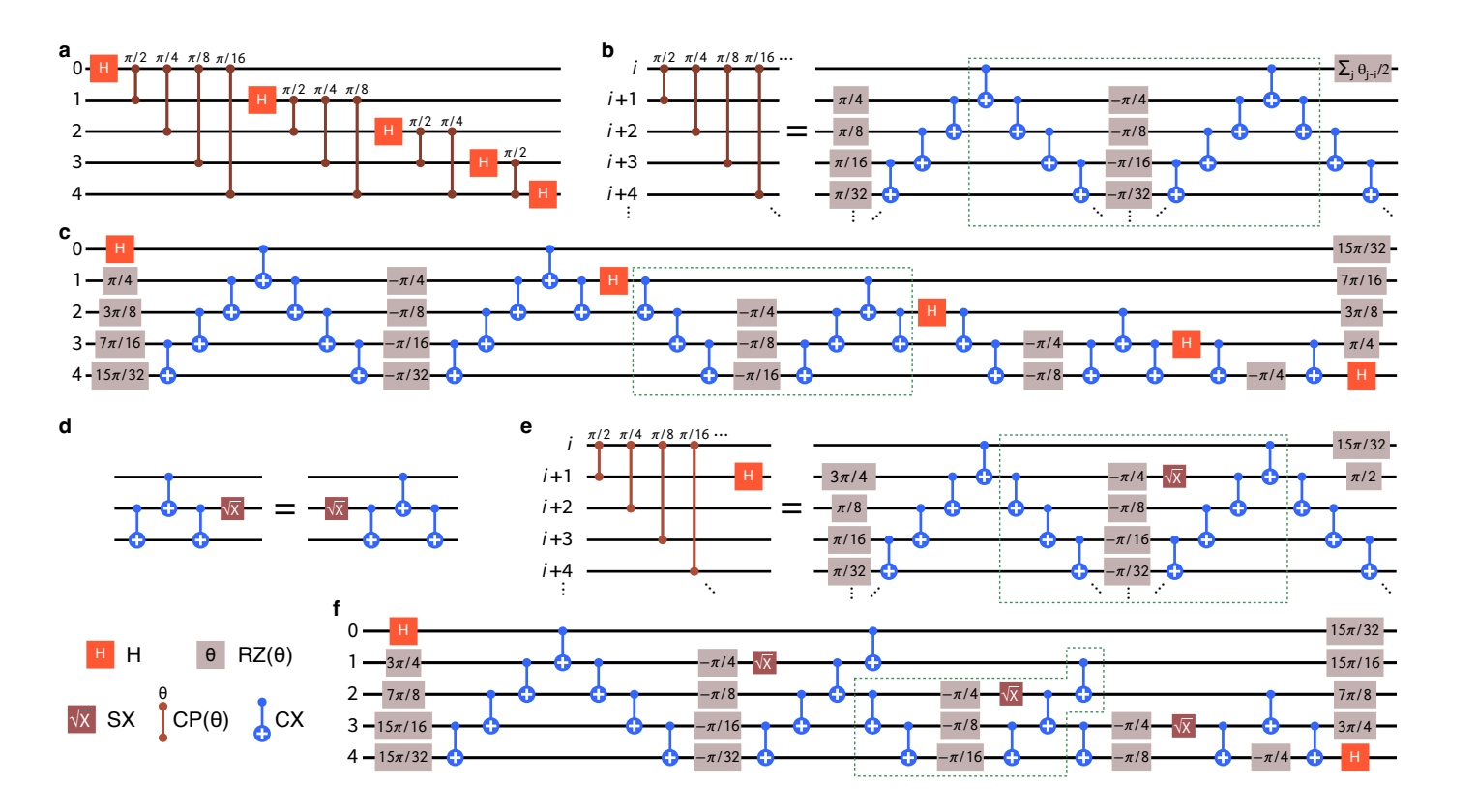
Quantum infrastructure software provider Q-CTRL has demonstrated an experimental execution of the Quantum Fourier Transform (QFT) subroutine on up to 100 physical qubits. Published on arXiv (arXiv:2608.05435), the research presents a constructive compilation architecture termed the Convolutional QFT. Executed on the IBM Heron R3 superconducting processor ibm_boston, the demonstration resolves periodic signal frequencies across a 2100-dimensional Hilbert space, marking the largest experimental execution of a functional QFT algorithm on quantum hardware to date.
A primary bottleneck in scaling subroutines like the QFT on near-term and fault-tolerant architectures is the two-qubit gate overhead required to route interactions across restricted connectivity layouts. Standard direct implementations on linear nearest-neighbor (LNN) topologies incur substantial routing penalties compared to all-to-all connected architectures. Q-CTRL’s compilation strategy eliminates this routing overhead entirely on LNN layouts by leveraging identity cancellations, matching the theoretical baseline of an all-to-all architecture using n2 – n two-qubit CX gates for a full n-qubit QFT, and d(2n – d – 1) CX gates for an Approximate QFT (AQFT) retaining the d largest phase rotation angles.
To optimize execution on physical hardware, the authors refined the LNN layout into the Convolutional AQFT by incorporating a single ancilla qubit and two additional CX gates. The addition of the ancilla reverses the directional dependency chain of initial entangling operations, allowing the algorithm to synthesize as a compact, translation-invariant kernel circuit gadget spanning d + 2 qubits. As the kernel steps along the quantum register with a stride length of 1, it minimizes the average number of two-qubit gates in the causal light-cone history of each physical qubit, suppressing noise propagation into downstream logic.
| [ QFT Compilation Strategies & Performance Benchmarks (ibm_boston) ] | ||
|---|---|---|
| Compilation Strategy & Metrics | CX Gate Complexity & Depth | Experimental Fidelity & Signal Fidelity |
| All-to-All Baseline | • CX Count: n2 – n • AQFT CX: d(2n – d – 1) | • Theoretical baseline (requires all-to-all physical connectivity) |
| Low-CX LNN Compilation | • CX Count: n2 – n • AQFT CX: d(2n – d – 1) | • Zero routing overhead on linear nearest-neighbor topologies • CX Depth: (2d – 1)n – d(d + 1) + 3 |
| Convolutional AQFT (Q-CTRL Hardware Implementation) | • CX Count: n2 – n + 2 • AQFT CX: d(2n – d – 1) + 2 | • 50 Qubits: 11.4% Process Fidelity (10.8× signal peak) • 80 Qubits: 1.8% Process Fidelity (7.5× signal peak) • 100 Qubits: Target state remains mode output (Signal-to-Noise > 1) |
During execution, qubits participate briefly in the dense convolutional kernel before entering long idle windows. These idle periods were protected against decoherence and crosstalk using Q-CTRL’s robust, crosstalk-suppressing dynamical decoupling sequences integrated with ‘as late as possible’ (ALAP) gate scheduling. In experimental benchmarks across 20 randomly sampled target frequencies, the Convolutional QFT achieved a readout-mitigated process fidelity of 11.4% at 50 qubits and 1.8% at 80 qubits. Up to 100 qubits, the correct integer frequency bitstring consistently emerged as the highest-probability measurement outcome above background noise.
Review the research preprint on arXiv (Convolutional QFT) here.
In GQI Portal
The players behind the news
The team that writes QCR tracks every company, deal and technology in the GQI Factory, GQI's verified database of the quantum industry. Next up: every story linked to its players, coming to QCR's paid plans.
- Players Companies and institutions across the quantum industry, by segment.
- Scorecards How the players compare on hardware, software, funding and more.
Newsletter
QCR Alerts in your inbox
The latest reporting and analysis from Quantum Computing Report. Free, unsubscribe any time.