

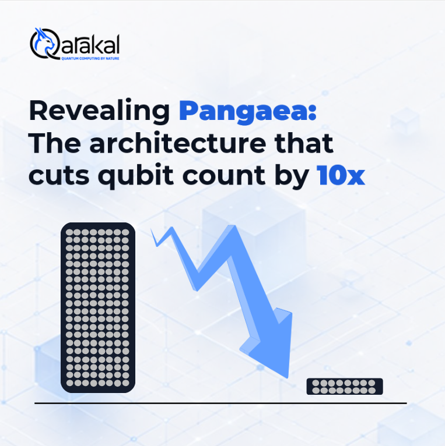
Israeli quantum startup Qarakal Quantum Ltd. has officially launched Pangaea, a modular, three-dimensional superconducting quantum computing architecture engineered to reduce the physical qubit requirements of fault-tolerant systems by an order of magnitude. Published in an arXiv pre-print titled “The Pangaea Architecture: Fault-Tolerant Heterogeneous Topological Codes via a Quantum Bus,” the design resolves the long-standing routing bottleneck of two-dimensional lattice surgery by introducing an IP-protected quantum bus to mediate logical operations between physically separated 2D topological code patches.
Rather than relying on direct physical adjacency, Pangaea uses an auxiliary gauge-code strip as its quantum bus. The bus reconstructs multi-qubit joint Pauli operators and supports native operations between heterogeneous topological code families (such as joint parity measurements between surface codes and color codes) while preserving nearest-neighbor physical connectivity. By replacing traditional planar lattice surgery, the architecture scales multi-qubit interactions using O(dNL) physical qubits for NL distance-d logical qubits—a significant reduction from the O(d2NL) footprint required by standard 2D surface-code layouts.
                      [ Pangaea Modular Bus Architecture ]
                                        │
     ┌──────────────────────────────────┴──────────────────────────────────┐
     ▼                                                                     ▼
  Specialized Code Patches (Memory/Logic)                 Auxiliary Gauge-Code Quantum Bus
  • Surface Codes & Color Codes.                         • Mediates Long-Range Joint Parity Measurements.
  • Dedicated Functional Module Roles.                   • Native 15-to-1 Magic-State Distillation Module.
  • Hardware Specialization per Patch.                   • Scales at O(dNL) vs O(d2NL) Physical Qubits.
In fault-tolerance simulations using pseudo-threshold noise models at a scale of 50 logical qubits, Pangaea achieved a matched logical error rate using 10 times fewer physical qubits than planar surface-code architectures. The architecture also demonstrated measurement-based fault-tolerant CNOT primitives and a native 15-to-1 magic-state distillation module, significantly lowering wiring density, control electronics overhead, and cryogenic cooling requirements.
Qarakal Quantum’s architecture-first approach reflects an industry shift away from monolithic processor scaling toward modular, backplane-connected system design—drawing an analogy to classical bus architectures. By allowing computational, memory, and routing modules to be configured and scaled independently, Pangaea provides a streamlined pathway for enterprises and research institutions to execute large-scale fault-tolerant quantum algorithms on near-term hardware footprints.
Review the official launch announcement on GlobeNewswire here, examine the pre-print research paper on arXiv here, and explore technical details via the Qarakal Quantum Architecture Hub here.
In GQI Portal
The players behind the news
The team that writes QCR tracks every company, deal and technology in the GQI Factory, GQI's verified database of the quantum industry. Next up: every story linked to its players, coming to QCR's paid plans.
- Players Companies and institutions across the quantum industry, by segment.
- Scorecards How the players compare on hardware, software, funding and more.
Newsletter
QCR Alerts in your inbox
The latest reporting and analysis from Quantum Computing Report. Free, unsubscribe any time.