

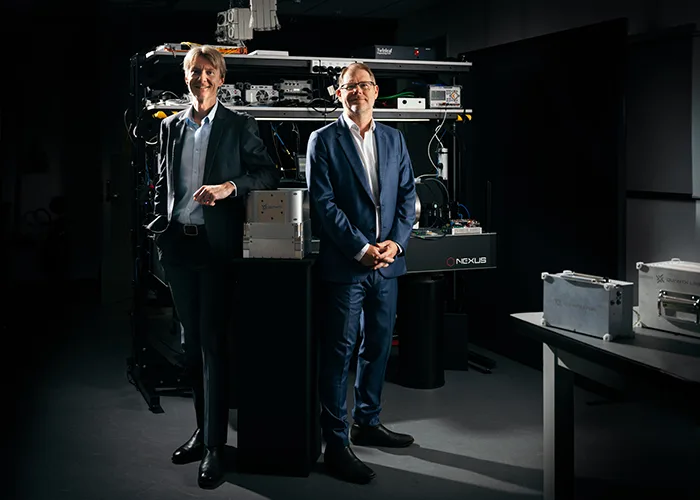
South Australian deep-tech pioneer QuantX Labs has announced the successful in-orbit commissioning and operational verification of its space-qualified optical frequency comb. Supported by the Australian Space Agency’s Moon to Mars Demonstrator Program, the achievement marks the first time an optical frequency comb has been deployed and successfully operated in the space environment.
The optical frequency comb was launched into Low Earth Orbit (LEO) on March 30, 2026, aboard French space logistics firm Exotrail’s spacevan™ orbital transfer vehicle, hosted on SpaceX’s Transporter-16 rideshare mission.
Bridging Optical Precision to Space-Based Electronic Timing
An optical frequency comb—a technology based on Nobel Prize-winning physics—acts as an optical-to-electronic gear ratio. While modern optical atomic clocks achieve ultra-high stability by oscillating at optical frequencies (hundreds of terahertz), standard electronic processors cannot directly count these rapid pulses. The frequency comb converts these optical frequencies down to usable radio-frequency (RF) signals without sacrificing timing precision.
The successful in-orbit activation confirms several critical engineering parameters:
- Structural & Launch Survivability: The optical alignment and precision components withstood mechanical vibrational forces during launch and deployment.
- Space-Environment Operability: Demonstrates thermal, electrical, and mechanical stability under space vacuum and radiation conditions.
- Platform Integration Flight Heritage: Verifies hardware and communication interfaces between Australian quantum technology and international satellite buses.
Derisking the Full TEMPO Space Optical Atomic Clock Deployment
Current Global Navigation Satellite Systems (GNSS), such as GPS, rely on microwave-based atomic clocks. Optical atomic clocks promise to improve timing precision by up to an order of magnitude, offering greater resilience against signal jamming, spoofing, and loss in electronic environments.
The in-orbit frequency comb serves as the primary subsystem for QuantX Labs’ broader TEMPO space optical atomic clock payload. With the comb validated in orbit, the company’s engineers are completing environmental testing on the full TEMPO Proto-Flight Model (PFM). A successful deployment of the complete TEMPO payload—targeted for 2027—would deliver the world’s first fully operational optical atomic clock in space, providing sovereign timing capabilities for defense, synchronized satellite communications, and deep-space navigation.
Review the official mission announcement via the QuantX Labs Newsroom here, and examine defense and space industry coverage on Space & Defense here. For policy and program context, explore the Australian Space Agency Portal here.
In GQI Portal
The players behind the news
The team that writes QCR tracks every company, deal and technology in the GQI Factory, GQI's verified database of the quantum industry. Next up: every story linked to its players, coming to QCR's paid plans.
- Players Companies and institutions across the quantum industry, by segment.
- Scorecards How the players compare on hardware, software, funding and more.
Newsletter
QCR Alerts in your inbox
The latest reporting and analysis from Quantum Computing Report. Free, unsubscribe any time.