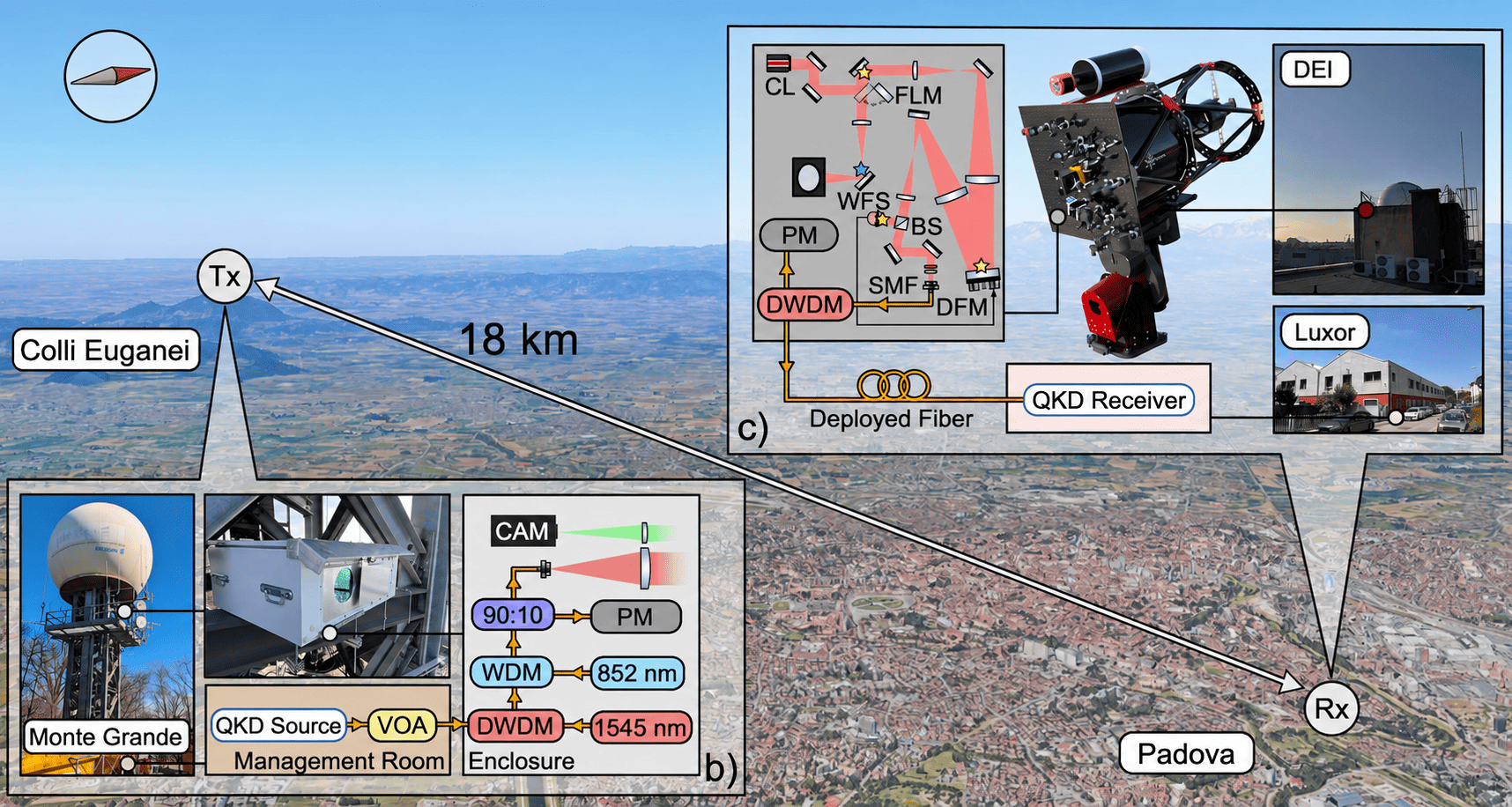
Researchers from the University of Padova, Italian photonics firm ThinkQuantum s.r.l., and the National Research Council of Italy (CNR-IFN) have published a real-time field trial of an intermodal quantum key distribution (QKD) system in npj Quantum Information. The experiment connected a remote optical transmitter on Monte Grande to an urban Optical Ground Station (OGS) at the University of Padova across an 18-km horizontal free-space link, which then coupled into a 0.5-km deployed fiber network to reach a receiver laboratory.
| [ Intermodal 18-km Free-Space to Fiber QKD Architecture ] | ||
|---|---|---|
| Optical Transmitter & Channel | Adaptive Optics & Receiver OGS | Quantum Hardware & Key Rates |
| • 18-km Free-Space Horizontal Link | • 41-cm Ritchey-Chrétien Telescope | • ThinkQuantum QUKY QKD Platform |
| • Telecom Wavelength (1565.5 nm, C-Band) | • 64-Actuator Piezoelectric Deformable Mirror | • 200 bit/s SKR (Room-Temp InGaAs SPADs) |
| • Multiplexed 1545 nm Beacon & 850 nm Alignment | • Shack-Hartmann Direct Wavefront Sensor | • ~1 kbit/s SKR (Cryogenic SNSPDs) |
High-Order Adaptive Optics Overcomes Atmospheric Turbulence
Atmospheric turbulence over long terrestrial links introduces severe wavefront distortions, making efficient injection into single-mode optical fibers (SMFs) difficult. To overcome high channel attenuation (~29 to 30 dB), the team implemented a high-order Adaptive Optics (AO) system at the receiving telescope:
- Beyond Tip-Tilt Stabilization: Using a 64-actuator bimorph deformable mirror and a Shack-Hartmann wavefront sensor running closed-loop feedback, the AO bench corrected high-order spatial aberrations up to 35 Zernike modes.
- Fiber Coupling Efficiency: The system achieved single-mode fiber coupling efficiencies of up to 19% (-7.2 dB), allowing the free-space quantum signal to be directly multiplexed into standard telecommunications fiber without performing untrusted intermediate measurements.
- Turbulence Modeling: Experimental wavefront sensor data validated theoretical models for predicting the Fried parameter (r0) and coupling efficiency under varying atmospheric conditions.
Room-Temperature Detection and Satellite Network Alignment
The field trial was executed using commercial polarization-encoded QKD hardware (the QUKY platform by ThinkQuantum) running the 3-state 1-decoy efficient BB84 protocol:
- Room-Temperature Deployment: Equipped with uncooled InGaAs single-photon avalanche diodes (SPADs) operating at room temperature (15% detection efficiency), the system generated a secure key rate (SKR) of ~200 bit/s with a quantum bit error rate (QBER) of ~2%.
- Cryogenic Benchmarking: Paired with high-efficiency superconducting nanowire single-photon detectors (SNSPDs, 80% efficiency), the same setup produced an average SKR of ~1 kbit/s with QBER under 1%.
- European Space & Terrestrial Framework: The protocol-agnostic, intermodal architecture aligns with deployment roadmaps for the European Quantum Communication Infrastructure (EuroQCI) and upcoming European Space Agency (ESA) satellite-to-ground optical link missions, including Eagle-1 and SAGA.
Review the open-access research paper in npj Quantum Information here or via arXiv:2602.16680 here.
August 26, 2026

Leave A Comment