

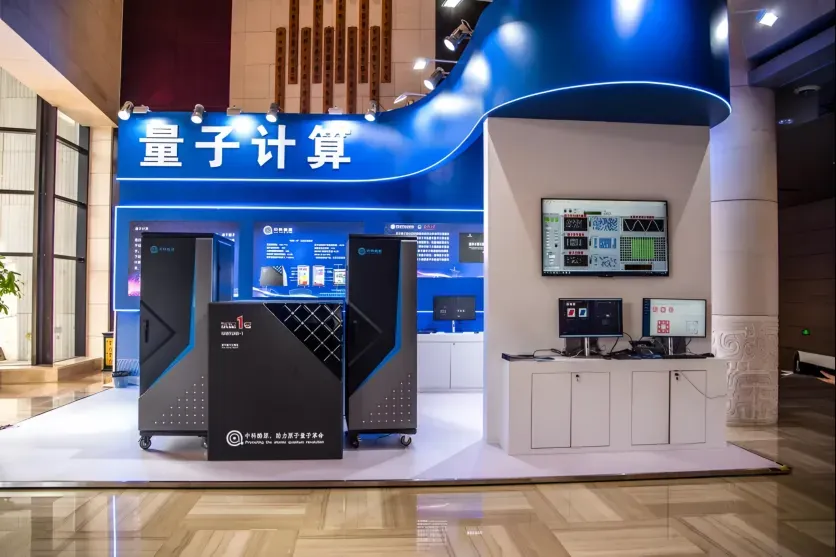
At the World Artificial Intelligence Conference (WAIC 2026) in Shanghai, Chinese deep-tech startup Zhongqi Wuliang (众擎无量) formally unveiled Qinghe No. 1 (清河一号), a neutral-atom quantum computer engineered to fit directly into a standard data-center server rack.
Spun out from the Chinese Academy of Sciences’ Shanghai Institute of Optics and Fine Mechanics (CAS SIOM) and founded by Lu Xudong, the company pitched the second-generation system as a major step toward removing bulky cryogenic refrigeration from enterprise quantum deployments.
Bypassing Dilution Refrigeration for Data-Center Racks
Standard superconducting quantum architectures (such as those used by IBM and Google) require dilution refrigerators to cool physical circuits to ~15 millikelvin. This cryogenic equipment demands specialized infrastructure, high energy overhead, and heavy vibration isolation that traditional enterprise data centers cannot accommodate.
Neutral-atom quantum processors operate on a different physical framework:
- Optical Tweezers: Individual, chemically identical atoms are trapped in a vacuum chamber using focused laser beams.
- Laser Cooling: The atoms are cooled to micro-kelvin temperatures internally via laser pulses, eliminating the need for external, room-scale liquid-helium cooling loops.
- Rydberg Blockade Gates: Two-qubit entangling operations are controlled by exciting atoms to high-energy Rydberg states, using dipole-dipole interactions to conditionally shift neighboring energy levels.
By packaging the vacuum chamber, control optics, and laser delivery systems into a single-rack chassis, Zhongqi Wuliang aims to allow cloud providers to deploy quantum hardware alongside classical servers. The hardware integration was accelerated through supply chain partner Xuanxiang Technology, which recently commercialized a metasurface chip capable of generating large-scale optical tweezer arrays to simplify optical alignment.
China’s Accelerating Neutral-Atom Roadmap
Qinghe No. 1 marks the third commercially positioned neutral-atom system to emerge from China’s regional quantum hardware cluster in less than a year:
- Hanyuan-1 (October 2025): Developed by Zhongke Kuyuan, this 100-qubit, room-temperature neutral-atom system occupies three standard equipment racks. It was delivered to a China Mobile subsidiary and exported to Pakistan for its national quantum computing center.
- Hanyuan-2 (May 2026): A dual-core cabinet-style system operating below 7 kW of power consumption, designed for parallel processing or main-core/auxiliary-core logical qubit encoding.
- Qinghe No. 1 (July 2026): Zhongqi Wuliang’s single-rack form factor, representing the latest iteration toward smaller physical footprints.
This rapid hardware iteration is backed by municipal industrial policies in Shanghai. The city has designated neutral-atom technology as a core roadmap, establishing dedicated innovation zones—such as the Xuhui Cultivation Zone and Zhangjiang Quantum Bay—backed by state research funds and municipal subsidies.
Verification and Market Context
While the server-rack form factor represents a notable engineering concept, technical buyers should note that Zhongqi Wuliang has not yet published peer-reviewed metrics for Qinghe No. 1, such as independent qubit counts, two-qubit gate fidelities, or coherence times. Third-party benchmarks will be essential to evaluate its performance against established global neutral-atom benchmarks—such as QuEra’s commercial systems.
The announcement also comes as global interest in neutral atoms expands. In early 2026, Google Quantum AI launched a dedicated neutral-atom research program in Boulder, Colorado, to run alongside its superconducting efforts, citing the modality’s reconfigurable connectivity and scalability.
Read the full technical analysis on the TechTimes Hardware Coverage here and the official debut reporting via Pandaily here.
In GQI Portal
The players behind the news
The team that writes QCR tracks every company, deal and technology in the GQI Factory, GQI's verified database of the quantum industry. Next up: every story linked to its players, coming to QCR's paid plans.
- Players Companies and institutions across the quantum industry, by segment.
- Scorecards How the players compare on hardware, software, funding and more.
Newsletter
QCR Alerts in your inbox
The latest reporting and analysis from Quantum Computing Report. Free, unsubscribe any time.