

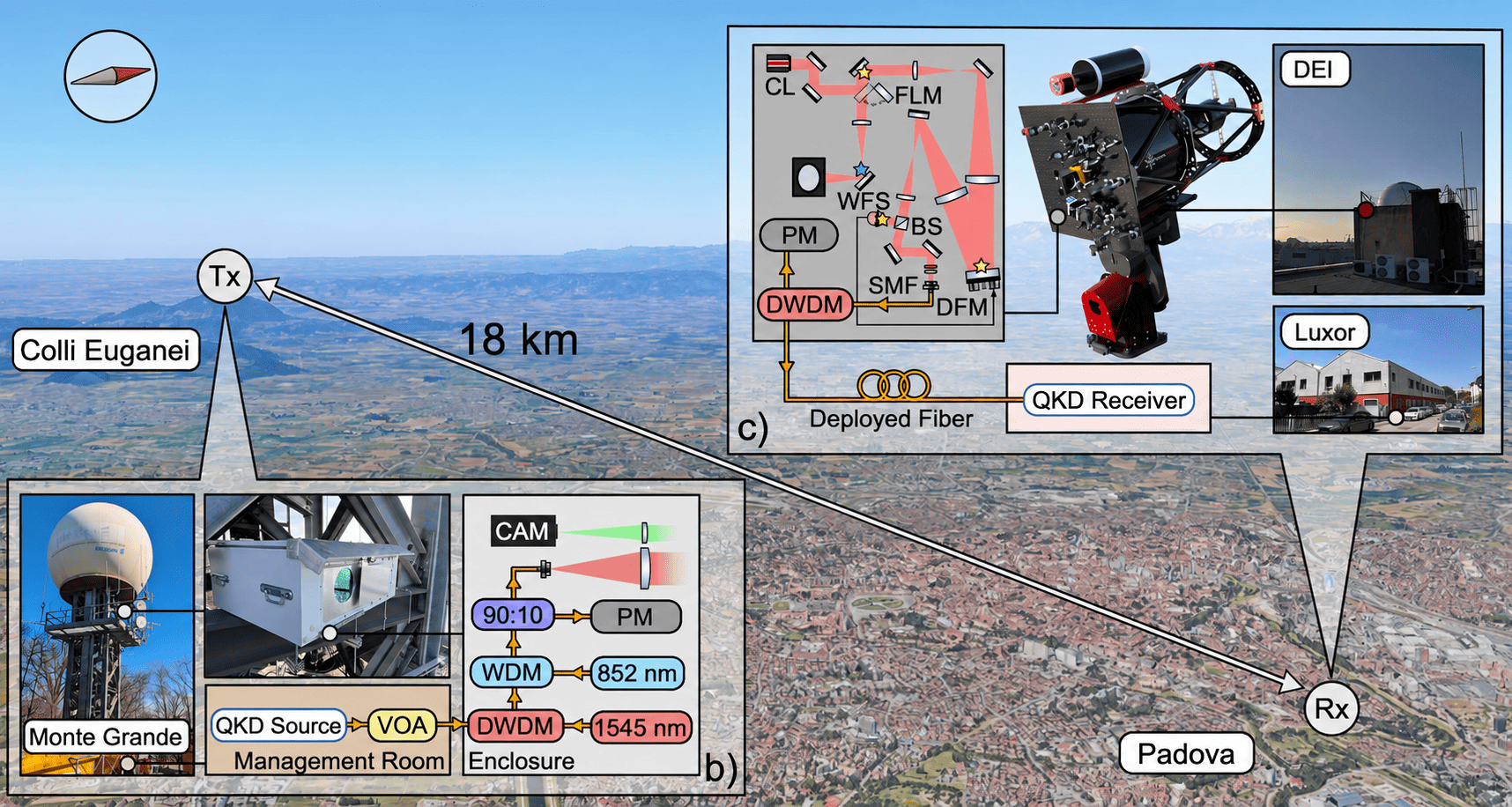
Researchers from the University of Padova, Italian photonics firm ThinkQuantum s.r.l., and the National Research Council of Italy (CNR-IFN) have published a real-time field trial of an intermodal quantum key distribution (QKD) system in npj Quantum Information. The experiment connected a remote optical transmitter on Monte Grande to an urban Optical Ground Station (OGS) at the University of Padova across an 18-km horizontal free-space link, which then coupled into a 0.5-km deployed fiber network to reach a receiver laboratory.
| [ Intermodal 18-km Free-Space to Fiber QKD Architecture ] | ||
|---|---|---|
| Optical Transmitter & Channel | Adaptive Optics & Receiver OGS | Quantum Hardware & Key Rates |
| • 18-km Free-Space Horizontal Link | • 41-cm Ritchey-Chrétien Telescope | • ThinkQuantum QUKY QKD Platform |
| • Telecom Wavelength (1565.5 nm, C-Band) | • 64-Actuator Piezoelectric Deformable Mirror | • 200 bit/s SKR (Room-Temp InGaAs SPADs) |
| • Multiplexed 1545 nm Beacon & 850 nm Alignment | • Shack-Hartmann Direct Wavefront Sensor | • ~1 kbit/s SKR (Cryogenic SNSPDs) |
High-Order Adaptive Optics Overcomes Atmospheric Turbulence
Atmospheric turbulence over long terrestrial links introduces severe wavefront distortions, making efficient injection into single-mode optical fibers (SMFs) difficult. To overcome high channel attenuation (~29 to 30 dB), the team implemented a high-order Adaptive Optics (AO) system at the receiving telescope:
- Beyond Tip-Tilt Stabilization: Using a 64-actuator bimorph deformable mirror and a Shack-Hartmann wavefront sensor running closed-loop feedback, the AO bench corrected high-order spatial aberrations up to 35 Zernike modes.
- Fiber Coupling Efficiency: The system achieved single-mode fiber coupling efficiencies of up to 19% (-7.2 dB), allowing the free-space quantum signal to be directly multiplexed into standard telecommunications fiber without performing untrusted intermediate measurements.
- Turbulence Modeling: Experimental wavefront sensor data validated theoretical models for predicting the Fried parameter (r0) and coupling efficiency under varying atmospheric conditions.
Room-Temperature Detection and Satellite Network Alignment
The field trial was executed using commercial polarization-encoded QKD hardware (the QUKY platform by ThinkQuantum) running the 3-state 1-decoy efficient BB84 protocol:
- Room-Temperature Deployment: Equipped with uncooled InGaAs single-photon avalanche diodes (SPADs) operating at room temperature (15% detection efficiency), the system generated a secure key rate (SKR) of ~200 bit/s with a quantum bit error rate (QBER) of ~2%.
- Cryogenic Benchmarking: Paired with high-efficiency superconducting nanowire single-photon detectors (SNSPDs, 80% efficiency), the same setup produced an average SKR of ~1 kbit/s with QBER under 1%.
- European Space & Terrestrial Framework: The protocol-agnostic, intermodal architecture aligns with deployment roadmaps for the European Quantum Communication Infrastructure (EuroQCI) and upcoming European Space Agency (ESA) satellite-to-ground optical link missions, including Eagle-1 and SAGA.
Review the open-access research paper in npj Quantum Information here or via arXiv:2602.16680 here.
In GQI Portal
The players behind the news
The team that writes QCR tracks every company, deal and technology in the GQI Factory, GQI's verified database of the quantum industry. Next up: every story linked to its players, coming to QCR's paid plans.
- Players Companies and institutions across the quantum industry, by segment.
- Scorecards How the players compare on hardware, software, funding and more.
Newsletter
QCR Alerts in your inbox
The latest reporting and analysis from Quantum Computing Report. Free, unsubscribe any time.