

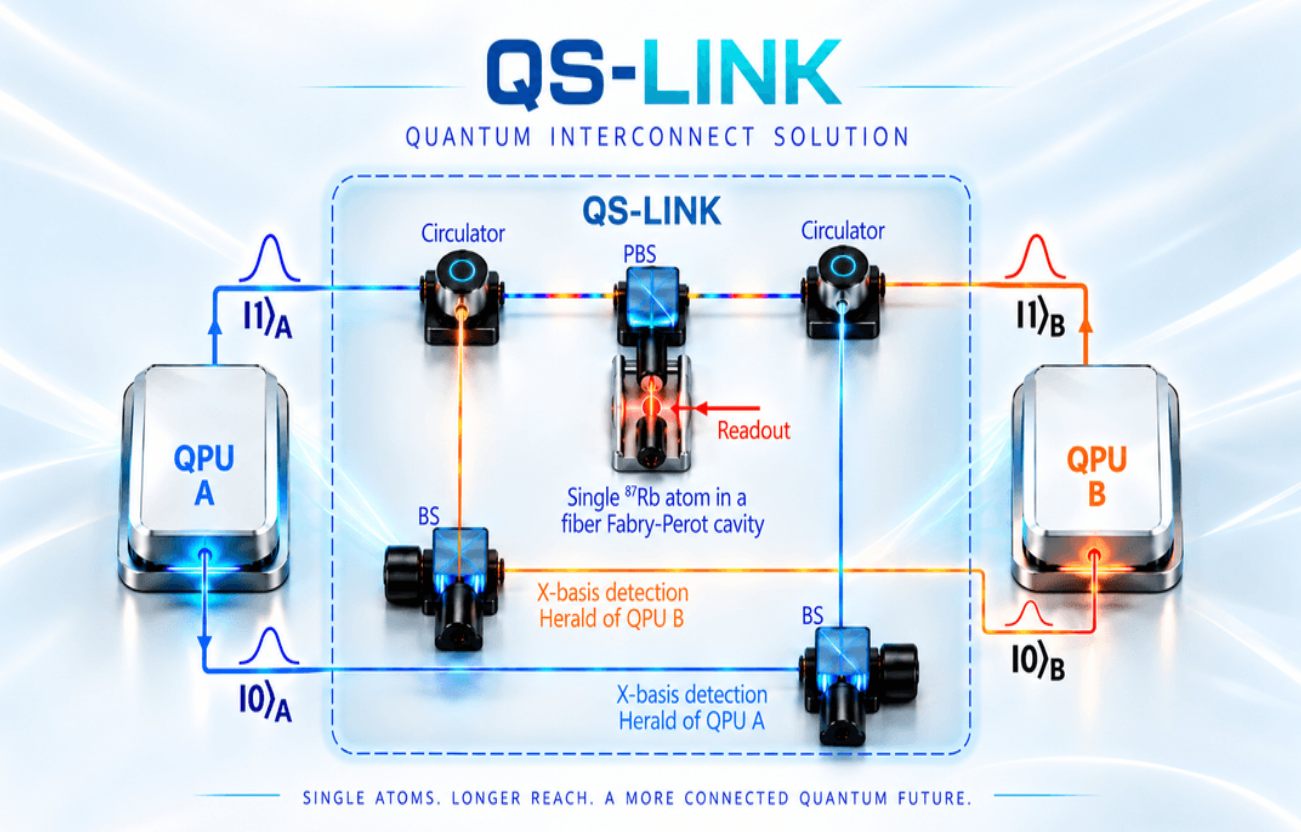
Tel Aviv-based photonic hardware developer Quantum Source has published the technical details of its proprietary quantum interconnect, QS-LINK. Designed to address scaling limits in multi-processor quantum networks, the system utilizes a single cavity-trapped rubidium-87 atom as an asynchronous quantum memory buffer to establish remote entanglement between separate quantum processing units (QPUs). The architecture operates at room temperature over standard optical fiber and supports multi-vendor interconnectivity across distinct physical hardware modalities, including trapped-ion, neutral-atom, superconducting, and photonic platforms.
Conventional photonic Bell-state measurements (BSM) rely on linear-optics type-II fusion gates, which require photons from two independent QPUs to arrive simultaneously at a beam splitter in identical quantum states. Because per-attempt photon delivery probabilities (p) across fiber channels typically remain at or below 1%, simultaneous arrival succeeds probabilistically at an order of p2 (roughly once in 10,000 attempts). QS-LINK replaces the two-photon interference requirement with a single-atom cavity quantum electrodynamics (QED) interface. The trapped atom executes a near-deterministic controlled-Z (CZ) gate with an incoming photon from the first QPU, storing the resulting atom-QPU entanglement state while the second QPU continues execution attempts. Once a photon from the second QPU interacts with the atom, a local atomic state measurement projects the two remote QPUs into a shared Bell pair.
| [ Quantum Interconnect Architecture Comparison ] | ||
|---|---|---|
| Architectural Parameter | Linear-Optics Type-II Fusion | QS-LINK Cavity-QED Memory |
| • Entanglement Scaling | • Quadratic scaling (p2) • Requires simultaneous photon arrivals | • Linear scaling (p) • Asynchronous photon arrival & storage |
| • Attempts for 10k Pairs/sec | • ~190 million attempts/sec | • ~3.2 million attempts/sec |
| • Photon Indistinguishability | • Mandatory (Identical temporal envelopes & phase matching required) | • Not required (Photons interact sequentially with central atom) |
| • Cross-Modality Support | • Highly restricted (Requires identical QPU photon sources) | • Hardware-agnostic (Connects trapped-ion, neutral-atom, & superconducting) |
Because entanglement is mediated sequentially through the atomic memory rather than direct photon-photon interference, the interconnect eliminates the requirement for mutually indistinguishable photon envelopes or joint optical phase stabilization. Mathematical modeling and Monte Carlo simulations published by the company indicate that achieving a target threshold of 10,000 entangled pairs per second—a rate required by fault-tolerant distributed architectures—demands approximately 3.2 million attempt cycles per second using QS-LINK, compared to 190 million attempts per second under linear-optics fusion gates. The projected parameters assume a photon-atom CZ gate duration of approximately 20 nanoseconds at 98.4% photon-survival efficiency.
Review the technical paper on arXiv here and inspect product specs on the Quantum Source Portal here.
In GQI Portal
The players behind the news
The team that writes QCR tracks every company, deal and technology in the GQI Factory, GQI's verified database of the quantum industry. Next up: every story linked to its players, coming to QCR's paid plans.
- Players Companies and institutions across the quantum industry, by segment.
- Scorecards How the players compare on hardware, software, funding and more.
Newsletter
QCR Alerts in your inbox
The latest reporting and analysis from Quantum Computing Report. Free, unsubscribe any time.