

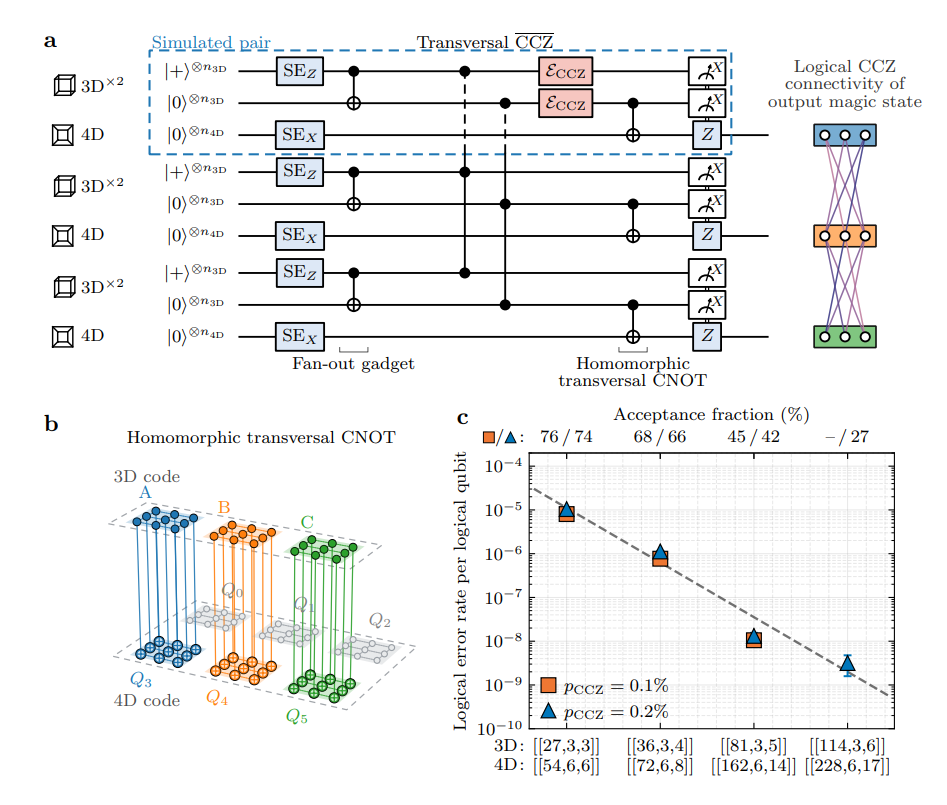
Researchers from Harvard University, QuEra Computing, Caltech, the University of Maryland, and MIT have introduced a fault-tolerant magic state factory architecture for high-rate quantum low-density parity-check (qLDPC) codes that reduces space-time resource costs by 10× to 40× compared to state-of-the-art surface-code and color-code magic state cultivation. The design pairs three-dimensional balanced-product tricycle codes, which generate parallel non-Clifford magic states via transversal controlled-controlled-Z (CCZ) gates, with four-dimensional balanced-product quadcycle codes identified through an AI-assisted algebraic search.
| Magic State Factory Performance Comparison (Circuit-Level Noise p = 10−3) | ||||
|---|---|---|---|---|
| Protocol & Fault Distance | Output State & Target Code | Single-Shot | |CCZ⟩-Converted Error Rate | Expected Space-Time Volume / |CCZ⟩ |
| 3D–4D qLDPC Factory (f = 3) | 2 |CCZ⟩ in [[54, 6, 6]] Quadcycle | Yes | 1.2 × 10⁻⁵ | 4.3 × 10³ |
| Surface / Color Cultivation (f = 3) | |T⟩ in Surface / Grafted Code | No | 1.2 × 10⁻⁵ | 80.4 × 10³ / 162.8 × 10³ |
| 3D–4D qLDPC Factory (f = 4) | 2 |CCZ⟩ in [[72, 6, 8]] Quadcycle | Yes | 1.2 × 10⁻⁶ | 8.6 × 10³ |
| Surface Code Cultivation (f = 5) | |T⟩ in Surface Code | No | 1.2 × 10⁻⁶ | 83.8 × 10³ |
| 3D–4D qLDPC Factory (f = 5) | 2 |CCZ⟩ in [[162, 6, 14]] Quadcycle | Yes | 1.6 × 10⁻⁸ | 6.7 × 10⁴ |
| Color Code Cultivation (f = 5) | |T⟩ in Grafted Color Code | No | 1.6 × 10⁻⁸ | 228.6 × 10⁴ |
To overcome the asymmetric distances of tricycle codes without deep syndrome-extraction cycles, the protocol uses a distance-2 repetition fan-out gadget to execute the transversal CCZ in a single Rydberg pulse, followed by a depth-1 homomorphic CNOT that teleports the nine-qubit hypergraph magic state into paired quadcycle blocks. Because quadcycle codes possess redundant metachecks in both Pauli bases, they support constant-depth single-shot state preparation and error correction while transversal X measurements of the tricycle blocks enable postselection, pushing logical error rates down to 10−9 at a physical error rate of 10−3 and yielding two disjoint |CCZ⟩ states directly inside high-rate memory blocks.
The authors also mapped the factory onto reconfigurable neutral-atom arrays, showing that the shared quasi-cyclic structure of matched tricycle-quadcycle pairs allows uniform parallel atom shuttling, overlaid CNOT teleportation, and constant-depth homomorphic extraction and Clifford feed-forward gadgets within 33 array-traversal steps.
Read the full research paper on arXiv here.
In GQI Portal
The players behind the news
The team that writes QCR tracks every company, deal and technology in the GQI Factory, GQI's verified database of the quantum industry. Next up: every story linked to its players, coming to QCR's paid plans.
- Players Companies and institutions across the quantum industry, by segment.
- Scorecards How the players compare on hardware, software, funding and more.
Newsletter
QCR Alerts in your inbox
The latest reporting and analysis from Quantum Computing Report. Free, unsubscribe any time.