

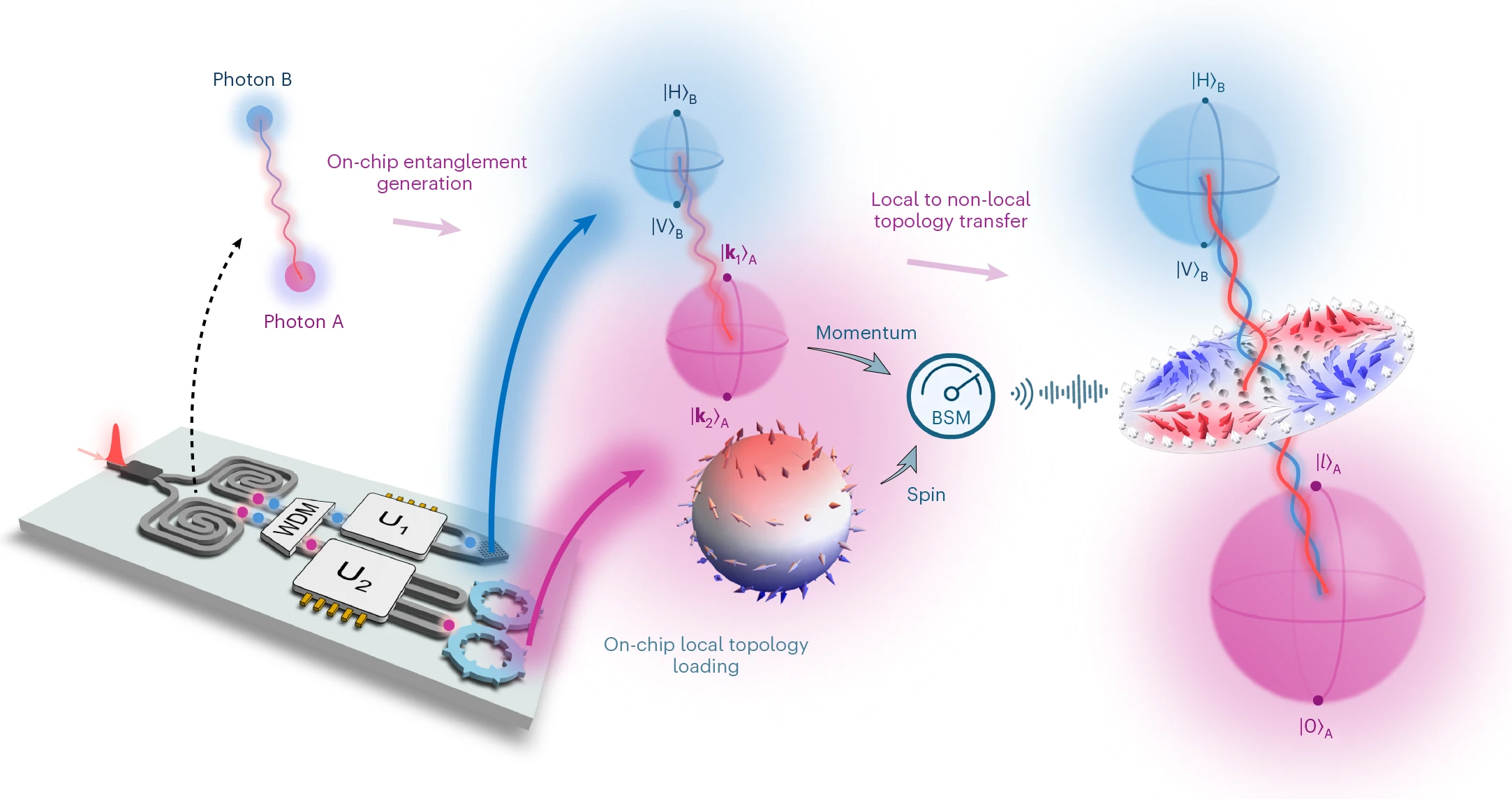
In a research paper published in Nature Physics, an international research team led by the University of Pennsylvania, in collaboration with the University of the Witwatersrand, Nanyang Technological University (NTU), and South China University of Technology, has demonstrated the preparation and reconfigurable transfer of photonic quantum skyrmions on an integrated nanophotonic chip.
By leveraging spin-orbit-locked microring resonators on a silicon nitride (Si3N4) platform, the researchers succeeded in transferring topological skyrmion structures from single photons to two-photon entangled states, establishing a noise-resilient quantum state transfer mechanism that maintains its topological invariant even after entanglement vanishes.
Photonic quantum skyrmions are topological light structures where the polarization (spin texture) across a beam profile wraps around every point on the Poincaré sphere an integer number of times. The topological invariant, known as the skyrmion number (Nsk), serves as a robust quantum observable.
The integrated nanophotonic circuit executes a three-stage topological protocol:
1. Path Entanglement Generation: Spontaneous four-wave mixing (SFWM) in tailored 650 nm wide silicon nitride spiral waveguides generates path-entangled photon pairs across distinct optical paths.
2. Local Topology Encoding: Photon A passes through spin-orbit-locked microring resonators with asymmetric inner and outer sidewall gratings, coherently encoding a local single-photon skyrmion state with a skyrmion number of Nsk = 1.981 ± 0.002.
3. Topology Transfer via BSM: An on-chip spin-momentum Bell state measurement (BSM) projects photon A onto the Bell basis, transferring the local single-photon skyrmion topology into a shared, non-local two-photon entangled skyrmion with a measured skyrmion number of Nsk = 1.981 ± 0.001.
| [ Performance & Topological Robustness Under Noise ] | ||
|---|---|---|
| Quantum Metric / Channel | Pure-State Baseline | Depolarizing Noise Regime (γ < 0.34) |
| • Quantum Fidelity (F) | • 89% ± 2% | • Decreases continuously with noise strength |
| • Entanglement (Concurrence) | • Non-zero (pure state) | • Drops to 0 (entanglement link vanishes) |
| • Quantum Discord | • Non-zero | • Persists above zero in mixed-state regime |
| • Skyrmion Number (Nsk) | • 1.981 ± 0.001 | • Preserved intact (Nsk ≈ 2.0) |
Unlike conventional quantum teleportation, which fails immediately once the shared entanglement link breaks down, the skyrmion number exhibited resilience under depolarizing, phase-flip, and bit-phase-flip noise channels. Even when environmental noise reduced concurrence to zero, non-classical correlations (quantified by quantum discord) remained active, keeping the skyrmion number intact until extreme noise (γ ≈ 0.25) completely overwhelmed the system.
The study proves that quantum skyrmion numbers can act as topological witnesses for non-classical correlations, providing a blueprint for noise-tolerant quantum optical interconnects in distributed quantum computing networks.
Review the full research article in Nature Physics here.
In GQI Portal
The players behind the news
The team that writes QCR tracks every company, deal and technology in the GQI Factory, GQI's verified database of the quantum industry. Next up: every story linked to its players, coming to QCR's paid plans.
- Players Companies and institutions across the quantum industry, by segment.
- Scorecards How the players compare on hardware, software, funding and more.
Newsletter
QCR Alerts in your inbox
The latest reporting and analysis from Quantum Computing Report. Free, unsubscribe any time.